Shackled to the Humean Corpse
What is liberalism? That is now the enduring question of contemporary political philosophy, though, in some respects, this goes back to debates in the 1950s that occupied thinkers like Leo Strauss, Eric Voegelin, and Isaiah Berlin. When I was an undergraduate studying philosophy, concentrating in political philosophy, the seminal liberal figures I studied included Sir Francis Bacon, Thomas Hobbes, John Locke, and Baruch Spinoza. Then there were more modern liberals like John Stuart Mill and John Rawls. David Hume was absent from this story, though not absent from my curriculum (we read selections of his Enquiry Concerning Human Understanding where he was presented as a leading empiricist). But should Hume be given a prominent place in the origin and development of political liberalism and its stunting of the modern political imagination?
Aaron Alexander Zubia argues that Hume should be given a prominent place in the codification of liberalism and its stifling of contemporary political dialogue and thinking. The basic narrative that Zubia retells for us in The Political Thought of David Hume properly and appropriately restores Hume’s prominence as a political thinker, one in which he was recognized as a dangerous temptation to republican virtue and Christian theology from both sides of the Atlantic, in America and in Great Britain. Some definitions, though, are important to establish before moving forward.
First, what is liberalism? Liberalism, here, is not the mythic narrative of democracy, human rights, and the rule of law as has become fashionable to assert by woefully ignorant ideologues and journalists trying to support the excesses of the American Empire against internal and external skepticism and critique. (This narrative is problematic, historically speaking, because it implies such notions did not exist until after World War II when they very clearly did.) Liberalism, as Zubia presents it, from its foundational sources, is similar to how Leo Strauss understood it: a philosophy of relativistic hedonism, materialism, atheism, wherein natural science eventually replaces metaphysics and theology as the governing spirit of human life, which further lends itself to the philosophy of scientific industrialism and conquest. Liberalism is, therefore, a philosophy that regards God and religion as hostile to human virtue and flourishing rooted in the Epicurean vision of man and the social contract theory of politics. Historically, liberalism may have permitted “freedom of religion,” but this merely hides the fact that liberalism is hostile to religion in the public square. In other words, keep it private and out of public debate and policy-making.
Second, the story of liberalism as a political ideology of tolerance is also rejected. The aim of political liberalism is not toleration, per se, but the limitation of legitimate questions within political society. Toleration is the guise to eliminate questions of metaphysics, God, virtue, the nature and destiny of man, and so on, from political discussion because – according to preeminent liberals like Hobbes and Hume – such questions enraged the passions of the mob who unleashed chaotic violence over early modern Europe (especially England). As Zubia forthrightly states:
Under the doctrine of political liberalism, citizens are called to extend the scope of toleration and restrict the scope of political discourse…Any public debate over the nature of the cosmos or the possibility of a providential, or teleological, universal order would, of course, have implications for the nature, goals, and structure of society and the type of behavior incentivized within society. But these kinds of ideas are barred entrance into public discussion, since they are allegedly immune from garnering universal consent.
One should reread Zubia’s analysis and ponder the paralysis currently gripping western political culture, especially in the United States, where political rhetoric re-emphasizing God, the moral life of virtue, the importance of family, and legislative rewards for fostering the good life within community are deemed suspect and derided with all sorts of name—now, including, “weird.” It is a form of ostracization, of course, because, as Zubia notes, the guise of toleration is really the attempt to “restrict the scope of political discourse.” Any political discourse that doesn’t fall squarely into the materialist and contractarian vision of politics cannot be entertained as it threatens the myth of civilizational progress offered by the new epic of salvation laid out by liberal political theorists.
While many are familiar with the account of early modern liberalism in the so-called classical liberal theorists like Hobbes, Locke, and Spinoza, maybe also Grotius and Pufendorf (men that I also had to read as an undergraduate), David Hume plays a much more important role in legitimizing these views according to Zubia. In fact, Hume is essential in how political liberalism (as defined above) comes to dominant the modern world. How Hume ended up playing such an important role in entrenching the neo-Epicurean vision of the universe and humanity is part of the dazzling story that Zubia tells.
It was with much delight that Zubia revisited so much of the neo-Epicurean vision of Thomas Hobbes within this story of David Hume’s politicizing Epicureanism. Hobbes was the major thinker who “developed a philosophy designed to cleanse politics of theological speculation” and provided what Michael Oakeshott famously described as “a new myth [of] the Augustinian epic of the Fall and Salvation of mankind,” but it was Hume who would refine and endorsed the Hobbesian view of history that has captured the modern liberal imaginary regarding politics. Hobbes is arguably far more important than Locke or Spinoza or Mill to the creation and eventual entrenchment of liberal philosophy over modernity because Hume closely followed Hobbesian liberalism (Epicureanism, materialism, and implicit atheism).
Looking at Hume’s many writings, Zubia concentrates on the Scotsman’s various arguments against theology, Christianity in particular, and how he does multiple things. First, he pours scorn and skepticism toward the truth claims of Christianity. In divorcing faith from reason, Hume permits fideism as an option for people (but one that intellectuals surely won’t accept) which really means the intelligentsia will all accept the natural philosophy of the New Science as the only guiding light for knowledge. Second, he asserts that religion (Christianity) was the cause of the conflicts that devastated Europe and England in the seventeenth century. Third, he implies that clergy and religiously sympathetic philosophers have selfish motives for their preaching and profession (either wanting power over their congregants or securing their economic livelihood by professing fidelity to the oaths demanded of universities at the time). And most decisively for Zubia, Hume’s writings assert that “religious beliefs corrupt the moral sentiments [of the people] and engender public disorder.” This sounds very familiar to modern ears. Many who have never read Hume and wouldn’t even know the name agree! That’s how far Hume’s constrictive conceptual framework has spread.
Having attacked the origins of humanity and society through his skepticism toward Christianity (and classical natural law), Hume rearticulates the social contractarian myth as the origin of humanity and society in its place. Social contract theory is the alternative origin myth to the paradisical bliss of Christianity and its similar golden age equivalences of the classical philosophers. In Christianity and in classical philosophy, the mythic past is something good and ultimately something to aspire a return to (or at least learn from): the perfect union of Adam and Eve (man and women) in relationship to the world (Eden) and the harmonious virtue of the Golden Age past of Plato, Ovid, and others. Hume agreed with and expanded upon the Hobbesian (even Lockean) state of nature theory which posits a “transition from savagery to barbarism.”
The “transition from savagery to barbarism” necessarily restricts the past from contemporary political discourse by its own constructive conceptualization. Since the past is always worse than the present, the past offers nothing for the present in its relentless pursuit of progress and perfection. This is the parasitic ideology of “presentism.” The past can never be a guiding light, which, of course, is problematic to the promoters and teachers of religion and classical philosophy.
More to the point, since humanity is not naturally loving (social) and virtuous as Christian and classical accounts of humanity assert, Hume takes from Locke the economic myth of human socialization whereby material self-interest bringing humans into cooperation with one another makes them social animals by convention but not by nature, “Hume, in his own conjectural history, confirmed that it is commerce and trade, not religion, that makes men social.” This Humean vision becomes the neoliberal capitalist credo whereby “prosperity appears as a challenger to religion, as an antidote for the ills fostered by it.” Hume’s tentacles have spread far and wide.
Nevertheless, Hume’s triumph comes during the French Revolution. Some may be perplexed to know how this is so. The critics of the French Revolution, whom we often erroneously call “conservative” in today’s political rhetoric and discourse, ceased their criticism of Hume and adopted him for practical political expediency. Hume was always regarded as suspect by the clergy, philosophers, and statesmen of a traditionalist disposition prior to the French Revolution. The defenders of the Christianity, Monarchy, and Divine Right saw in Hume’s Epicurean materialism direct challenges to their philosophy and vision of human organization and social life. Hume was a radical.
However, Hume’s History of England made him into a moderate historicist. Hume did not condemn the Tories to the dustbin of history but praised their moderation in defeat – accepting the changes wrought by the Glorious Revolution, the ascendancy of Parliament, and the newfound liberties expanded and promoted by the Williamite settlement. He lauded their ability to constrain the more dangerous zealotry of the radical Whigs which threatened to return chaotic conflict to England. The critics of the French Revolution came to endorse Humean moderate politics, forcing them to adopt a soft Epicurean and materialist conception of politics, in order to ward off the most dangerous aspects of revolutionary zeal. Thus, utilitarian “pragmatism” became the new language of political royalists and legitimists – giving rise to the modern “conservative” ideology now divorced from its prior reliance of metaphysics, theology, and the divine ordering of the cosmos and human society.
Yet the Humean vision of the cosmos and our place in it, following from Epicurus and Lucretius, meant that there was no divine order of the universe and human nature. The cosmos came into existence by chance, completely at random. Human nature, just being a body of mass in motion per Hobbes, which Hume agreed with, therefore sought material comfort and security instead of self-sacrifice, denial, and charity toward others as the virtues to live by. This, of course, amounts to nothing heroic or noble to live for. “The Humean worldview, like the liberal one, in general” Zubia writes, “is one in which life lacks a higher principle, in which there is no final end for man, in which man lives without hope in the final victory of justice and righteousness, in which man, alone on this isolated blue planet, occupies a fatherless world.”
Ultimately, the crisis of contemporary liberalism is in its victory over the barriers that tempered it from Hume’s time to the 1960s, specifically Christianity, which called humans to love each other as neighbors and citizens as an expression of the First Commandment. If the liberal account of the origin and destiny of humanity is wrong, from nothing to nothing, rather than in love for love (per Christianity), then it will implode because it is hostile to the very reality of existence.
This permits me to bring up Eric Voegelin who is absent from Zubia’s reading. Voegelin articulated the view that liberalism had forgotten its historical origin—not in Epicurus, but in combatting the excessive revolutionary zealotry of the metaphysical disorder in humans. This metaphysical or spiritual disorder is the “Gnostic” spirit according to Voegelin. Yet the Gnostic spirit is, in part, true – even if only partially. Humans are metaphysical beings, not merely material beings. Because liberalism denies the metaphysical reality of humans, it cannot provide humans with the sense of meaning and purpose they crave. According to Voegelin, the de-spiritualized liberalism of modernity was threatened by the totalitarianism of Gnostic revolution because, for all the evils and ills of Gnostic totalitarianism—first in the form of Nazism then in the form of global communism via the Soviet Union—it implicitly gave an outlet for the metaphysical yearning of humans even if, as with communism, it denied God (just because Marxist-Communism denied God didn’t mean it abrogated the metaphysical impulse of human nature, on the contrary, by turning metaphysics on its head and altering the eschatological destiny of humanity from transcendence to temporality, that is what made Marxist-Communism simultaneously so appealing and dangerous). Voegelin’s call for us to confront the evils of Gnostic totalitarianism required a recovery of the spiritual strength offered by Christianity: “Greater love hath no man than this, that a man lay down his life for his friends.” This, of course, is something that liberalism cannot endorse. Whether liberalism was a stopgap to Gnostic revolution or a modernist recreation of Epicurean materialism with the philosophy of the New Science, both readings of liberalism acknowledge the metaphysical emptiness of liberalism, its de-spiritualized vision of humanity and the cosmos.
Zubia concludes his magnificent work by suggesting that it is time for a return to Christian and classical visions of the origin and destiny of the cosmos and humanity as the antidotes to the malaise of modernity. “Perhaps time has come to recall those opponents, to resuscitate their rich and ennobling vision of human excellence, and to reinstate the rule of honestum” This would be an expansion of political discourse and dialogue, a true expansion of democracy, rather than the shallow restrictive politics we are currently drowning under. One must also consider that the opponents of the West—and enemies do exist—are not as blind as many of us our to the crisis of politics being a metaphysical one. Zubia’s work is a heroic work, one that all who are concerned with contemporary political questions should read.
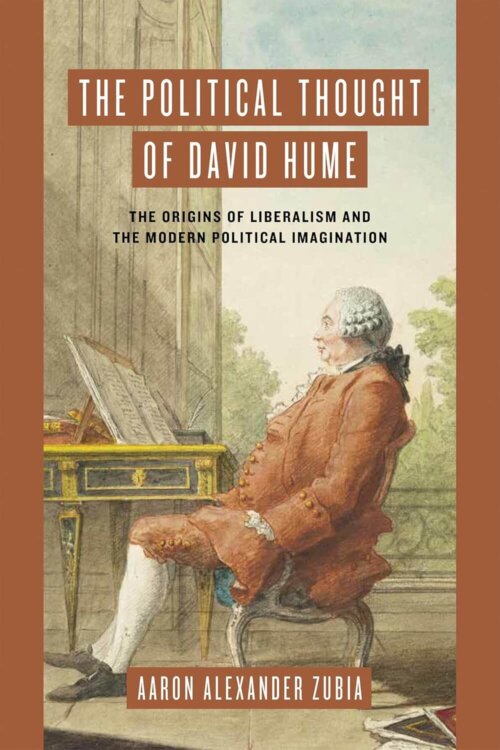
The Political Thought of David Hume: The Origins of Liberalism and the Modern Political Imagination
By Aaron Alexander Zubia
Notre Dame: University of Notre Dame Press, 2024; 366pp


Related Posts