Only Sing!
In his review of John Berryman’s 1965 Pulitzer Prize winning 77 Dream Songs, John Malcolm Brinnin said, “Strictly in terms of technique, the book is a knockout. Subsuming all the work of nearly thirty years, including and surpassing the remarkable Homage to Mistress Bradstreet, Berryman seems to have grown in a progress that calls to mind Andre Gide’s ‘Gradation, gradation—and then a sudden leap.’ Such bravado and such excellence calls for celebration.” These gushing words sound more like a publicity campaign than literary criticism, but Brinnin was no doubt sincere when he wrote them. (If Brinnin was a stan, it was for Dylan Thomas.) Four years later Berryman published another volume of Dream Songs. It included the seventy-seven from the first volume plus an additional three-hundred and eight new poems. It was the last of his Dream Songs collections to be published in his lifetime.
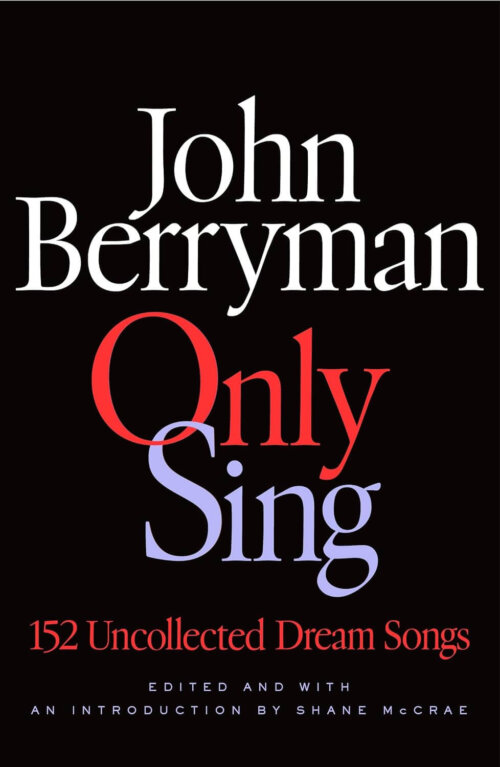
Only Sing (Farrar, Straus and Giroux 2025), edited by Shane McRae, brings together one-hundred and fifty two previously uncollected Dream Songs. McRae had a difficult task putting this collection together and made the decision, for better or worse, to arrange the poems alphabetically by first word of first line. (It’s interesting to note that there are only fourteen poems that begin with “I,” maybe Berryman wasn’t so self-centered after all.) Of course, a chronological ordering would be best, but McRae said many of the poems were not dated and he did not want to venture a guess as to when they may have been written. It’s cobbled together without coherence, just like the two volumes of Dream Songs published before it. McRae also reintroduces Henry for those who may have forgotten or are new to Berryman. Henry is the narrator of most of the Dream Songs, a narrator that Berryman always absurdly denied was himself. Henry is “a twentieth-century white American male, not especially remarkable, the sort of person who doesn’t establish or recover a nation, or parley with angels, or explore Hell, but the sort of common person of who nations are constituted…Henry is a hero for a disenchanted nation from which once common beliefs have mostly fled.” McRae tells us in the introduction to Only Sing that he left out four or five uncollected Dream Songs because of their “tentativeness” and scholarlyness. Well, how many was it, McRae? Four or five?
Most of these uncollected Dream Songs are in the same form that Berryman used for them from the beginning: three sestets. There are a couple with an extra line tacked on at the end, and a few that are short some lines, but undoubtedly still complete. Then there are a few that were probably never intended to be called Dream Songs at all. The reader is still kept off balance with Berryman’s irregular rhyme schemes, the slant in-line rhymes still as much of a delight as they were in those first Dream Songs sixty years ago. There’s one included here where he seems to be foretelling his own death:
Having my whole force hoofing for the ground,
seemeth my pilot ‘chute did not punch me
brilliantly safely open
but I must have daze while plunging, hurtling round
until I meet & squash. Distressedly
they’ll scrape up who happened.
Berryman committed suicide by jumping from the Washington Street Bridge in Minneapolis, Minnesota on January 7, 1972.
Berryman was an alcoholic—constantly in and out of rehab, often in and out of hospitals. He once said he put away a quart of whiskey a day. He writes often about his drinking in many of his Dream Songs and Henry’s unnamed friend (who always refers to Henry as Mr. Bones) sometimes upbraids him about it: “-Now, Mr. Bones: you know you booze a storm/ with all them pals:/ be of high cheer: another one of the East’s/ luxury’s almost here. Make welcome warm/ William’s, Saul’s, Cal’s.” Berryman often faced criticism for his use of verbal blackface. Novelist and critic Rick Moody made heavy weather of it in his essay “Unspeakably Miserable for the Most Part” in Poetry: “What do we make of the Mr. Bones voice, the minstrel voice, as employed in Berryman’s most successful work, much of it written during the high period of the civil rights movement? And what of the author? And why is the Poetry Foundation assigning a review of Berryman’s letters, today, when they could instead review a new volume by an African American poet?” Reactionaries like Moody miss the artistic value, looking only at the universal, and missing, likely deliberately so, an artistic choice made by Berryman that deserves to be understood in its own context.
Before Berryman became a poet he wanted to be a scholar. He failed miserably at it, taking on projects and then never finishing them. Always over-promising and always under-delivering, he nonetheless kept asking for scholarships and fellowships to fund his loitering in dusty archives. Berryman often dunned his old professor Mark Van Doren for letters of recommendation, which Van Doren often wrote. After years of waiting on Berryman’s edition of King Lear, Van Doren finally cut off the water supply and stopped writing letters for him. The only major scholarly project that Berryman completed was a biography of Stephen Crane, and that was probably because Crane only lived to be twenty-eight years old. His scholarliness still shows up in his poetry, although too often he’s portraying himself as the smartest guy in the room. Poets writing about writing is almost always a bad idea, but Berryman pulls it off well:
Three blue rooms, & one brown, where he thinks,
only from his typewriter blurts sound,
here’s Henry free,
with none of his beloved wives around,
no telephone, no friends for miles.
Quite so.
Some of his poems about writing are done from a hospital bed, nurses rushing to and fro, where he’s recovering from yet another breakdown.
In his 1969 The Dream Songs, Berryman wrote “These songs are not meant to be understood, you understand./ They are only meant to terrify and comfort.” That still applies to this newest release. (After she read 77 Dream Songs Elizabeth Bishop wrote to Robert Lowell, “Some pages I find wonderful, some baffle me completely.”) Part of the impenetrability of Berryman is his private references—if you aren’t familiar with his personal life and the people in it, you aren’t likely to understand what you are reading; similar to some of Pound’s Cantos. Biographer John Haffenden clarifies the references in some of the Dream Songs: Little Baby is Berryman’s daughter Martha, Diana is the daughter of Kate Berryman’s (his wife) best friend Eugenia Foster, The Beast is the boy that lived next door to the Berrymans in Dublin, Mir is Berryman’s mother. The biographies of Berryman today serve as something of a primer to his poetry.
Berryman doesn’t give much explication of his loathing of Evelyn Waugh’s later works: “The fates of our dogs/ are more important than the later novels of Evelyn Waugh.” What is, however, perfectly clear is Berryman’s psychic squalor. He’s the most confessional of the confessional poets. Part of the appeal of the Dream Songs is how outrageous they are—the lecherousness, drunkenness, the minstrely voice. (While many critics expressed revulsion at the Mr. Bones vernacular, critic Ralph Ellison said he liked the minstrel dialect.) Much of Berryman’s lecherousness is as comical as it is appalling. In his biography Dream Song: The Life of John Berryman, Paul Mariani recounts an encounter between John Berryman and Miriam Ostroff (wife of Berkeley professor Anthony Ostroff): “Berryman came over to see Miriam, chatted with her, read her some of his Dream Songs, and was soon boasting of his sexual prowess. In spite of her protests, he began chasing her around the room. When she told him to get out, he suddenly became contrite and downcast and promised to be good if only he could stay. After a short while, however, he started again, until he finally browbeat her into letting him spend ‘ten or fifteen minutes reverently caressing her feet, while reciting poetry.’ Then, realizing that the house had windows and that someone might be watching, Berryman recovered himself, hailed a taxi, and went home.” Berryman was insatiable, he opens up this dream song about his time in Dublin: “I puff: away the smoke floats, here indoors:/ a north African brothel, crawling with whores/ in the middle of Dublin.” Berryman’s Dream Songs are self examination without the reek of narcissism found in many memoirs because they are uncensored, bald self disclosure.
The poems in Only Sing feel so long ago and they do little to refute the critics who said Berryman was in a constant, if slow, state of decline ever since 77 Dream Songs (not that it intends to). Henry still wants out, the way Shakespeare’s tragic heroes want out, of this world that is too much and too little for them. As a critic of literature Berryman was always precise. His definition of a masterpiece: “a work of the literary imagination which is consistent, engaging, and dramatic, in exceptional degrees; which exhibits largely mastered a human subject of the first importance; and which seems in retrospect to illuminate the whole physical and spiritual situation of which it was by the strange partuation of art, an accidental product. One easy test will be the rapidity with which, in the imagination of a good judge, other works of the period and kind will faint away under any suggested comparison with it.” Taken in the aggregate, Berryman’s Dream Songs are no doubt a masterpiece.
Only Sing: 152 Uncollected Dream Songs
by John Berryman, edited by Shane McRae
New York: Farrar, Straus, and Giroux; 192pp


Related Posts