Our Civilizational Moment: A Review
One of the panels that the Alliance for Responsible Citizenship organized during their first conference in October of 2023 was “What is the West?” Jordan Peterson, a co-founder of the newly established organization, conducted the panel. Among the panelists was Ayaan Hirsi Ali. Born in Somalia, Ali became a member of the Dutch parliament before moving to the USA. At the time, she was likely known to most of the participants of the conference as an atheist, which she became soon after the terrorist attacks on the World Trade Center in New York, which disgusted her to the extent of abandoning what remained of her Islamic faith. However, during the panel, she spoke of her fledgling Christian faith. Soon after the conference she published her break away essay “Why I am now a Christian,” in UnHerd online journal in 2023, attracting a great deal of attention.
Ali raised the following dramatic point toward the essay’s conclusion. Regarding the civilizational challenge before us, she wrote: “We can’t withstand China, Russia and Iran if we can’t explain to our populations why it matters that we do. We can’t fight woke ideology if we can’t defend the civilization that it is determined to destroy. And we can’t counter Islamism with purely secular tools.”
Approximately half a million people have viewed the panel. Among the panelists was Os Guinness, philosopher and social critic. He has been a Visiting Fellow at the Brookings Institution and was the lead drafter of The Global Charter of Freedom of Conscience and Religion. Among his statements during the panel was one which became its informal motto: “Western Civilization is a cut flower, and cut flowers die… but we have the remnants, the symbols of Western heritage, and their seeds. All we have to do, those of us who inherited it, is to go and see them, grow them, nurture them, water them.” His book Our Civilizational Moment, published barely a year later, explores this problem at great length. And Ali’s problems above are also there. The challenges of what can be done during this civilizational turning point are what he refers to as the civilizational moment.
First, the author answers the question of why studying civilization is important. He draws upon Niall Ferguson, author of Civilization (2012), who advises: “We study history in order to see more clearly the situation in which we are called upon to act.” Guinness stresses how important this is for a knowledge of civilization, adding the urgent question: “What is actually happening?” And what are our capabilities to deal with this crisis? Stressing human agency, he claims that “the moment may be fateful, but we are not fated.”
Guinness defines a civilizational moment as one of the great turning points in history, a critical transition phase in “the rise, course, and decline of a civilization when a civilization loses its decisive connection with the dynamic that inspired it.” He goes on:
Such a moment must then issue in one of three broad options: a renewal of the dynamic that inspired the civilization in the first place, a successful replacement of the original dynamic by another, or the decline of the civilization. In sum, the issue for a civilization in a civilizational moment is its vision of ultimate reality: Is the civilization in living touch with the ideas, ideals, and inspiration that created it in the first place and that it needs to continue to flourish? Or, with its roots severed, is it destined to decline and die?
But what is the essence of this turning point in civilization? He argues after nearly two millennia of existence and half a millennium of unprecedented dominance, Western civilization is on the wane and the shadows it casts are lengthening. It briefly seemed the West was reawakening, given the case of its initial unity in the face of the invasion of Ukraine in February 2022. But to this point, the author insists, “the West has not been strong enough, persistent enough, nor united enough on the elemental civilizational issues and convictions necessary to sustain resistance.” Much like J.D. Vance in Munich in February 2025, who was referring to Europe, Guinness argues that the most vehement and radical enemies assaulting the West are from within.
To begin with, the West is now largely opposed to the faith that made it. For instance, “The European Union is notorious for its miserly appreciation of its own debts to its Christian origins.” While the intelligentsia in the West leads society, America is likewise increasingly opposed to both the faith that made it and the revolution that made America. Guinness makes a number of crucial observations. Naturally, the West is also indebted to other civilizations and their ideas. But he agrees with Richard Starkey, who in his One True God (2001) stresses the primary importance of Christianity for the rise of the West. In Guinness’s broad understanding of Christendom, he includes the powerful Christian consensus that exerted its influence in many Western nations. A key article of Christian faith itself, and a matter of Christian realism and hope, is that perfectibility is impossible in this life, and where there is failure, there can and must be correction, forgiveness, reform, and renewal. Guinness does see, for instance, how the transgressions of Christendom gave rise to the ardent faith in reason, obviously with its own failures. Moreover, no statement of the centrality of the Christian faith to the West is complete without an equally clear acknowledgment of the centrality of Judaism to the Christian faith. The Christian faith made the West, and the Jewish and Christian faiths have been the central inspiration and dynamic of the West.
Guinness argues there are things we can presently see clearly. For instance, reason is now tainted, and secular liberalism has failed. He brings up how liberalism has bred “authoritarian democracy.” Liberal political philosopher John Gray largely parallels this analysis. In The New Leviathans (2023), he gives a similar penetrating diagnosis of the prevalent axiological trauma that has evolved in our times, creating a contemporary “Leviathan,” which it may be argued the West currently confronts. According to Gray:
Liberalism was a creation of Western monotheism and liberal freedoms, part of the civilization that monotheism engendered. Twenty-first-century liberals reject this civilization, while continuing to assert the universal authority of a hollowed out version of its values. In this hyper-liberal vision, all societies are destined to undergo the deconstruction that is underway in the West.
The renewal of faith is now indispensable. People need three things: meaning, belonging, and purpose. Faith provides roots, restraints, and potential renewal for civilization. The West is a “cut flower” civilization—cut off from its roots, it looks fine for a while but will not last. There is a need for renewal. The biblical story is one of exile and return, signaling that a fall does not necessarily follow decline. The alternative to returning to faith is to be focused on power. The will to become powerful has a lengthy presence within the West, as already Nietzsche observed it. Guinness declares, “We are at a showdown moment in Western Civilization.”
And certain problems are especially poignant for the West. Guinness asks can countries that pride themselves on being liberal, free, and open maintain that freedom without belief in God? As the lead country, he focuses primarily on America, noting four problematic waves: The Red Wave, that is, radical Marxism, subversively transformed into cultural Marxism. The Rainbow Wave—the sexual revolution, stressing hyper-individualism. The Black Wave—radical Islamism, which is distinct from Islam itself, and finally the Gold Wave—corrupt elitism, with its Globalist ReSetters emanating from Davos. These waves can mix in toxic fashion. For instance, when radical Islamism, which craves the death of Israel, finally became allied to left-wing progressive radicalism after October 7, 2023, “this toxic amalgam now fuels the dangerously mounting antisemitism across America, across Europe, and across the world, thereby fueling the ‘new anti-Jewish war’ and underlying assault on the West that is the target behind them both.” In sum, Western civilization is spiritually exhausted and deeply divided. Its intellectual, political, and social territory is fractured along numerous fault lines. The diverse legions of cultural Marxism and Critical Theory have emerged triumphant from their “long march” through the American institutions.
Guinness argues that “Globalists and Global Resetters go wrong from the start by beginning with problems, not principles.” Moreover, the idea of global governance inevitably would lead to a revived imperialism, along the lines of a Fuhrer. He pointedly notes, “the real evil of Hitler’s ‘nationalism’ was his refusal to remain a nation.” Fascism, often thought of as rampant nationalism, is actually rather a first step to imperialism: here he is in line with Yoram Hazony’s use of the same example with a similar conclusion for his support of virtuous nationalism. In this lies a major tension between globalization and civilization. And coveted liberty comes at a price of eternal vigilance, “that must always be internal as well as external, and it must be external no less than internal.”
In the concluding chapter, “Choose Freedom,” Guinness argues that there is a choice to be made between the world’s three major families of faith, philosophies, and worldviews. The first family is the eastern (including Hinduism, Buddhism, and the corresponding New Age movement). The second is the secularist (including atheism, agnosticism, naturalism, and materialism), which involves freedom without responsibility, leading to anarchy. The third is the Abrahamic (including Judaism, the Christian faith, and Islam). In light of Western history, the choice is more likely to be between a form of secular materialism that has descended from the Enlightenment and a partnership between the Jewish and Christian faiths that have been the central inspiration of the West. A choice must be made. He forcefully argues that only the Jewish and Christian faiths, and their ideas and ideals that made the West at its best, can renew and remake the West at this momentous civilizational moment, and so lead all humanity forward towards a truly human-friendly future.
*
In his masterly analysis of the West, there is a key element that Guinness hardly touches upon. In V.S. Naipaul’s lecture “Our Universal Civilization,” delivered in 1990 at the Manhattan Institute, he praised the American “pursuit of happiness.” He insightfully noted that the pursuit made the West attractive outside its bounds. And for good reason, “So much is contained in it: the idea of the individual, responsibility, choice, the life of the intellect, the idea of vocation and perfectibility and achievement. It is an immense human idea.” Indeed, it is, with roots in Greek moral philosophy, known as eudaimonism, broadened by Christian thinkers, among them St. Thomas Aquinas, who added that human flourishing was intended to go beyond personal excellence and contribute to the strengthening of the sense of community. Worth adding, after Geoffrey Hosking in Trust: A History (2014), that the national community is virtually the largest community in which a sense of trust can be achieved, so Guinness is right to stress the importance of the nation for civilization.
Hardly surprising, at this time, it seems a sense of sadness is pervasive in the West. Certainly, the challenges that need to be faced are quite serious, as Guinness forcefully makes clear. And if human flourishing is among the sources for dealing with them, the spreading therapeutic culture is only one of the indications of the shrinking of this powerful resource for dealing with them. Strengthening the communities that foster it, both local and national, is one of the keys to facing this problem and can certainly play a role in the renewal of our civilization. This will take time. Perhaps among the few things worth learning from the cultural Marxists is that long marches can succeed. This is a quest for all of us.
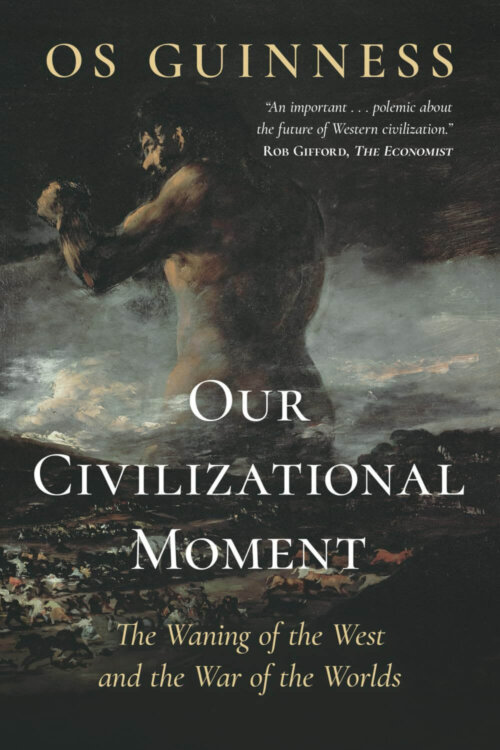
Our Civilizational Moment: The Waning of the West and the War of the Worlds
By Os Guinness
Kildare, 2024; 190pp


Related Posts