Pierre Manent’s Defense of Christianity Against Modern Atheism
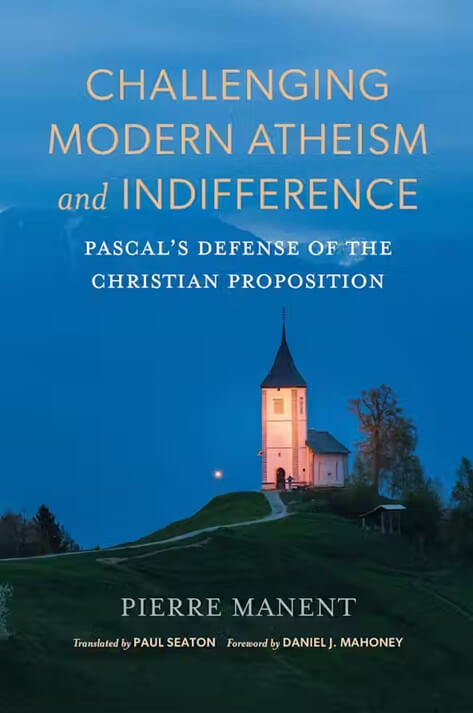
Pierre Manent is best known as one of Europe’s leading political philosophers. Given this status, many would find it puzzling that a scholar who has limned the intellectual origins of modern liberalism would make a defense of Christianity the theme of his latest offering. However, for those familiar with his work and the weighty subjects he tackles, there should be nothing surprising in Manent’s turn to his Gallic confrere, Blaise Pascal, to illumine and to advance what he calls “the Christian Proposition”.
While there are contemporary political thinkers who give lip service to religion in general, Manent’s approach is strikingly different. Today, commentators of a political bent tend toward two views of religion. Some see it as apposite for its political utility. Others consider religion as one more of the panoply of subjective human rights that must be respected and occasionally celebrated as a cultural phenomenon. In both instances, religion is feted not for its objective obligatory content but as an expression of individual autonomous choice with an arguably efficacious social function.
Manent sees things differently. Indeed, in his intellectual biography – Seeing Things Politically – he comments that his itinerary throughout his academic career has been to place himself in the center of a triangle of forces, of “spiritual masses” in Hegel’s apt phrase. Politics, philosophy and religion, each taken to account on their own and in their interaction, animate Manent’s thought in all his works. They do so again in this unexpectedly timely return to one of France’s most enigmatic authors.
As one who “sees things politically” Manent turns to the Christian Proposition manifestly for its specificity but also its universalism as displayed in Pascal’s thought. Christianity, alone among the world’s major religions, though intimately joined to Judaism, proposes something to Europe and to mankind broadly. Europe and mankind must then reply, even if that response entails rejection.
As with Judaism, Christianity is built on an active covenant with the source of all being – it is not simple enlightenment nor is it submission. In Manent’s Pascalian reading, Christianity makes space for the prudence of political action. At the same time, through the Incarnate God, it mediates between the universal and humankind in a manner that escapes philosophy’s erotic daemon. Christianity does this because, as Pascal would have it, it is a religion that speaks to the Will, both animating and freeing it. Before diving further into Pascal, it will be helpful to retrace some of Manent’s past steps.
In his earlier career, Manent set himself the task of uncovering the roots and meaning of our modern liberal and democratic regime. Central to this was understanding the instrumental reason of early modern thinkers such as Machiavelli, Hobbes, Locke and Montesquieu – a form of rationality now so roundly rejected but that still seems to ensnare the late modern masters of suspicion: Marx, Nietzsche, Freud and their progeny.
At the same time, Manent searched for the source of this modern turn in a specific situation that had the effect of disorientating man in his political life. The source of that disorientation was a Christianity, especially in the wake of the late medieval and reformation sundering of faith and reason, that left early modern man without a clear sense of how to choose among the various political, religious and philosophic prospects before him.
In this light, the Christian Proposition came to appear as more of a hindrance than a help. The solution, as Manent saw in the works of the great modern thinkers, was to banish both religion and the Aristotelian framework of substance and specific difference that informed it. As Machiavelli would have it in Chapter 15 of The Prince, going forward, we must depart from the imagined republics and principalities of past philosophers, turning to the solid and efficacious utility of what truly motivates humans. Manent’s 1987 book, An Intellectual History of Liberalism, traces this development in the arc of thinkers running from the great Florentine secretary through to that other great French sage, Alexis de Tocqueville.
In his subsequent work, The City of Man, published in French in 1994, Manent revisits the nature of modernity. This time he approaches the modern difference through the lens of the self-consciousness of modern man – History, Society, Economy – as well as his self-affirmation. As with Christianity, modernity’s self-affirmation comes to light through a series of propositions: the hidden man, the triumph of the Will, and the end of Nature. We moderns put behind us, as hidden, the question: What is man? With Hobbes and Locke we refuse to seek out humankind’s murky Aristotelian substance in order to facilitate the social effects of a generalized state of nature; with Kant we bracket and disarm questions of ordering nature to make room for the self-legislation of morality; with Nietzsche and Heidegger we finally propose to unveil and thereby forever banish the remnants of nature still lurking in their predecessors in the hopes of finding some elusive revelation of the Will to Power or Being.
The effects of this now five-centuries old endeavour are ubiquitous. On the one hand, as Manent notes, we collapse the realms of political practice, reason and revelation into a flattened world of utility and domination subject to ideas placed, apparently, at our disposal. On the other hand, we elevate the Will, but it is a Will that, at the end of modernity, has become inert, stymied, paralyzed. Religion is banished to subjectivity, reason is reduced to calculating social forces, and politics is the plaything of the necessity of human rights without human decision or choice.
Having painted this picture of modern decadence, Manent’s work then turned to a more positive track, if even for the purposes of saving our representative, liberal and democratic nations. In 2010, he published his Metamorphoses of the City. In this wide-ranging work, Manent turns from the “grandeur and miseries of our democracy” to the origins of politics in “the prodigious innovation that was the first production of the common”. Manent takes up the theme of the Greek city that gave us the word polity, and its accompanying analysis of the various regimes in the writings of Plato and Aristotle.
But in turning to the Greek city, Manent is not setting out on an archaeological dig for the classical regime. Instead, he extends the Aristotelian analysis of the regime to the entirety of western political history under the ontological figure of the political form: city, empire, Church, and nation with its modern incarnation in the nation-state. The effect of this approach is nothing less than the reinvigoration of classical philosophy from its historical exile by modern rationality, the return of the practical and theoretical virtues.
In doing so, Manent dedicates one-third of Metamorphoses of the City, to the Church. And yet, as Manent notes, the Church is not a political form like the others. Its goal is not political order but beatitude. It seeks a more universal domain than ever the Roman Empire could imagine at its most extended, and a more intense familiarity than the Greek city could offer, entering not only into the citizen’s breast but the Christian’s intimate heart. Appropriately, Metamorphoses includes the most prolonged analysis of a Christian author – Augustine – that Manent has provided in any of his works.
This brings us to Pascal. Following Metamorphoses, Manent began to write a series of highly intellectual but also profoundly political books; and here I mean political in all its meanings, from the practical and apologetic to a philosophic account of human order. His current work on Pascal fits nicely into this category. It also represents one of two books he has written in this later period that focuses solely on a single author; the other being his book on Montaigne, entitled Life Without Law, also published by Notre Dame Press. In fact, both books provide a synoptic view of their subjects but also serve as an important source of comparison making it helpful to read them together. Fittingly, Manent’s Pascal book includes a number of references and contrasts between the two great French authors of the sixteenth and seventeenth centuries, along with other constructive parallels and points of differentiation with Anselm, Descartes and Rousseau.
Turning to Pascal himself, Manent draws out his distinct departure from our modern confusion of the realms of politics, theory and faith by delineating his stinging critique of the casuistic Jesuits. Seeking to replace the prudence that takes account of particular facts in moral decision-making, the Jesuits proffered the doctrine of “probable opinions” that allowed the penitent to replace the possibility of action directed by considerations of truth and falsehood with the probability that, if the right calculation is applied, the binary of pro and con could cede way to the likelihood that both could be appropriate under the correct circumstances.
As Manent notes, Pascal countered this confusion with his tripartite description of the human realms of three ways of seeing: with the eyes of the flesh, the eyes of the mind, and the eyes of the heart. Corresponding to the political, the philosophic and the religious, Pascal presents each regime as separate and complete unto itself. The eyes of the flesh, driven by concupiscence and domination fix the goals of rulers and kings. The eyes of the mind, animating philosophers and scientists alike, reflect the pride of understanding. The eyes of the heart, speak to the Will and the conversion brought by the God who condescends to man.
Important to remember here is that Pascal is not denigrating any realm in favor of another. To the contrary, in portraying the human as subject to the three realms, he seeks to preserve and respect what is proper to each. Thus, unlike we moderns who so rapidly theorize politics under the rubric of autonomy, Pascal was clear that politics is a domain of justice and force. Similarly, the domain of the mind, while it departs from politics in the philosophic endeavors of the few proud wise, serves as a lynchpin for human understanding that can never simply tyrannize the political or the religious. Manent is quick to point out that Pascal was himself very much a man of modern experimental scientific inquiry with his work on motion in a vacuum.
As for Christianity, as a proposition, it brings to the table an unparalleled analysis of the Will, and the Will’s bondage to sin. In this regard, it appears precisely as a proposal to conversion that simultaneously smacks of foolishness to the wise and weakness to those charged with ruling. Yet in doing so, it protects the integrity of these realms with its humility while also providing a mediation through conversion to the Incarnate Christ between the universal and the human, a mediation that, Manent contends, philosophy cannot fully achieve through reason itself.
According to Manent, the Will is the centerpiece in this dynamic. Specifically, it is the Will’s freedom from bondage through acceptance of the Christian Proposition, along with its Jewish antecedent, in its alignment with the divine Will that is the source of being. To demonstrate this point, Manent turns to the movingly poignant portrait of Chris’s agony in the Garden of Gethsemane. Throughout Christ’s ministry, and even in his death, Christ is shown as commanding, as exercising his authority through miracles culminating in his assurance of his fellow sufferer at Golgotha that he, too, will join him in paradise. The one instance when Christ is not commanding, when he is unable to even move his friends, is during his submission to the Father’s Will in Gethsemane. Entering the Garden to pray, he instructs his three most trusted disciples – James, John, and Peter – the same who were with him on the Mount of Transfiguration, to join him apart from the other disciples. But as the Gospels portray the story, when Jesus most needs his friends, they fall asleep and even Christ cannot wake them. In his agony, in Gethsemane, which is the center of the divine drama that is Christ’s earthly life, Christ submits to the Father’s Will as well to the force of his soon-to-be captors.
It is helpful here to quote Manent’s references to Pascal’s description of the scene. Referring to Matthew 26:38 and Mark 14:34, Pascal notes Christ’s confession: “I am deeply grieved, even to death.” Manent comments:
Pascal, who highlights this sentence, accompanies it with the following commentary: “I believe that this is the only occasion on which Jesus ever complained.” Between Jesus and his disciples, the roles seem reversed: “Jesus seeks companionship and solace from men. It seems to me that this is unique in his whole life, but he finds none, for his disciples are asleep.”
The impact of Christ in Gethsemane for Pascal is his total removal from the human world and his acceptance, in accord with the Father’s Will, that Jesus must bear God’s wrath on his own. Christ sought human support and found none. In doing so, he did not rebel against the human world of concupiscence or proud reason but entered into the Will of the Father that allowed him to ultimately overcome death through a Will that is fully activated, no longer inert and bludgeoned by sin. At this point, it is worth noting that in his Metamorphoses of the City, when discussing Homer’s Iliad, Manent notes that Jesus is for each human what both Hector and Patroclus were for Achilles: “the enemy he has pierced with blows and the friend, the brother, who was pierced with blows for him.”
One last point on the Pascalian Will. As noted above, our modern notion of the Will is something that is simultaneously totally dominant through our free and autonomous determinations (Kant), but also something that is entirely subjected to the necessity of that autonomy (existentialism). All we need to picture here is Rousseau’s individual in the pure state of nature, who must somehow pass through the debauchery of civilization to dissolve himself as if by a pure mathematical function in the General Will. That Rousseau found this fate so guiling is gainsaid in his own final reflections on the reveries of solitude.
By contrast, conversion to the Will of God is the release of the Will from bondage into life, a life that never tyrannizes over reason or political action. Practically, the instances of the visible Christian Church meddling in the material world are legion. But the point of the Christian Proposition that contemporary Europe so adamantly and yet so ineptly seeks to ignore is the unique import of Europe’s own history and self-understanding. In developing this theme through Pascal, whose wager was nothing more than bringing this Proposition before seventeenth-century Europe in its own turn to instrumental science, Manent reminds us of the always-present possibility (i.e., not probability) of the Christian message. As for himself, Manent, it seems to me, as he did with his exposition of the modern difference and the instauration of Aristotelian philosophy through the metamorphoses of the political form, has illuminated the third great vector of the spiritual masses of his intellectual itinerary.
Challenging Modern Atheism and Indifference: Pascal’s Defense of the Christian Proposition
By Pierre Manent; trans. Paul Seaton
South Bend: Notre Dame Press, 2025; 294pp


Related Posts