Revisiting the Renaissance
Within scholarly discourse, there is some debate over what to call the period of Western history stretching from the fifteenth to the seventeenth-centuries. The traditional term for this period is “Renaissance.” As scholars such as David Scott Wilson Okamura note, this term is fitting, for it is a term that would be familiar to the people living during this time. As texts and art from the classical world were unearthed, there was a sense that an earlier period of Greek, Roman, and even Egyptian history was being reborn as Renaissance Europeans read the texts of Cicero and Plato and erected obelisks in St. Peter’s square. However, for some, the term “Renaissance” is too triumphant and too conservative, privileging the allegedly cruel and oppressive regimes of Greece and Rome. One of the more popular terms that was moved to replace the Renaissance is “Early Modern.” The Early Modern approach emphasizes the birth of individuality, secularism, the dominance of technology, the nation state, and interiority, which expanded and deepened into the modern Enlightenment, postmodern electronic, and now the digital postmillennial age.
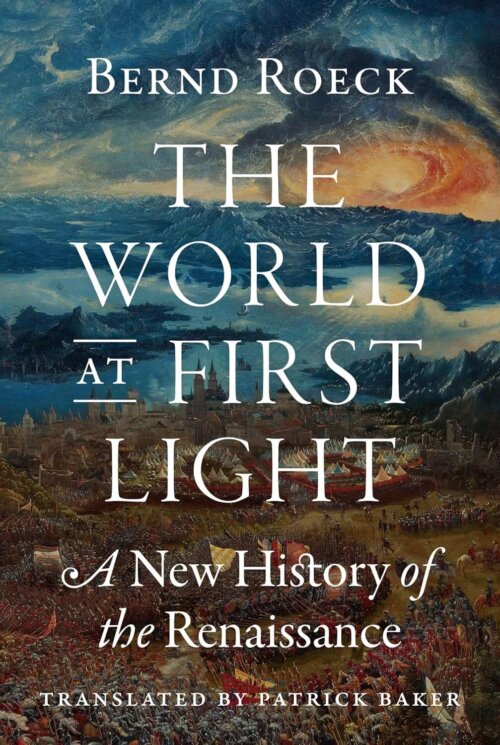
Both terms, “Renaissance” and “Early Modern” however, highlight the fact that something changed four hundred years ago in Europe and her colonies. This change caused the West to expand and dominate most the world. This growth and dominance has been an object of critique to the left and at least cautious celebration for the right—depending on which sort of right we talking about. There are multiple depictions of Renaissance or Early Modern period. In his recent work, The World at First Light: A New History of the Renaissance, University of Zurich historian Bernd Roeck presents a rich and multilayered depictions of the Renaissance as a fundamentally good thing. At the same time, Roeck tries to moderate any triumphalism with a generous discussion of non-European cultures, while he does admit that scholars have gone so far as to call the dominance of the West as the “European miracle.” Roeck’s task, over the next nearly 1200 pages, is to answer why Europe has been successful.
Roeck’s approach is something that is exceedingly rare in the 2020s in which even academic scholarship is becoming dominated by both the radical left and the reactionary right. Roeck appears to be present the Whig version of history that used to dominate much of Anglo-American discourse. This approach is a celebration of liberalism, capitalism, technology, and a tamer, secularized Christian culture as being the engine for the progress and success of civilization. Unlike many reactionaries and Traditionalists today in the New Right, he sees Western Civilization in a state of progress as opposed to a deterioration from pre-modern strength and spirituality. As the Renaissance dawned, Europe, for Roeck, progressed beyond myth into reason and science. Science is fueled by the distribution of information as well as intellectual freedom, in Roeck’s view. Roeck thus places a great deal of emphasis on the development of the printing process. He gives the example of Georg Agricola’s 1556 treatise on mining, which spread the idea of the piston pump; Roeck humorously notes that the wood block prints in the treatise were enough to show how to make a prefiguration of the railroad car.
He sees Western success as being the result of paper, Indo-Arabic numerals, the alphabet, and other sources that allowed information to diffuse throughout Europe. Gordon Gecko and Max Weber, Roeck sees the desire for acquisition (as well as social mobility) as something that drove Western Civilization forward. It is this competition and drive for success. The Early Modern Western state with its bureaucracy and just legal system further created the structure for the advancement of European civilization. Drawing from Joseph Needham, Roeck further argues that the fact that Europe was politically fragmented created a subsequent market economy that produced money to finance and science and culture. Moreover, public political rhetoric also propelled Europe forward.
There further was a relative stability in Europe. After the fall of Rome, Europe did not experience the collapse of entire states. Roeck further notes that the toleration in some European countries allowed for the growth of science; at the same time, Latin united the people of Europe and allowed for the diffusion of ideas—even before Gutenberg. Roeck acknowledges that many Early Modern scientists from Athanasius Kircher to Rene Descartes, to Johannes Kepler and even Galileo were believers. However, Roeck argues that limits on what he calls religious fanaticism in Europe allowed for the progress of science. Its, Roeck argues, liberal democracies, not authoritarian governments, that produce scientific discoveries. Taking a traditional approach, Roeck also sees Western thought, rooted in Greece (and perhaps the “East”) as well as Roman engineering and law. He also praises the Arabs for transmission of classical as well as genuine innovations. He further includes Indian numbers and Chinese paper. This is a tension throughout the work. He further notes Medieval developments of sciences and technology. All of these factors (and more) created an environment that allowed for the European miracle.
One of the most curious things about the book is the tension between Roeck’s efforts to provide generous praise for the achievements of Asian, African, Islamic, and Amerindian civilizations, and the reality of the dominance of Western modernity. In his epilogue, we see the commentary that drew such strong responses to the book’s German language edition. Roeck notes that in no other civilization in the Early Modern period was there such rich abundance of scholars and technicians and engineers and crafts men. The World at First Light thus contains some elements of the great man or great woman version of history noting that Copernicus and Kepler were given the possibilities of achieving their discoveries from the environments in which they lived. Roeck also clashes with scholars such as Achille Mbembe who suggest slavery was the principle driving force for the advent of modernity. Roeck further notes that attempts in books to explain away European success by saying that there were no plagues in Europe after the fifteenth century is simply inaccurate, and catastrophes, including food shortages occurred even into the 1840s. Roeck further notes that European success required a great deal of suffering by Europeans, who cannot be reduced to comfortable masters in (pseudo-)Hegelian master-slave dialectic.
One of the key notions is that our time is in a state of decline. The future, according to most predictions, will be Chinese, Indian, African, or Amerindian. Europe and then the wider West grew and developed to dominate the world for both good and ill. Some have argued, a la Martin Heidegger, that Western technology such as smart phones and AI no longer prove the quality of life by deteriorate. New Right thinkers such as Patrick Deneen argue that Western liberalism has consumed itself and become totalitarian. Religious freedom and pluralism also allegedly has made the West secular and skeptical and deprived the West of the fervor of the search for truth and knowledge that, even Roeck admits, drove some Christian scholars. There may be some truth to these arguments, but, ultimately, “decline is a choice,” and we have the tools at hand for a new renaissance.
The World at First Light: A New History of the Renaissance
By Bernd Roeck, Trans. Patrick Baker
Princeton: Princeton University Press, 2025; 1144pp


Related Posts