Revolt of the Eternal
In recent years, there have been a revival of interests in Traditionalism, an eclectic school of thought that draws on elements of Eastern and Western religion, myth, and philosophy to provide a thought-provoking critique of modernity. Unfortunately, the critical stances of the principal Traditionalist thinkers towards such sacrosanct modern ideals as progress, secularism, democracy, and science have meant that few scholars are willing to engage with the subject on its own terms.
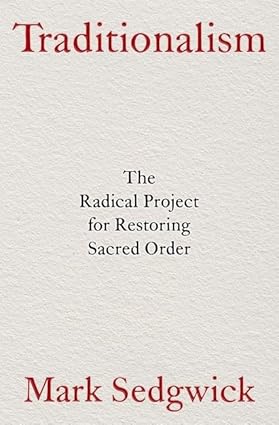
With his recent book Traditionalism: The Radical Project for Restoring Sacred Order, Mark Sedgwick (Professor of Arab and Islamic Studies at Aarhus University) helps to bridge this gap, offering fresh insights into a rich, though often misunderstood, tradition of thought that speaks to one of the defining questions of our time. That is, how can we reconcile ourselves to the wisdom of the past without compromising the achievements of the present?
Traditionalism, capital “T”
For Sedgwick, Traditionalism is a ‘metaphysical’ doctrine that rests on two fundamental pillars, both well established (though never predominant) in Western thought. The first is the belief in perennialism, the idea that beneath the world’s various religious traditions there lies a single, esoteric body of sacred teachings (i.e. the ‘Tradition’) that have been passed down since time immemorial. While the principal Traditionalist thinkers often differ among themselves as to the particular content of these teachings, they invariably describe a kind of ‘received wisdom’ distilled from religion, myth, and philosophy—what Huston Smith, a twentieth-century American Traditionalist, dubbed the “cumulative wisdom of the human race.” Because this wisdom is believed to have a divine rather than merely earthly origin, knowledge of the Tradition (typically imparted through ‘chains of transmission’ involving teacher and student) is also explicitly contrasted with the discursive mode of the Enlightenment, under which knowledge or truth arises from rational discourse and debate.
The second pillar is the Traditionalist historiography. Since at least the eighteenth-century, the dominant historical narrative in the West has been an essentially Whiggish account of history. That is to say, history is understood as a linear development where things are steadily improving. Though there may be occasional periods of regression, an optimistic view of human nature and the products of human ingenuity encourages the belief that a better, more prosperous world is always around the corner. A closely related idea is the tripartite division of human history into ancient-medieval-modern regularly taught in school.
Traditionalists, by contrast, adopt an older cyclical model, which imagines history as an entropic process of decline. As Sedgwick explains, “For Traditionalists, modernity represents not recovery, but a continuation of the Fall.” According to the Traditionalist narrative, history begins with a golden age during which humanity maintains its connection to the primordial Tradition. Eventually, however, some tragic mythical event (Adam’s decision to eat from the tree of the knowledge of good and evil for example) occurs and severs this connection, causing the golden age, or paradise, to be lost. As time goes on, humanity’s connection to the Tradition grows dimmer and dimmer, until finally what remains of the qualitative world of form and spirituality gives way completely to a dark, chaotic world of sheer quantity.
While the linear historical model meshes well with our contemporary notions of progress, Sedgwick observes that the prevalence of cyclical conceptions in so many of the world’s mythological traditions suggests that the modern view of history is the exception rather than the norm. The Greek myth of the ‘ages of man’ (as recounted by the poet Hesiod in the Works and Days), for example, describes the temporal decline of humanity over the course of five ages, beginning with the Golden Age, during which humans enjoyed a quasi-divine existence among the gods, and culminating in the present Iron Age, where evil is ascendent and virtues such as truth and loyalty have all but been forgotten. The Eastern equivalent of Hesiod’s model is the Hindu conception of four yugas, and the last of which—the Kali Yuga—denotes an age of strife where “the gods are absent, and disorder, immorality, and chaos grow.” Despite being generally understood as a linear narrative, Christianity also shares with the cyclical model the idea of an initial fall from glory followed by continuing temporal deterioration, at least until the return of Christ.
Modernity and its Discontents
Implicit in the Traditionalist historiography is the Traditionalist critique of modernity. This is also the point where Traditionalism becomes political, and thus more controversial. If modernity represents not evolution, but degeneration, then what of the cherished political ideals and institutions that have emerged over the course of the last three centuries?
As Sedgwick explains, modern Western political theory is rooted in the concept of popular sovereignty, or the idea that “the legitimacy of government depends on the will of the people and the consent of the governed.” From this fundamental axiom, modern Western political theory invariably arrives at a positive valuation of ideals such as democracy, freedom, equality, and fraternity (or solidarity) as the highest expressions of political life. Indeed, most academic debates in modern politics are about how best to realize these ideals, not their status as first principles.
In keeping with their aversion to all things modern, the Traditionalists reject the positive meaning attributed to these ideals, viewing them as signs of decadence that underscore how far we have fallen away from the wisdom of the Tradition. With regards to democracy and equality, for example, Traditionalists do not see the empowerment of the individual, but a smothering homogeneity that suppresses all true difference and leads to the advent of the ‘mass man.’ As Sedgwick explains, from the Traditionalist perspective, “Modern centralized administrations treat all persons as identical, and actually do their best to make them identical. Democracy and equality, in practice as well as in principle, try to make every individual as similar as possible to every other individual.”
Other criticisms are directed toward the centrality of science and technology in modern life, which the Traditionalists argue has alienated the human person in a spiritual sense, trapping him in what sociologist Max Weber famously described as a stahlhartes Gehӓuse, or ‘steel-hard cage.’ On the one hand, Traditionalists concede that science and technology have enabled us to exert considerable power over the natural world. Given its purely material theoretical basis, however, Traditionalists maintain that modern science is ultimately incapable of saying anything substantial about the spiritual or transcendent, and thus these dimensions of human experience are deemed subjective at best and nonexistent at worst. Many Traditionalists also argue that the rosy view of technology on which much modern thinking depends tends to overlook the darker possibility that “Material progress may also ultimately prove fatal, as many realize, seeing the great progress in armaments.”
Traditionalists are also natural opponents of secularism, which either consigns spiritual concerns to a restricted place in the social order or, in more extreme manifestations, attempts to eliminate spirituality altogether. The result, from the Traditionalist perspective, is the spread of social chaos and upheaval. Because man is by nature a spiritual being, Traditionalists also maintain that he will actively attempt to fill the void created by secularism with all manner of “pseudo-religions,” whether the idols of science and progress, totalitarian ideologies of one kind or another, or false spiritual or therapeutic paths such as psychoanalysis, which privileges the subconscious and thus “takes its victims on a descent into hell.”
While Sedgwick is of the opinion that the Traditionalists make the mistake of throwing the baby out with the bathwater by condemning modernity in its entirety, he also shows that the Traditionalist critique hardly emerged in a vacuum. As students of Classics will recall, Socrates and Plato rejected democracy on account of the tendency of democratic polities to slide into disorder. Throughout the nineteenth-century, the Enlightenment emphasis on rationality and science was challenged by everyone from the Romantic poets to philosophers such as Friedrich Nietzsche and Søren Kierkegaard. For twentieth-century thinkers like Hannah Arendt, Nicolás Gómez Dávila, and Ernst Jünger (to name a few), the loss of religion, tradition, and authority associated with modernity did not lead to greater freedom, but to the emergence of the totalitarian state. In this sense, the Traditionalist critique of modernity does not represent a break with the Western Tradition, as many of its critics assert, but a particular way of thinking from within that tradition.
Mystics, Warriors, and Scholars
An expert on Islamic history, Sedgwick explains that he first became aware of Traditionalism in the 1990s while researching Sufism in Cairo. It was during this period that Sedgwick encountered the work of René Guénon, a French mystic and prolific writer who can rightly be called the founder of Traditionalism (though Guénon himself would no doubt have disputed the notion that Traditionalism has any identifiable ‘founder’).
As Sedgwick explains, Guénon’s writings are primarily concerned with metaphysics, though some also dealt with subjects that could be considered more political. In The Crisis of the Modern World and Spiritual Authority and Temporal Power in particular, Guénon expressed admiration for pre-modern political orders such as those that existed in Europe during the Middle Ages as well as ancient Asian states like China and India. The defining characteristic of these civilizations for Guénon was the unity of spiritual and temporal power, an arrangement which in his view helped maintain a harmonious social order that was oriented toward the transcendent.
While Guénon could certainly be criticized for perpetuating an overly romantic view of pre-modern societies, he did not harbor any illusions about turning back the clock or reinstituting the divine right of kings. The most important task was always the recovery of traditional knowledge, without which any direct political action would not only be useless, but also potentially dangerous. For Guenon, this knowledge could only be acquired through initiation into some form of long-established traditional organization. By the twentieth century, however, such organizations had all but disappeared in the secular West. Guénon thus looked to the East, which in his view harbored the few unsullied initiatory paths remaining in modernity. In the early 1930s, Guénon relocated permanently to Cairo, where he joined a Sufi order and continued to write on subjects of traditional interest until his death in 1951.
By far the most polarizing Traditionalist is the Italian esotericist Julius Evola, who attempted to synthesize the Traditionalist project begun by Guénon with the political concerns of the European interwar Right, especially the so-called “Conservative Revolution,” with which he claimed a deep affinity.
Much of the controversy surrounding Evola understandably stems from his involvement with Italian Fascism and, to a lesser degree, German National Socialism, as well as the popularity of his writings with the “New” or “Alternative” Right. On this subject (which has been debated somewhat extensively by apologists and critics alike), Sedgwick offers a balanced assessment that neither exonerates nor condemns. For the purposes of the present article, suffice to say that Evola initially had high hopes that the alliance between Hitler’s Germany and Mussolini’s Italy would pave the way for “the union of the two eagles”—a kind of modern Holy Roman Empire capable of revivifying a decadent West, ideally on the basis of a virile Traditionalist spirituality.
But Evola was never a ‘blood and soil’ nationalist, and his hopes were dashed by the reality of daily life under the extensive Fascist bureaucracy, as well as the unprecedented destruction brought about by the Second World War. In two of his later books, Fascism Viewed From the Right and Notes on the Third Reich, Evola even wrote detailed critiques of both regimes. As Sedgwick notes, neither of these critiques were developed from the Liberal perspective from which these regimes are generally condemned today. They are unlikely to completely absolve Evola of his earlier sympathies, at least as far as his critics are concerned.
Sedgwick’s intellectual portraits of Guénon and Evola are rounded out with detailed considerations of other notable Traditionalist thinkers, including the renowned Romanian scholar of religion Mircea Eliade; the Swiss Sufi Frithjof Schuon, whose writings exerted a considerable influence on scholars of art and religion; Ananda Coomaraswamy, a Sri Lankan scholar and art critic who helped introduce ancient Indian art to the West; the Iranian-American professor Seyyed Hossein Nasr, who made significant contributions to the academic study of Traditionalism; and even the Canadian psychologist and public intellectual Jordan B. Peterson, who Sedgwick considers a “Traditionalist fellow-traveler.”
Applications
In one of the most intriguing sections of his book, Sedgwick shows how Traditionalism has exerted a lasting influence on various spheres of activity that remain relevant to the present time. Students of music may be surprised to learn that the compositions of the late English composer Sir John Tavener were inspired by his understanding of Traditionalist perennialism. The more philosophical side of the contemporary environmental movement also owes something to the Traditionalist critique of modernity, especially the idea of a ‘desacralization’ of nature brought about through a materialist worldview that views nature as a mere resource to be exploited. Proponents of interfaith dialogue have also looked to Traditionalism for inspiration in various contexts, including Bosnia in the aftermath of the 1992 war and the Middle East during the War on Terror.
While these are generally seen as positive examples of Traditionalism’s influence, this influence also has a darker side. As mentioned, the Traditionalist critique of modernity has been embraced by elements of the Far-Right in both the United States and Europe. In some cases (such as in Italy during the ‘Years of Lead’) these groups have committed real acts of terrorist violence.
Outside of the West, Traditionalism has also exerted considerable influence on Russian political philosopher Aleksandr Dugin, who some claim is the intellectual inspiration behind Vladimir Putin’s Ukraine war. In his book The Foundation of Geopolitics in particular, Dugin draws on the Traditional-Modern dichotomy developed by Guénon to argue for a Neo-Eurasian approach to geopolitics. According to this view, the Atlanticist Western powers represent ‘modernity’ (with all that it implies), while non-Western powers like Russia, China, and Iran represent ‘tradition,’ and should thus work together to resist Western attempts to dominate the globe.
While Sedgwick disputes the notion that Dugin is ‘Putin’s brain,’ as some have suggested, he concedes that Dugin’s views on geopolitics “fit well with Putin’s own,” as can be seen by Putin’s attempts to present Russia as a champion of ‘traditional values’ in recent years, as well as his calls for a “multipolar” world order capable of challenging the hegemony of the United States.
Gnostic Disorder
The practical and moral pitfalls of these attempts to apply Traditionalism directly to politics recalls the German political philosopher Eric Voegelin’s critique of ‘Gnostic’ ideologies, especially as developed in his book Science, Politics, and Gnosticism. For Voegelin, there was a clear parallel between modern mass political movements that sought to remake the world through the application of a systematic ideology (for example, the ‘science’ of Marxism-Leninism) and Gnosticism, a Christian heresy dating to the Middle Ages which held that the material world was inherently flawed and could only be overcome by the application of a secret knowledge, or gnosis.
As the terrible consequences of these ideologies attest, the Gnostic endeavor to attain a perfect world by destroying the fallen, imperfect world of the here and now is fraught with peril, and can only compound the very disorder that the Gnostic desires to escape. In other words, paradise has been lost, and it is not given to man to reclaim it, at least not in this life.
While Traditionalism does not fit perfectly into Voegelin’s framework given that Traditionalism is neither a mass movement nor a seamless ideology, certain aspects of Traditionalism (for example, the idea that esoteric knowledge of the Tradition points the way back to a utopian golden age) could certainly be called Gnostic-adjacent. It follows that any attempt to apply Traditionalism directly to politics in hopes of restoring sacred order is bound to fail.
At the same time, Traditionalism can still tell us something important about the nature of modernity. Ever since Machiavelli de-divinized the cosmos, modern man has taken pains to neatly separate the spiritual from the secular, the sacred from the profane, often to the advantage of the latter. But man, as the Traditionalists recognized, is both Zoon Politikon and Homo Religiosus. A political order that ignores this essential duality in human nature, or that actively attempts to suppress it, would deny man his full measure as man, and thus be similarly bound to fail, at least from a certain anthropological perspective.
Indeed, it may be that one of the principal challenges for us in the twentieth-century is not to definitively resolve the contest between these two dimensions of human experience in favor of one or the other, but rather to find a way to live amid the tensions between them. To the extent that Traditionalism can inspire thinking about how best to strike this balance, it is likely to continue to attract interest in the coming years, regardless of the controversies associated with it. As Seyyed Hossein Nasr, one of the most respected Traditionalist scholars, observed:
The traditional doctrine of man is the key for the understanding of that anthropos who, despite the rebellion of Promethean man against heaven, is still the inner man of every man, the reality which no human being can deny wherever and whenever he lives, the imprint of a theomorphic nature which no historical change and transformation can erase completely from the face of that creature called man.
Traditionalism: The Radical Project for Restoring Sacred Order
By Mark Sedgwick
New York: Oxford University Press, 2023; 424pp


Related Posts