Shakespeare and the Will to Power
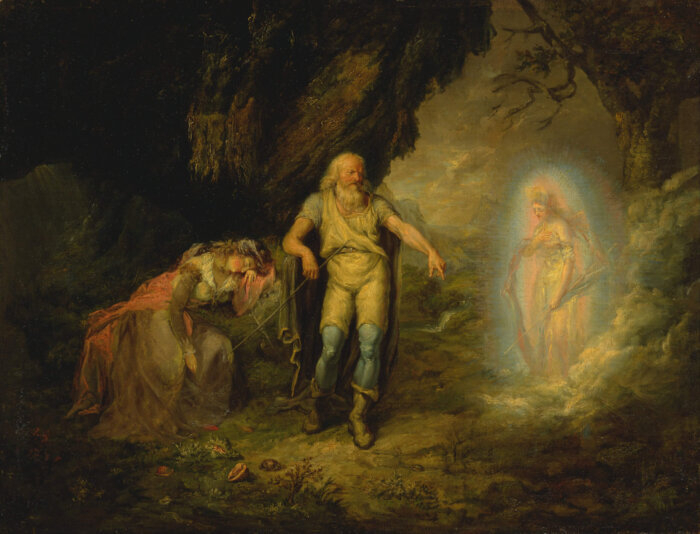
Like the majority of Shakespeare’s plays, The Tempest, which is said to be his last play, is an exquisite and perhaps final manifestation of the dramatic genius of the immortal Bard. The play is often approached in terms of issues such as liberal education, Prospero as both, a director of events and a philosopher king, the teaching of Eros- apropos of Prospero’s remarks to Miranda when she becomes enamored with Ferdinand- and other things such as the question of political philosophy in the play. Nevertheless, when it comes to will to power, this theme is often brushed aside by readers of The Tempest even though instances of it abound in the play. Hence, a discourse about will to power in The Tempest is by no means a boorish intrusion upon the poetic and political nature of the play. The play is a commingling of love and power. Shakespeare pre-eminently amalgamates a purely romantic endeavor with other political endeavors. While Miranda and Ferdinand are primarily preoccupied with love hoping to be redeemed and sanctified, Antonio, Sebastian, Trinculo, and Stefano are ensnared in a seemingly grinding political battle for power. Thus, The Tempest is a singularly fine portrayal of a relentless quest towards power, in which almost all characters evince an unyielding will to power.
The play opens with a scene of extreme tumult, a scene admirably appropriate to a central issue in the play, namely that of will to power. Caught in the bustle of a tempest, the Boatswain and the mariners rightly assume the power and the role of saving the King and his suits from a calamitous shipwreck. However, Antonio and Gonzalo try to exert their “authority” over the Boatswain to take the matter of the tempest more seriously. Consequently, he addresses them with an invective tone, asking them to “keep below…To cabin! Silence! Trouble us not.” This opening scene of The Tempest is a subtle manifestation of both a will to power and a reversal of power. The councilor of the king, Gonzalo, and Prospero’s brother, Antonio, seem to have no sway in this tumultuous event. The power that they hold in Milan is abruptly taken by the tempest and given to Boatswain, and the Mariners. Thus, the storm of the opening scene opens up the question of whether power is given and obtained by convention or fought for and therefore obtained by harboring an unyielding will.
In discussing Antonio, it is important to mention that he is easily among the quintessential embodiments of will to power. This is decidedly conspicuous when Prospero informs Miranda about the matter of the shipwreck. Prospero explains to her how his brother, Antonio, usurped his dukedom from him while he was so buried in his esoteric education or “the liberal arts” as he refers to it. Prospero tells Miranda that Antonio was blinded by his treachery and fundamentally by his fervor for more power:
He being thus lorded,
Not only with what my revenue yielded
But what my power might else exact…
out o’ th’ substitution
And executing th’ outward face of royalty
With all prerogative. Hence, his ambition growing—
Dost thou hear?
Prospero speaks of Antonio’s growing “ambition,” thereby corroborating the notion that the question of will to power is indeed embedded in the play. Through this political affair between Prospero and Antonio, the play addresses a recurring point in Shakespearean plays, which has to do with the will to power and how one pursues power at the expense of perennial values like eros, brotherhood, loyalty, and moral standards. Shakespeare seems to hint that a romantic and somewhat insatiable yearning for power results in abstinence from and omission of metaphysical love. Furthermore, in Act 4, Scene 1, Ferdinand witnesses Prospero while he is trying to restore his power and dukedom, and he tells Miranda that her father is “in some passion that works him strongly.” This passion that Ferdinand observes may be a clue and a display of Prospero’s lust and yearning for power, a power that he used to exert at Milan and was ultimately taken from him.
Prospero’s telos or “project” as he calls it is aimed at recuperating the power he used to enjoy as a Duke of Milan. At the end of the play, when Prospero’s “project” fares rather well and he becomes close to returning himself to power, he tells Ariel: “Now does my project gather to a head.” Prospero’s articulate “project’ that consists of unveiling his brother as a false duke of Milan and recuperating his stolen dukedom is a manifestation of his will to power. Furthermore, although Prospero directs and orchestrates the events in the play as he wishes by virtue of his sheer wisdom and “rough magic,” he nonetheless chooses not to stay and subsist on the island. He is willing to abjure his magic and leave the place where he orchestrates the entirety of what happens for the sake of returning to power. at the beginning of Act 1, Prospero explains to Miranda why he orchestrated the tempest. In so doing, he rhapsodizes about his time as a Duke and the power he used to enjoy. He tells her: “Thy father was the Duke of Milan a prince of power.” Therefore, we can safely assert that all of Prospero’s actions are predominantly moved and induced by both a repressed will to power and a deep yearning to be a philosopher king who rules.
In The Tempest, Shakespeare considers the limits one can reach and the measures one takes to get hold of power. This is evident in the play’s multiple subplots and the coups of Antonio, Sebastian, Trinculo, and Stefano. The first subplot is that of Antonio and Sebastian. Antonio convinces the king’s brother, Sebastian to plot against the king and usurp the kingdom of Naples only for themselves. Once again, this shows that the kind of ‘ambition’ that Prospero speaks of in relation to Antonio is just a euphemism for his will to power. On the other hand, Trinculo and Stefano are encouraged by Caliban to kill Prospero, take his daughter, and “inherit” the island from him. As this subplot progresses, we see that Stefano is willing to go to extremely difficult ends just to have power: “I will kill this man. His daughter and I will be king and queen-save our graces! … Dost thou like the plot, Trinculo?” He goes even further: “This will prove a brave kingdom to me, where I shall have my music for nothing.” Thus, we can safely assert that Stefano and Trinculo, just like Antonio and Sebastian, are preponderantly blinded by an insatiable yearning for power.
With this display of the characters’ ambitions, especially the tantalizing ambition of Antonio, Sebastian, Trinculo, Stefano, and to a lesser degree, Caliban, Shakespeare enacts a stage wherein the conventional hierarchy, equipoise, and power of society are openly dissolved. This stage is also a site wherein man’s vanity and unmitigated lust for power are decidedly unleashed and eventually turned loose. Ultimately, Prospero manages to restore his power and reconcile this latter with wisdom. Through the character of Prospero, Shakespeare, with his untrammeled wisdom and insights regarding the human soul and human undertakings, suggests that one’s will to power can fare better when it is coupled with wisdom, equanimity, and political acumen, as is the case with Prospero.


Related Posts