Shakespeare: Political Theorist
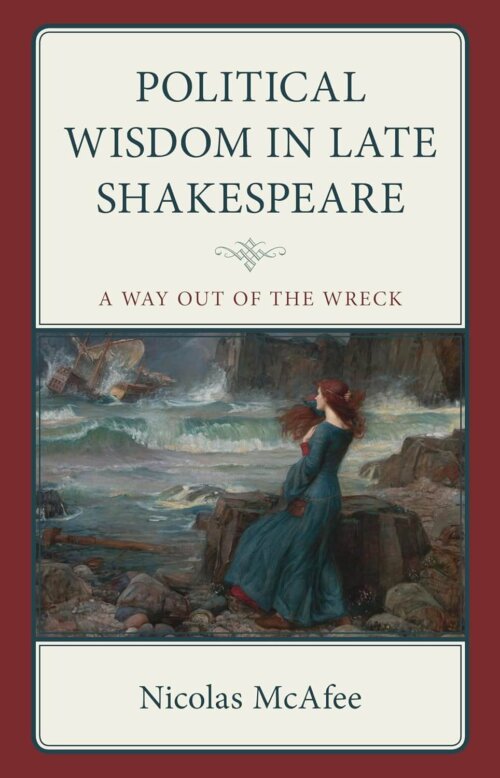
When you think of William Shakespeare, the great Bard of the English language, you don’t necessarily think of him as a political theorist. Yes, he wrote about politics. But that’s all stage drama and rhetorical flare, isn’t it? Not quite, argues Nicholas McAfee in his new book Political Wisdom in Late Shakespeare. In fact, a careful reading of Shakespeare reveals a deeply insightful and prescient political commentator despite our first impressions of the Bard as a master of rhetoric and stage drama.
While Shakespeare is an undisputed master of stage and human drama through rhetoric, McAfee rightly pivots our attention to other avenues of the Bard’s consideration; in fact, his opening grabs the reader’s attention, “William Shakespeare is a poet and playwright whose depth of characterization and artful mastery of plot development invites careful critical consideration across a range of thematic concerns. Politics is one such concern.” Examining several of Shakespeare’s plays where political considerations drive the plot or the characterization of his dramatic individuals, McAfee notes that we can begin to see Shakespeare “communicat[ing] moral insights” in his plays.
From the comedies to the tragedies to the direct political plays, we can see a dichotomy between “clemency and reconciliation” emerge in contrast with “revenge.” The need for clemency and reconciliation is not merely applicable to individual life but to social and political life as well. This should make immediate sense given the social or political nature of humanity: we do not live in isolation or a vacuum from each other. This is especially true in the late plays of Shakespeare.
While minimalists would argue that drama was vulgar and lowbrow, meant to entertain audiences and nothing more, this view diminishes the rich legacy of the intellectual past. Why denigrate the dramatic tradition of England and not Athens? Or, shall we dispense with the social, moral, and political readings of the Athenian playwrights if we are to take the same to Elizabethan and Jacobean drama? Once the reader of Shakespeare realizes that the minimalist argument for disregarding deep intellectual consideration in Shakespearean drama suffers its own incongruencies (notwithstanding the fact that eminent political philosophers like Plato and Aristotle saw moral and political ramifications in dramatic art), we can accept the obvious as McAfee does, “Spectators are thus guided more intimately into acceptance of what we will see is a central motif of the late plays: clemency and reconciliation triumphing over and against revenge.”
Although it can be said Shakespeare is, at times, one dimensional in his presentation of villainous characters, this critique doesn’t distract the framework of mora and political wisdom communicated in Shakespeare’s plays. In fact, it is essential because the bluntness of certain evil characters with their “malic,” “ill-doing,” “deception,” and “violence” helps to underscore a sharp contrast with the protagonists who either embody certain virtues Shakespeare wants his audience to equally embody or come to embody virtues that contrast with villainous courtiers and antagonists.
Among the virtues of human nature found, for instance, in Cymbeline is “patience and piety.” Patience is the absence of rash action that leads to negative consequences. Piety is marked by duties to others and duties to God, or “[f]aith in divine providence.” Furthermore, piety as faith in divine providence and trust in the relationships of others (duties toward others) are also interlinked in Cymbeline. The testing of patience and piety is also a test in one’s religious trust; failure in patience leads to the disintegration of the union of patience and piety thus revealing characters as unvirtuous.
Even if characters fail, does this mark the impossibility of virtue? Not necessarily. Characters transform. Shakespeare reminds us that human nature can be molded toward good and better things. Characters who are unvirtuous, lacking in virtuous, or their pretensions to virtue fail, sometimes have redemptive character development. Posthumus is the perfect example in Cymbeline, sticking with this play that McAfee so brilliantly analyzes. The growth in virtue can lead to the acquisition of new virtues, like clemency, where characters are willing to embrace the better angels of our nature for others. Clemency allows for the possibility of moral growth for Shakespeare’s characters which implicates our own lives in society: we too can grow in moral virtues if given the chance. While this is not universal for not all of Shakespeare’s characters grow in virtue, this call for mercy and the reality that some of us do change is a positive aspect of political society. Do we really want to live in a society where it is one strike and that’s it? Only the heartless would say so.
Furthermore, diligence as a virtue is explored in Shakespeare’s late plays. Diligence is an intellectual consideration where a one “proactively seek[s] to fulfill one’s duties in their entirety.” The role of diligence in our lives binds us to society since we do have duties not merely to ourselves but to others. Others can come to rely on us for support in their weakest moments and we must be strong enough and wise enough to rise to the challenge that social living demands. This helps to create a “community of moral support” that often undergirds secondary and tertiary actions and plotlines in Shakespeare’s later plays.
In teaching Shakespeare, I often tell students of Shakespeare’s breadth of considerations that we can find in his plays. Shakespeare is not merely a master of rhetorical drama; he is a dramatist of the human heart and soul. Nicholas McAfee’s Political Wisdom in Late Shakespeare is a triumph of Shakespearean scholarship, helping to remind readers of the totality of Shakespeare’s understanding of the human condition through a careful and considerate reading of his plays—especially those later plays that sometimes are forgotten but are filled with tremendous wisdom. For those seeking a deeper understanding of Shakespeare as first-rate thinker of the human condition, Political Wisdom in Late Shakespeare reveals the splendor and depth of the thought found in the Bard of Stratford-upon-Avon.
Political Wisdom in Late Shakespeare
By Nicholas McAfee
Lanham, MD: Lexington Books, 2024; 186pp


Related Posts