Simsala Grimm: The Magic Key to the Land of Fairytales and the Trapped Children Deep Inside our Souls
Fairy-Tales. I don’t know about you, but in recent times I noticed that I really miss this particular branch of the literary genre. However, when I say fairy tales, I mean actual fairy tales and not what we traditionally place under the label in modern times (works such as deconstructions, postmodern retellings, and childish watered-down versions of the originals from which the initial meaning/message is missing due to the changes made). As I once pointed out in my previous review on the work by Armando Maggi “Preserving The Spell” classical tales no longer seem to hold the same status that they held during the time that they were written, or during the American golden age when our country was still an embodiment of traditional values which these tales taught and preserved. Today it seems more appropriate to laugh and scrutinize at them for they are nothing more than “artificial constructs created to spread harmful ideas such as sexism, racism, misogyny, classism, inequality and homophobia in society, along with enforcing the normality of stereotypes and biases in children.” as believed by many people today who associate themselves with the Liberal movement. According to their perverse logic propaganda and indoctrination are the only purpose of such tales and that the only way to make them “good” is by having them include elements that they view as humane and progressive (while humorously ignoring the fact that the values that they desire to promote are “humane” and “progressive” only in the context of our current political and societal climate). Lost is the time when, under the paper wrap of magic and adventure, along with ancient symbols, important values and truths about human existence that have always been present within us through the will of the Creator have been revealed both to children and adults alike. In this review, I would like to talk about a modern tv show that unlike many of its modern counterparts was not only able to preserve the core values of fairy stories (as Tolkien had called them) but also had awakened in my young soul a passion for the genre that I hold dear to my heart even now. Ladies and gentlemen allow me to take you by the hand and lead you to a land where childish magic and wonder never die and all the characters of classic tales that you loved as a child live.
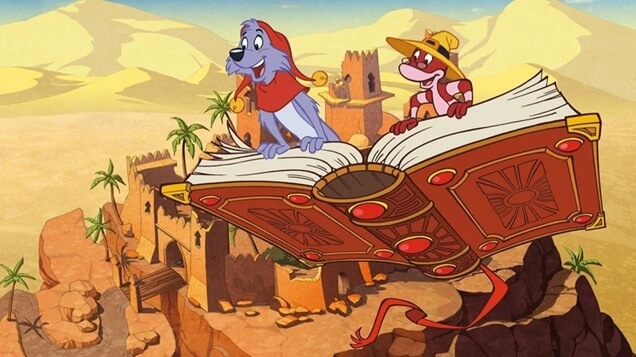
“Abra Kadabra Simsala Grimm” These are the words that many German children along with those Americans whose childhood period happened to be during near the end of the 90’s and early 2000’s. These words were present as part of the introduction to a series called “Simsala Grimm” whose purpose was to introduce children to classical fairy tales of the Grimm Brothers. The overall premise of the show was that two characters named Yoyo and Doc Croc would take on the role of the Grimm Brothers and through a magical flying book of fairy tales would travel to various stories contained in the book to help the main characters of the classic fairytales in achieving their happy endings. Both main characters embody a traditional dualism that is present in many classical stories whether modern or old, which is that of a brave thrill seeker and his rational minded partner. In a way it also could be said that they serve as an embodiment of the famous Harlequin and Pierrot duo from Italian comedy.
The role of the former is usually played by Yoyo since out of the two protagonists he is the most adventurous and active. He also gives himself away with his wardrobe for his hat is similar to that worn by jesters who in the medieval European tradition are a common embodiment of the Trickster archetype. According to his own words he is “the greatest adventurer since ever.” With such a boastful perception of himself, it is no wonder that such an attitude leads to trouble in certain situations. However, despite this negative trait in his heart Yoyo is a brave and kind soul whose main drive is helping others and bringing wrongs to right. It is mainly through his kindness and openness that both him and Doc gain the trust of the protagonists of the fairytales that they must lead to their proper conclusion. In comparison to him, Croc or Doc, as he more commonly calls himself, is more restrained and introverted in his behavior. While Yoyo plays the role of a Harlequin troublemaker Doc on the other hand is given by fate the role of the duo’s Pierrot. Like the aforementioned clown, he is quite melancholic and often plays the role of an advisor/giver of wisdom instead of taking direct action like Yoyo. At first glance it might seem that compared to his companion Doc is lacking in emotion due to his rational approach and unwillingness to act more directly when solving problems, in truth that is not really the case at all. Beneath the hard shell of a strict mentor and cold-minded intellectual hides an empathetic and caring soul. A good example of this can be found in the episode based on the tale Table Set Yourself where Doc stands up for the mother of three brothers (who are the main characters of the tale) and through a passionate Platonic speech convinces her husband to allow them to return home. Despite his positive traits there is one negative aspect in his character that often causes trouble for the duo and that is his cowardice. Compared to Yoyo who is naturally brave and runs into danger at full speed, Doc is more of a scaredy cat and prefers to hide or run away from foes (especially when he finds out that they are far stronger than them). However, all fear and paranoia disappear when either Yoyo or the protagonists that they befriend along the way are in danger. In such moments he is ready to restrain his personal demons and come to the rescue of those who he cares about. We see this quite well in the Rapunzel episode where Doc is the one to help save both Rapunzel and her prince by defeating the evil witch using her own spellbook against her. Although their personalities are radically different from each other both characters get along with each other quite well and in the world of today where individuality is praised over love, such a genuine relationship between two opposites is a pleasant sight for sore eyes.
In addition to the main cast consisting of our comedic archetypical duo, the series also includes recurring side characters as well, which mainly play the role of support or exposition in the settings to which Yoyo and Doc travel. The former role is traditionally played by a trio of mice, while the latter function is given to a trio of birds. Of the two side character groups in the series, the mice play a more direct role and serve as physical help, although in some cases like the Devil and Three Golden Hairs episode they play the role of a living information bureau which provides context about the main characters of the fairytale in which Doc and Yoyo find themselves in. The birds on the other hand are deliverers of exposition and buildup in the sense that they reveal crucial information about the fairytale itself or major events that take place. Since they are birds, naturally this takes place in song format. For those who grew up with or watched classic Disney movies, scenes with these characters might bring up a sense of pleasant nostalgia. Another role that is played by both groups of side characters in the series is that of comic relief. In order to ease the mood of certain episodes or to have a more lighthearted introduction to a certain plot point either the mice or the birds act out a funny miniature skit that for a moment makes the audience forget about seriousness and just lets them relax for a bit before moving forward with the plot. One of my favorites out these moments was from the episode Puss in Boots (which prior to changes made in later editions of the Grimms fairytale collection was part of it, along with certain other French tales) where during the scene when Puss is learning to walk in his new boots the birds mock him by singing that he would most likely end up as a pair of gloves and that his attempts to pass for a human are laughable and have little chance of success. Overall, both character groups are neatly integrated into their respective tales and fulfill their roles in the plot quite well, whether as open support, exposition or comic relief. This makes it stand a bit higher than most children’s shows today where side characters are either annoying or have no impact on the plot of an episode yet are still present due to the incompetent decision of the writer.
One of my personal favorite things about this show is that while presenting classical tales to the modern audiences and making changes for that purpose in the process, the writers nevertheless strive to preserve the essential symbolic meaning of the stories that they adapt. In my view this is very important for in today’s world many retellings of classics make changes to them with the purpose of removing details and elements that seem “inappropriate” or unfitting for the present day. A good example of this is the modern presentation of the Cinderella story. Everybody knows and recognizes the parts of the tale regarding the ball and the glass slippers, while the fate of the stepmother and the stepsisters (ending up disfigured as a result of self-mutilation and blinded by birds) are known by a rare few people who either read or heard the uncensored version. The main reason for this is that disfigurement and cruel punishments such as blinding or burning someone at the stake to break a spell are viewed as too violent for modern children and that violence itself is a subject that children should be shielded from at any cost. While on the one hand I can understand the place from which this sentiment is coming from, I still find the overall argument to be quite silly. Mainly because violence is something that children will have to confront in their lives soon or later (mostly during their teenage years and adulthood) so avoiding the subject altogether and keeping them sheltered from a crucial aspect of real life for a prolong period of their existence is not that of a practical or good solution. However, the issue that concerns me more is that the removal of violence from the tale causes it to become castrated in terms of its meaning and symbolic value. Despite what modern intellectuals and parents like to think violence in fairytales and other classic stories such as myths and legends was not included in them simply because “violence is cool” or violence for the sake of violence itself (a view usually held by idealists). In truth its purpose was to strengthen and, in some cases, assist in the delivery of the main idea/truth present within the story or overarching narrative. Unfortunately, this is ignored by many publication organizations and modern writers. Instead of keeping the violence what they end up doing instead is either removing it completely from the story leaving just the part with the “happy ending” or adding elements that while fitting narrative wise still make the story weak by making it lose connection with its initial meaning. Unlike most of their modern colleagues, the authors of Simsala Grimm had a different solution to this problem. In order to make the show acceptable for modern audiences and television companies with their restrictive PG ratings they decided to change some parts of the initial stories that had elements of violence or scenes that would seem questionable from a “civilized” perspective by replacing them with moments that while diverging a little from the original still carry the same symbolic message that it had within.
A good example of this can be found in the episode based on the tale Brother and Sister. The original tale tells us the story of a brother and sister who ran away from their evil stepmother (who was also a witch) and to break their cruel bond with her had to go through numerous trials and hardship some of which included being turned into a deer and coming back to life as a spirit as a result of foul murder. It ends with a “happily ever after” as most tales do, however, to achieve it the evil stepmother needed to be burned at the stake for only by destroying the source of evil can the hold that a curse has on an individual be broken. Such a mindset, while naturally understandable from the perspective of mythological thinking, the remnants of which were still present in Germany during the time of the Grimms, seems quite eccentric and unreasonable in a modern environment. In order to preserve the overall theme of the story, (which is that of escape from a devouring parental figure that prevents you from personal growth and entering adulthood) the writers of the show had to look for an alternative that would stay true to it, yet at the same time would be appropriate to show on television. The solution that they came up with was that instead of being burned at the stake the witch fell into her own trap by turning herself to stone with her own vile potion and becoming a statue in the royal garden. From my personal perspective this was not only a clever solution but a bit of an improvement of the original as well. One reason why I think so is because one of the traditionally recognized symbolic attributes of stone is stubbornness and resistance to change of any kind. This fits quite well with the role that the evil witch plays in the overarching narrative for the main driving force of her actions throughout the story is to prevent her stepchildren from achieving happiness away from her and to keep their souls in thrall forever. Like stone, she refused to let nature take its course and let her stepchildren go, which as a result led her to become a physical embodiment of her spiritual worldview/attitude towards life. This is much more fitting than just being burned alive to break a spell that she cast on the main characters. Another reason why I like this alternative is that being turned into stone has a long mythological connection with death and the Underworld. Being turned to a statue was associated with being forever trapped in a state of death both on a physical and spiritual level, for on one hand you cannot move your body while having a physical form and on the other your life essence loses connection with the source of existence. On a symbolic level this is quite a fitting punishment for a devouring mother archetype figure (which is a role embodies by the witch in the story), for this is the same state in which they keep the humans that live in their domains; exploiting and prioritizing the power of their body while at the same time keeping the soul ensnared in the dark. In my view, the writers did a fantastic job in terms of picking an ending that while being different still feels appropriate and fitting in terms of archetypical symbolism for the message that the original story had.
In addition to their approach in presenting the tales from the Grimms collection, I really like the fact that in addition to the well-known classics such as Little Briar Rose, Hansel and Gretel, Rapunzel, Cinderella and The Frog Prince they also include those that are less known to people who are not part of the German cultural mindset. Some of these tales are The Crystal Ball, The Goose Girl, The Six Swans, The Six Servants, The Lad Who Wanted to Learn Fear and Town Musicians of Bremen. One of my favorite episodes during childhood that was based on one of the lesser-known tales was the one about King Thrushbeard. The original tale was about a haughty and arrogant princess who refused to marry any suitor that attempted to ask for her hand in marriage. Among them was a king who due to his pointed chin got the nickname Thrushbeard. To the surprise of the princess and all the other suitors that were present, instead of being offended by her words he made a promise that she will be his wife. Naturally the princess laughed at his bold proclamation and did not give it much thought afterwards for in her view marriage to King Thrushbeard was an event similar to the well-known modern expression “When pigs fly.” Little did she realize how prophetic the words of this particular rejected suitor would end up being for her and what great changes would end up taking place inside of her soul as a result. Deeply upset by the behavior of his daughter, the king married her off to the first beggar that entered the palace gates, who turned out to be nothing more than a poor minstrel. Brought low from her life of luxury the princess had to adapt to life of simple women and bit by bit became humbler as time went on. One day, while working in the palace as a kitchen maid she stumbles upon King Thrushbeard who after having a dance with her (during which she spills leftovers that she gathered to bring home as food) reveals that the minstrel that she married was actually him all along and that her entire experience while being a poor woman was both his punishment and test from him so she could realize the error of her haughty ways. Personally, the main reason why I love this tale so much is that it contains within itself a truth that many modern feminists don’t seem to understand or want to learn. What it teaches us is that making your “personality” the core foundation of your existence or worldview especially if it involves looking down upon others is not a good idea and that a healthy alternative to such behavior is an environment where you can experience what it is like to be in another person’s shoes and grow as a person yourself. In the series this was portrayed quite well during a scene where the princess learned how to make pots out of clay. During the process she learned to love her work and began to understand that pleasure can come from not just from self-love but devoting yourself to a task with a purpose. I also really liked how in the episode even Doc and Yoyo ended up being transformed through their experience with the princess. At first, they feel a strong distaste for her because during her haughty stage she is rude to everyone including them. However, as time goes on, they begin to warm up to her and openly help her in times of need. Honestly, it’s a shame that tales such as this are not that popular in mainstream media and I am very grateful to the creators that gave modern children a chance to experience them and learn about their existence. This also reveals a lot about the taste of modern audiences, for instead of preferring stories that are good not only from the perspective of form but in terms of content as well, people favor those that are “popular” or embody progressive values such as political correctness, tolerance, inclusivity, social justice, and equality.
Simsala Grimm is a fun and enjoyable cartoon series that introduces children to fairy tales and the numerous wonders that are hidden inside them. Through their talent in the sphere of adaptation, the writers masterfully preserve the essence of the original tales while at the same time making them more presentable for modern audiences. In addition to that it also popularizes stories that have little or no recognition in comparison to their well-known counterparts whose status in terms of culture is akin to that of Hollywood stars. If you are a parent and are in search of modern media content through which you can not only entertain your child but also teach him about the important values that make humanity human, then this is the show for you.


Related Posts