The Art of Praise in Kierkegaard
The world today (and perhaps the academic world especially) is popularly considered to have a very strong negativity bias. Bad news sells, or at least draws clicks. Bad reviews are easier to find than good ones. I’ve read explanations of this, ranging from post-modernism and its accompanying ironies, deconstruction of all stripes, loss of societal trust, and so on. A current theory I have is that many of these explanations contain some part of the truth, held together by another fact: negative criticism is just more fun.
There is a certain pleasure in lambasting, in pulling apart, in pointing out the cracks at the heart of an idea, a philosophy, or a work. If you can get a cohort around you to point fingers with, so much the better. It’s quite easy to draw a crowd around you into a tight knit group formed against something than it is in forming one for something. Scholarly crowds and fandoms alike are typically known, not so much for their tight-knit appreciation of the thing so much as their antagonism toward fellow scholars or fans who do not engage with that thing in the “correct” way.
Criticism in art, literature, and philosophy seems to have followed this trend toward negativity, so much so that critics are often viewed as impossible to please snobs who will pick apart anything and everything about a book, painting, album, or poem. I think this is a deeply incorrect and unfair assessment of a critic’s role, although perhaps not completely unearned.
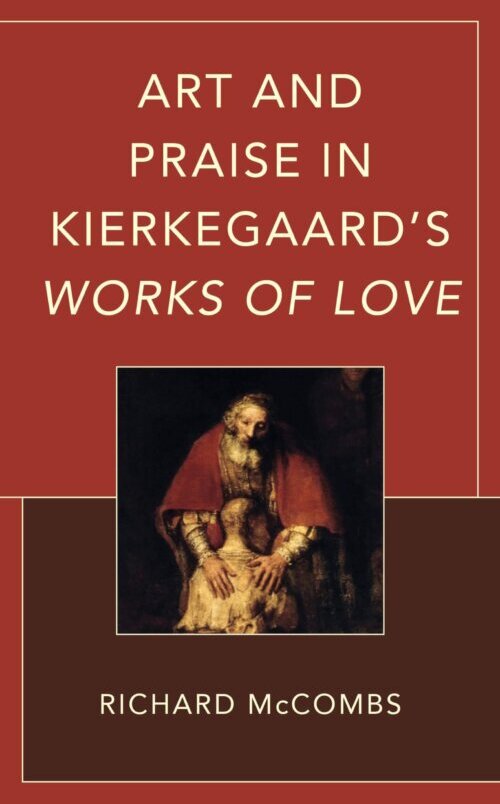
For these reasons, I found it particularly refreshing to find a piece of criticism that unironically and unabashedly praises the works of Soren Kierkegaard, who was himself wholeheartedly praising the concepts of faith and love. The book in question is Art and Praise in Kierkegaard’s Works of Love.
Both Richard McCombs and his subject, Soren Kierkegaard, were aware of the difficulties of praise. Unreserved or unearned praise of an object can come across as saccharine or naive. Praise of the Virtues like Love and Faith could result in them seeming like heavy duties or even impossible ideals. Both possibilities would drive a reader away from emulating them. McCombs recognizes the art which Kierkegaard employed in making arguments for these ideals.
In Chapter 1, McCombs points out that Kierkegaard clearly understands that Faith is a great virtue, and that it requires an enormous cost to the one who would acquire it. This cost, this difficulty and striving, would put off a reader from the pursuit if it was plainly stated, even if the praise of the virtue were persuasive. So he creates a pseudonymous character, Silentio, to praise faith while not having it himself. He lists all kinds of reasons why he does not have faith, many of which can be sympathetic to any reader, and thus leaves the reader open to hearing the praise of this impossible virtue and gaining the desire to have it, even at great cost.
Chapters 2 through 6, which make up the remainder of the book, focus more on the virtue of Love, and Kierkegaard’s book on it Works of Love. Throughout these chapters, McCombs notes that Kierkegaard highlights the importance of not only giving love, but how love is given. And really, this is where the Art in Art and Praise comes in. For McCombs points out that Kierkegaard not only praises the act of Christian Love, but points out the artistic ways in which it must be carried out.
Christian Love carries with it dangers of being extended incorrectly, leading its recipient either in unhealthy dependence upon it, or being driven away by too much earnestness. The ways in which these difficulties manifest differ depending upon the circumstance. And McCombs devotes a chapter each to the upbuilding nature of Love, and the reconciling nature of Love. In each, the goals of Love, their pitfalls, and the art which may avoid the pitfalls are all examined.
In this section, I appreciated that McCombs did not merely explain what Kierkegaard was writing or doing. While Chapter 1 was a fairly straightforward explanation of Kirkegaard’s famously difficult text that is Fear and Trembling, Works of Love is a little easier and maybe doesn’t require so much retelling. So instead of needless rewordings, McCombs turned to literature to find examples of the virtues that Kierkegaard is putting forth. He draws characters from George Eliot’s Middlemarch, and Fyodor Dostoevsky’s The Brothers Karamazov to illustrate the concepts being discussed.
In using this tactic, McCombs was able to shine a light on how philosophy and fictional literature work together in order to teach. By creating flawed protagonists that a reader can identify with, or a likable protagonist that a reader wishes to emulate, a writer can bypass automatic walls readers put up against didacticism. Kierkegaard did this with his pseudo-narrator Silentio in Fear and Trembling, and McCombs provides Dorothea Casaubon from Middlemarch and Alyosha Karamazov from The Brothers Karamazov to do the same for Works of Love.
By taking these three writers and their works, placing them together and bringing them into conversation with one another, McCombs was able to open up each of them a little further, helping to give this reader an even greater appreciation for all three of them. As well, he was able to challenge this reader to seek out further examples of how to engage in the art of loving the people in my life well so that I may do even better than I have done in the past.
Art and Praise in Kierkegaard’s Works of Love
By Richard McCombs
Lanham, MD: Lexington Press, 2023; 194pp


Related Posts