The Barbarism of Reflection
It is the nature of all developmental accounts that there will be fewer at the high end than at the base; in the case of morality, more sinners than saints. Given that fact, a belief in a moralizing punitive God could be expected to have a beneficial effect on many people’s behavior, providing, as it does, a panopticon for the soul.
According to studies involving getting people from various cultural backgrounds to play an economics game with opportunities to cheat one’s opponents, hunter-gatherers cheat without a conscience if they are playing against someone they do not know, while those people who believe in a moralizing God were much more honest with regard to strangers. We have evolved to play relatively nicely with family members and people we know well. Beyond about 150 people, known as the Dunbar number, explicit rules become necessary. Larger communities have a military advantage – big armies generally beat small ones – so human beings had to make an adjustment to living around people whose names one might not even know. Belief in a moralizing God who judges you and keeps an eye on your behavior is helpful in that context, and most larger societies have developed such a belief.
In Lawrence Kohlberg’s terminology, this moralizing God is applicable to those who are at the lowest, pre-conventional level of moral development. Such people are more or less amoral. They refrain from acting badly only out of a fear of punishment, not because they have a conscience per se. Morally, the reason why someone does or does not do something is crucial.
The intermediate level of moral development, the conventional level, is one where one knows and follows the moral rules. One asks oneself, “What would people think if they knew what I was planning to do?” This is not out of a fear of reputational damage, which would just be fear of punishment again, but as a guide to action. Do what other people think is right.
Such people are not philosophers, and they cannot tell you why the rules are as they are. This level is still pre-rational in its thinking. Doing what the group would want you to do is agreeable and prosocial but not rational per se. There is always the possibility that one’s group is wrong. And then there is the fallacy of popularity. The mere fact that a belief is common does not make it right.
Finally, the post-conventional person has a good idea of the spirit of the law and not merely the letter. He can hope to adjudicate between moral rules if they clash, and he should be able to articulate reasons, when asked, for his complicated moral judgments.
However, the implication that the post-conventional person is the ideal might be wrong. Robert Sapolsky’s book Behave, for instance, notes that people who act in the most heroic fashion – jumping into roiling waters to save people or hiding people from their persecutors – all say that they did so without thinking. They commonly say things like, “I just did what anyone would do.” Except, that is not true at all. An instinctive urge to help can be thwarted by reflection.
More importantly, since few people are moral heroes, there is the issue that asking very averagely intelligent people to provide reasons to explain why murder, rape, and fraud, etc., are wrong – to give reasons – could be counterproductive. If they are unable to do so, which is reasonably likely, this could throw such people into moral confusion and skepticism. And, if the rule is supposed to be, “He who has the better reasons wins,” then “the regular guy” would become vulnerable to the sophistry of people like ethics professors and other potentially manipulative shysters. The Trolley Problem definitely has this morally nihilistic tendency. Most people have conflicting intuitions: saying “yes” to pulling the lever to move a trolley onto another line of tracks to kill one person rather than five, but “no” to pushing a fat man off a bridge to stop such a trolley. People can see that either way, they are killing someone and that the two scenarios are morally and logically equivalent, and yet they also experience contrary moral intuitions concerning what to do. The truth is that one should not push the fat man, and one should not pull the lever, but it takes a lot of insight to see why, and that is beyond probably 99% of people. This makes the Trolley Problem almost uniquely diabolical in its ability to confuse people morally . But, finding oneself confused by this very artificial scenario that also presumes omniscience concerning the effects of one’s actions and thus looking askance at one’s own moral intuitions is like being shown a deliberate optical illusion and then choosing never to trust one’s eyes again.
Drawing on the account in Neema Parvini’s The Prophets of Doom, Giambattista Vico (1668-1744) provides grounds for thinking that the post-conventional person marks the beginning of the end for morality in general. This fact relates to what Vico called the “barbarism of reflection.” He identifies, in The New Science, three ages of man. The Age of Gods, the Age of Heroes, and the Age of Men. The Age of Gods is the one that occurs immediately after barbarians have begun to self-civilize. It involves the rise of burial rites, marriage rituals, and religion. The Age of Heroes is the brutal life depicted in Homer’s Iliad. A warrior ethic of strength and courage, with an emphasis on the avoidance of hubris. The Age of Men is philosophical, scientific, rationalistic, and thus skeptical. It is also soft and sentimental, looking with kindness on women and children. The philosopher, who emerges at this point, questions all beliefs and all institutions, looking for rational justifications for them, in the manner of Socrates, when the truth is that faith in God, not rationality, underlies all moral value. And working institutions are the product of trial and error, also known as tradition, not rationalism.
When it comes to economics, the monetary value of something is determined by supply and demand. One’s house, for instance, is worth whatever someone will pay for it, not how much it costs to build or any other factor. As Hayek pointed out, this crucial information is lost in top-down command economies, where no one knows the value of anything since that information is only made available by putting something up for sale. No individual or even group of people can determine value without running the experiment.
Competition in the marketplace is also an experiment with no known outcome. A product might be good, but an only slightly better product might get the whole of the market in the manner of the Pareto distribution. A ten percent advantage in quality can mean a one hundred percent greater market share.
Common law in England, too, avoids requiring legislators to anticipate issues and conflicts in advance in a rationalistic manner. Instead, common law developed out of actual disagreements adjudicated by a magistrate or judge, which set a precedent for later decisions. This process was relatively organic and did not require an omniscient legislator.
Vico was worried about Enlightenment rationalism because he saw the rational as only a very small part of the human soul – which it is. Poetry, literature, and religion tap into, speak to, and recognize some of the other aspects of man. Scientism is scientific triumphalism, claiming that science is the only valid source of knowledge and treating it with pseudo-religious reverence. Vico worried that applying it to human affairs would have a dehumanizing effect. He was right. To accommodate the rest of the human soul, Vico wanted to include “rumor, myth, fables, traveler’s tales, romances, poetry, and idle speculation” as possible sources of knowledge and insight. (Parvini, p. 26) For human affairs to go as well as possible, one needs a sensitive and intuitive sense of how actual people think, feel, and behave: what motivates them. This sense cannot be formalized and turned into an algorithm. Those who claim to rely exclusively on science cannot be trusted. Only a tiny part of the joys, sorrows, problems, hopes, and dreams of man have anything to do with measurement. Sciences like evolutionary psychology can sometimes provide insight but they should never be adopted as one’s singular point of view. We need myths, folk stories, poetry, religion, non-rational to get a better perspective and understanding.
The singing, worshipping, praying, and rituals associated with religion were discovered through trial and error, not science. They foster community but also nourish the non-rational aspects of our soul. Multiple cultures have discovered the same solutions. Things that worked were kept. Things that did not were dropped. God save us from those impressed by their own intellect and moral superiority. Tradition is empirical and small-scale experimental. It is consistent with a tragic conception of man: sinful and fallen, self-centered and not perfectible. Attempts to perfect society all fail because of the fallibility of man.
Thomas Sowell captures the hubris of the academic in The Vision of the Anointed. Professors, the “anointed,” are anti-religious, he thinks, partly because priests and the Church potentially offer a countervailing source of authority to them – although, currently, too many of them are disappointingly aligned. In another book, The Quest for Cosmic Justice, Sowell addresses another hubristic phenomenon beloved by progressive professors; “social” justice as cosmic justice. He argues that there is no such thing. Life is not fair and cannot be made fair. Human processes, like the justice system, can be fairer or less fair, but life outcomes, in general, are too dependent on things outside anyone’s control. 0.8 of intelligence is inherited, 0.5 for personality. It is not fair that the first thing one should do if one wants to be intelligent or pro-social is to choose the right parents. It is not even a question of what parents do and do not do. Parents have minimal influence on the personality and intelligence of their children except negatively if parents engage in truly harmful pathological behaviors. It is not fair that some people have drug addicts and the mentally ill as parents, and it is even less fair that these qualities can be passed down to their children. A sperm bank is being sued because a sperm donor claimed to have an IQ of 160 and to be pursuing a PhD. Neither was true. He even had a burglary conviction. “He also had been hospitalized for mental health treatment and had been diagnosed with psychotic schizophrenia, narcissistic personality disorder and significant grandiose delusions.” The child “conceived with the donor’s sperm, has a blood disorder inherited from the father. He also has suicidal and homicidal ideations, and takes anti-psychotic medications.” It is estimated that burglars commit, on average, between 50 and 60 burglaries before they are caught. So, the donor’s conviction will not result from a single bad decision – and what an odd bad decision it would be! Criminality and poor mental health are inheritable, and the child’s problems are consistent with that.
In the Age of Men, even when people recognize the benefits of theism and even its absolute necessity, rationalistic skepticism, faith in one’s intellect and the resulting hubris and cynicism become so prevalent that it is simply impossible to return to a healthy state. Intelligence can suppress instinctual theism; it is certainly useful in impulse control. Someone like Scott Adams recognizes that religious faith is a winning mode of existence but is incapable of it. Evolutionary psychology sees this as a mutational load – bad genes – since religiosity is immensely inheritable and is associated with mental and physical health. The people who once would have died as babies or young children have been saved by modern medicine, and they go on to have children, leading to dysgenic consequences. The only solution Vico identifies is societal collapse, leading to barbarism and then to the Age of Gods, and the cycle starts again.
Vico sees Plato and Socrates as spelling the end of Greek culture – subjecting all virtues and institutions to critique, which they cannot withstand. The barbarism of reflection regards a failure to rationally justify something as grounds for rejecting it. Conversely, Vico regards Homer as providing the real spirit of classical Greece. Homer’s stories speak to us emotionally – emotions provide behavioral impetus and provide narratives and role models. While Socrates claimed that he was merely trying to put people in a position to learn by demonstrating their ignorance – one who thinks he already knows cannot learn – asking for an explicit definition of virtues like courage and justice, with no answer in sight, can only lead to nihilism. At the heart of the love of family and flag is faith. These things do not begin with moral or epistemic evaluations.
Vico saw The Age of Men as leading to an obsession with freedom and equality, as opposed to the limitations imposed by non-rational tradition and authority, until all human institutions are dissolved, including church and family, since unchosen bonds restrict freedom in one way or another. Thence, the return to barbarism. Some modern books point out that liberalism has led to this dissolution and that the result is inherent in the logic of liberalism. Vico’s cyclical view of history sees liberalism as pathological, but also inevitable. “Liberalism” is just the name for this stage in civilizational decline.

With a faith only in their reason, morality and religion come to seem antiquated. Why should socially approved conduct and morality be followed? Without religion and morality, individualism predominates, and man becomes a beast looking to his main advantage, ready to betray friends and family. Vico argues that the very moment that reason would seem in a position to dream up the perfect society, instead, society dissolves, cities become forests, and forests become the lairs of man the wolf. If one has an urge, why not satisfy it? Who are other people to object? On what logical basis? In modern times, those who wish to uphold the old values can be accused of hate speech and prosecuted. It becomes illegal to be conservative. In fact, having the category “conservative” at all signals the beginning of the end. Hunter-gatherers have no such concept. They do what has worked for them in the past. Being an oral culture, they work to retain any wisdom their elders have accumulated. “Conservatism” implies its opposite – progressives advocating for and substantially altering social structures and ideals, and we have seen where this leads.
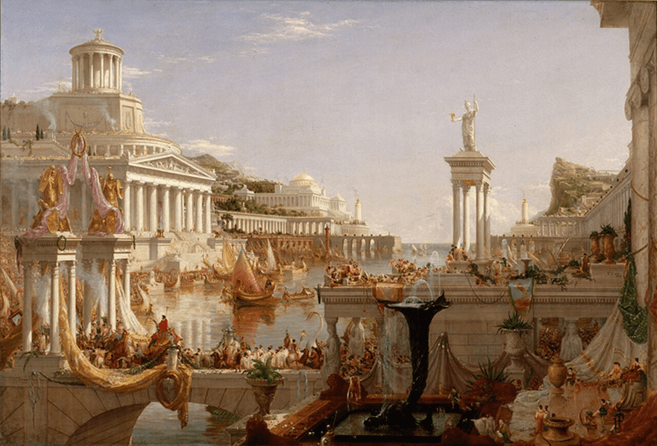
Vico himself was not reactionary. He obviously belongs to the philosopher class. He liked the softness and kindness to women and children of the Age of Men and the free speech that emerged. Theologians, as opposed to religious philosophers, must take the basic tenets of their faith as fixed, maybe especially within Catholicism. Someone like Jacques Maritain is somewhat boring for this reason. His conclusions have been predetermined. He is not merely following where reason, inner illumination, or intuition takes him. Berdyaev, on the other hand, is obsessed with freedom. He could be described as a mystic of intuition. Any two pages of Berdyaev can serve as the basis for eight pages of reflection and explication. He does not so much argue as present his ideas for the reader’s contemplation and he does not really care if he is agreed with or not. In fact, like Nietzsche, the concept of a follower was probably anathema to him. Berdyaev writes, “Theology has always been an expression of religious immaturity, authoritarianism, and external transcendence in the religious consciousness.” (p. 181, The Brightest Lights of the Silver Age) All philosophy is always anthropological – a revelation of wisdom in and through man. “A philosopher is always a heretic in the literal sense of the word, i.e., one who chooses freely.” (p. 178) Perhaps one could say that a pro-social, agreeable, philosopher is an oxymoron. One may agree with received truths, but one always retains the prerogative of rejecting them, too. If one wishes to preserve orthodoxy, ban the philosophers.
Some militant atheists like to point out that the historical course of development has been to go from believing in many gods to believing in just one: one divine light shining through all creation rather than each plant, stone, mountain and curve in the river having its own god. The atheist, he says, has just taken this process one step further and believes in no god. This is supposed to be a criticism of theism; instead, it could be thought of as part of the barbarism of reflection, a cancer of the intellect.
Eastern philosophy, seen from the outside, idealistically, would seem to mitigate and even prevent The Age of Men. Lao Tsu’s The Tao de Ching is poetic – reveling in paradox and crying out for interpretation. It is not at all rationalistic – but gnomic, intentionally puzzling, and thus, reflective. Confucianism, too, is about pursuing the middle way – heaven’s path – between yin and yang, male and female, order and chaos. Current Western culture, with its safetyism, including being protected from disconcerting ideas and opinions, is clearly a metastasis of the feminine impulse. So is cancel culture. Women are unlikely to confront someone directly in a physical altercation. Instead, they ostracize and character assassinate. Being generally smaller and weaker, they are passive-aggressive, aiming for plausible deniability. Anonymous online trolls hide in a similar manner. And then there is the obsession with the “oppressed” and the lost lamb – even extending to violent criminals. This is not the middle way but one-sided madness.
But, somehow, the Chinese, Vietnamese, Cambodians, and Koreans were just as susceptible to rationalistic dreams as the West, as seen by the rise of Mao Zedong, Pol Pot, and all the rest. Their elites, at least, were as much suckers for the evil fantasies of Marx as anyone.
There is a lot of discussion at the moment concerning intelligence and health in the context of embryo selection. If the barbarism of reflection is correct, increasing intelligence, coupled with lots of thinking, will just hasten the decline of any society. If intelligence were an unalloyed good, then natural selection would keep going in the direction of ever-increasing IQ, but it does not. Smart people, being highly environmentally sensitive, are particularly susceptible to social contagion and self-brainwashing in the interests of social promotion – also known as “knowing on which side one’s bread is buttered.” Scott Adams says things like, “Given DEI, applicants to colleges would be a fool to admit that they are white.” Clearly, Adams has no problem at all with lying. In fact, around 36% of white male applicants claim to be some other race, Native American being a favorite, so he is not alone. We have reason to think that the ability to argue has developed not so much in discovering the truth but in convincing other people. If someone agrees with us, there is no need for argument. Smart people are especially good at justifying opinions that are often just gut feelings or preferences – political beliefs and tendencies being more genetic than environmental. The dumber working-class person is less alert to where politically correct winds are blowing and, thus, is less likely to conform to crazy ideas promoted by the chattering classes.
Finally, it is well-established that the more educated a woman is, the more infertile she becomes. Thus, education and fertility are inversely correlated. Education, as part of the barbarism of reflection, thus becomes pathological for the species – at least for its more intelligent members. The less smart and reflective will carry on having unprotected sex and procreate away. Intelligent people can suppress their natural impulses better and thus their instinctive belief in God and the instinct to procreate. Both factors bring civilization to an end and presage the return to barbarism.


Related Posts