The Bullet Tree of Life: “Angel Down” and the Condition for Salvation
I have a low tolerance for despair in literature, and as a result, I cannot stomach much contemporary literary fiction. At the same time, I do not blame modern literary authors for their pessimistic outlook. With the endless flood of bad news gushing out of the tiny supercomputers in our pockets, the future looks grim to almost everyone, regardless of religious background or political persuasion. You cannot throw a rock online without hitting someone’s apocalyptic prognosis. Woe is me, everyone wants to say, the end is nigh!
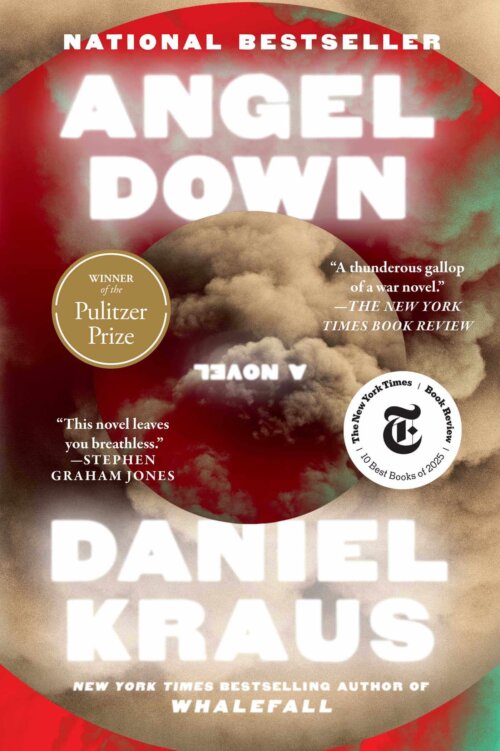
But despite my wariness of modern literary fiction, I recently took a chance on Daniel Kraus’s Angel Down, which won the 2026 Pulitzer Prize for fiction. Even though Angel Down is a World War I historical novel (and we all know how pessimistic those can be), I held out hope that the book would avoid the classic pitfalls of war fiction and offer a fresh perspective.
Much to my delight, the novel does not cater to naïve optimism, but neither does it cave to despair. This book takes the pessimism of the post-war world, acknowledges it, pulls no punches in exploring the terrifying postwar future—and then offers a glimpse of light in that darkness. Far from collapsing into nihilism, Angel Down contains the exact message of hope that the world needs at this cultural moment.
A Sentence that Never Ends
Written in a single breathless sentence, Angel Down tells the story of Private Cyril Bagger, a conman who serves in the US 43rd Division in 1918 during the Meuse-Argonne Offensive. In the novel’s opening lines, Bagger has just miraculously survived a bombing:
and Cyril Bagger considers himself lucky, he ought to be topped off, gone west, bumped, clicked it, pushing daisies, a new landowner, napooed, just plain dead, not only dead but scattered around in globs, for the last thing he saw was a shell dropping on top of him with the noise of colliding freight trains…
This opening sets up a central theme: the fragility of human life in the context of the unimaginable destructive power of the war machines developed in the 20th century. But it also sets the stage for Kraus’s interest in miracles and the ambiguity of the supernatural. Is it divine intervention that saves Bagger? Or just plain luck, as he seems to think?
On the way back to his company after narrowly avoiding this tragic end, Bagger hears a horrible shriek in the distance: the cry of a wounded soldier. Bagger’s commanding officer gathers him together with the four other most expendable soldiers in the 43rd Division and orders this ragtag team to find and euthanize the wounded soldier.
Bagger and the other four soldiers play rock-paper-scissors to decide who will leave the trenches and crawl into artillery fire in an almost certainly futile effort to find the wounded soldier. As a practiced conman who has swindled practically all his fellow soldiers at one time or another, Bagger wins handily—but unfortunately, the loser is a fourteen-year-old orphan named Lewis Arno who lied about his age in order to join the army. Bagger harbors a secret soft spot for Arno, a paternal protectiveness that he tries to cover up with gruffness and insults. So when Arno heads into the peril of the battlefield to find the wounded soldier, Bagger reluctantly follows him.
But as it turns out, the wounded soldier is not a soldier at all. She is an angel who was struck down by artillery fire and caught in barbed wire. Together, Bagger and Arno free the angel and carry her back to the other soldiers. When they discover the angel’s supernatural ability to grant wishes, the men devolve into heated argument over who will get to use her power to achieve wealth, fame, authority, even revenge. The conflict bubbles over into violence, and one of the soldiers kills young Arno and steals the angel. Bagger manages to save the angel from her kidnapper, and as a reward, the angel offers to grant whatever wish he desires. He wishes for her to bring Lewis Arno back to life, but the angel tells him that she will only grant this wish if he promises to obey a condition: he must never again take another human life. If he does, a terrible fate will befall humanity.
But Bagger fails. At the novel’s climax, he kills a man who is trying to murder Arno, thereby saving the boy’s life but simultaneously reneging on his promise to the angel. In response, the angel reveals the future that will unfold now that Bagger has broken the one rule he swore to keep. She shows him that the Great War is not the war to end all wars, but the war to begin all wars. World War II is still to come, and countless other bloody conflicts will follow, made far more horrifying by the development of new weapons of mass destruction. The sophistication of weaponry and man’s capacity for bloodshed and cruelty will grow and grow until they swallow the world whole. Indeed, the form of the novel itself reinforces this cycle of violence:
just like the war won’t ever end, like the carnage won’t ever end, it’s a sentence in a book careening without periods, gasping with too many commas, a sentence that, once begun, can’t ever be stopped, a sentence doomed to loop back on itself to form a terrible black wheel that, sooner or later, will drag each and every person to their grave…
The novel’s last lines keep this promise of an endless cycle. In the final pages, Bagger huddles with Arno in a crater, waiting to see whether a bomb will drop and kill them both. But when the bomb does not fall, the novel ends with the words, “and Cyril Bagger considers himself lucky,” an exact repetition of the opening line. We have looped back to the beginning. The wheel turns around and around until it “drag[s] each and every person to their grave.”
The Condition for Salvation
But this dismal future was never inevitable. If Cyril Bagger could have only fulfilled the angel’s simple condition, if he could have refrained from taking any more human lives, the world would have been saved. At first glance, this bargain might seem absurd. Why should the salvation of the world hang upon the actions of Cyril Bagger, the most expendable soldier in the 43rd Division? And yet in the context of this novel, which reads much like a modern fable or fairy tale, the logic of this bargain rings true. As G.K. Chesterton notes, fairyland is replete with stories of unimportant people whose seemingly inconsequential choices will nevertheless determine the fate of the world:
If you really read the fairy-tales, you will observe that one idea runs from one end of them to the other—the idea that peace and happiness can only exist on some condition. This idea, which is the core of ethics, is the core of the nursery-tales….A promise is broken to a yellow dwarf, and the whole world goes wrong. A girl may be the bride of the God of Love himself if she never tries to see him; she sees him, and he vanishes away. A girl is given a box on condition she does not open it; she opens it, and all the evils of this world rush out at her. A man and woman are put in a garden on condition that they do not eat one fruit: they eat it, and lose their joy in all the fruits of the earth. This great idea, then, is the backbone of all folk-lore—the idea that all happiness hangs on one thin veto; all positive joy depends on one negative.
In fairyland, the salvation of the world depends on one person keeping the law perfectly. Put another way, if one righteous person could be found, that one person’s righteousness would prove sufficient for all mankind. There is hope right down to the last man with the power to accept the bargain—even if that last man is a selfish conman in the trenches of World War I.
But Bagger fails to uphold his side of the deal. He fails not because of his flaws, but because of the only part of him that remains uncorrupted: the part that loves Lewis Arno. Bagger is a self-serving, conniving man who has all but abandoned his moral compass, and yet he accidentally comes to serve as a reluctant father figure to this fourteen-year-old orphan. Arno has absolutely no practical benefit to offer Bagger, not even a penny to swindle away. Far from profiting, Bagger sacrifices his evenings to read cheap novels out loud to an illiterate orphan. Despite all this, Bagger develops an unlikely, selfless love for this boy who, in a different life, might have been his son.
This love is what complicates Bagger’s failure to keep the angel’s condition for salvation. In order to save the world, Bagger must sacrifice his surrogate son, the last person on earth whom he loves. But it is this love, the most pure and human part of Bagger, that makes the condition impossible to keep. When Bagger faces the choice either to save Arno’s life by killing his attacker or to let Arno die and thereby save the world, he cannot both fulfill the condition for salvation and also preserve his own conscience. Bagger does not fail because he is selfish, but because he is not yet wholly corrupt. Love compels him to recognize that if saving the world requires the sacrifice of one child, it is better to let the whole world perish than to carry out that sacrifice.
The angel’s demand—that Bagger never take another human life—is reasonable because every human life is precious. At its heart, the condition is a restatement of the sixth commandment: Thou shalt not kill. The sixth commandment is a negative imperative, yes, but it is fueled by a positive imperative to love. Every living being deserves your love, and one ought not kill those whom one loves. Therefore, thou shalt not kill. But in order to follow this law, Bagger must break it. No matter what he chooses, someone will die. Bagger literally cannot fulfill the law.
But such are the ethics of fairyland. There exists a condition that, if kept perfectly, would save the world, and yet Bagger cannot keep that condition without betraying both his conscience and the spirit of the condition itself. If Angel Down ended at the moment in which Bagger kills Arno’s attacker, we might interpret the moral message of novel in this way: The condition for salvation is impossible to keep, and so the best that anyone can do is to love his neighbor in the midst of a world that moves closer every day to its inevitable destruction.
The Bullet Tree of Life
Fortunately, the novel does not end there. Out of love, Bagger refuses to sacrifice Arno to save the world. But soon after, Bagger demonstrates his willingness to sacrifice himself. He confronts the angel, offering to die to balance the scales by trading his life for the life he took. He even goes so far as to aim the gun at his own head and pull the trigger.
The angel does not allow the suicide. She stops the bullet midair. One might expect the angel to be displeased by Bagger’s attempted self-sacrifice—after all, it is technically a violation of the terms of the deal. But instead of rebuking Bagger, the angel takes the bullet and treats it reverently, as if it were something precious. Why? Because Bagger is willing to die. Bagger is ready to offer his own life to save Arno and the rest of the world, which upholds the spirit of the very law he broke: the law of love.
What follows is the novel’s strangest and most esoteric scene. The angel takes the bullet that almost killed Bagger and buries it like a seed in the battlefield. The bullet seed grows not into deadly weaponry, as we might imagine, but into a tree. Life proceeds from the bullet built to kill because this particular bullet is a symbol of one man’s willingness to serve as ransom for the whole world.
The image of the tree might well remind us of the Tree of Life in the Garden of Eden. Indeed, the parallels are striking. Exiled from the garden, man cannot return to the Tree of Life. Our exile drags on not because God desires our destruction, but because we are incapable of keeping the law that would save us, just as Bagger is incapable of keeping the angel’s condition for salvation. Before we can access the Tree of Life, something—or someone—needs to show us the way back. Someone must unlock the garden gate.
Similarly, the tree that grows from the bullet represents not salvation, but the possibility of salvation. When Bagger fails to uphold his bargain with the angel, the garden is sealed off, the world damned to destruction. But in offering his own life to balance the scales, Bagger reestablishes the hope of salvation. The law is still broken, and Bagger cannot unbreak it. He is not righteous enough to serve as a sufficient sacrifice, which is why his death would not undo the damage wrought by the Great War. But even if the depth of his love and his willingness to die cannot save humanity, they nevertheless plant a Tree of Life in the heart of a terrible and violent world. Bagger cannot open the path back to the tree. He cannot lead mankind back to the garden. The only thing he can do is to keep a flame of hope alive. As long as the Tree of Life waits in the garden, humanity could return to it. The world could still be saved.
Daniel Kraus is not religious. In spite of its imagery and themes, Angel Down is not a religious book. But like many of its postmodern literary predecessors, it takes the reader as far as it can down the path of salvation before arriving at the roadblock of secularism. We might well be reminded of the haunting lines at the end of Samuel Beckett’s Waiting for Godot:
Estragon. I can’t go on like this.
Vladimir. We’ll hang ourselves tomorrow. (Pause.) Unless Godot comes.
Estragon. And if he comes?
Vladimir. We’ll be saved.
Beckett means, of course, that humanity clings to the futile hope of salvation until the very last moment. If Godot comes, we will be saved. But he will not come, Beckett says. The hope endures, dangling like the fruit in front of Tantalus, yet when we reach out to grasp it, it slips away again.
One might argue that Daniel Kraus meant to communicate something similar, and that might very well be true. But regardless of what he intended, the novel itself ends ambiguously. The tree of life is still out there somewhere. The gate to the garden is shut, not destroyed. So what if someone should come who, unlike Cyril Bagger, keeps the angel’s law? Who loves all mankind, not just Lewis Arno, as sons and daughters? Who dies for the sake of the world without ever taking a human life? What then?
Then we would consider ourselves lucky.


Related Posts