Secularity as a Canvas for Personhood: Reflections on David Walsh’s “The Invisible Source of Authority, God in a Secular Age”
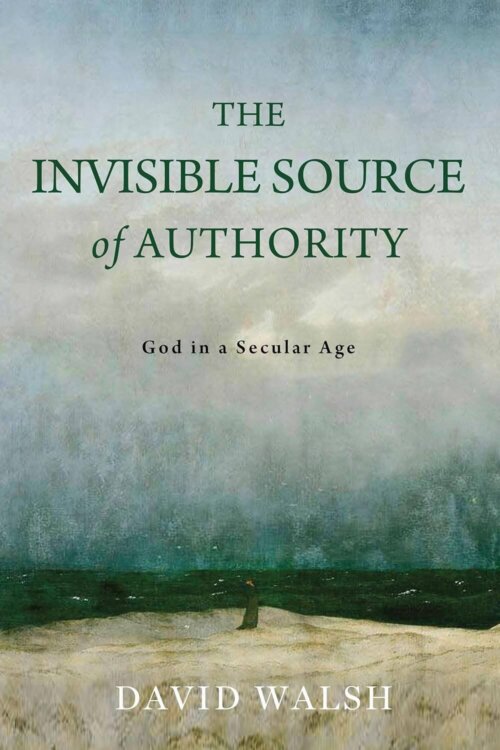
With his most recent masterpiece, The Invisible Source of Authority: God in a Secular Age (2025), Professor David Walsh has truly reached a summit in his luminous illustration of personhood as a transcendent mystery. To set the stage for diving more deeply into this text I have chosen to refer back to his Politics of the Person as the Politics of Being (2016), to provide the example of art as an analogy. Walsh captures in this earlier text how only a person is able of comprehending what art is and what art means, as without a person, a work of art would merely be colors and shapes on a canvas. Analogously, Walsh applies the same relationship of the sacred to the secular in The Invisible Source of Authority as he does of an artist to a canvas. God, or the sacred, is like the artist, he is needed for the secular to be understood and realized. As the artistic canvas is in need of an artist to bring it to creative life, so the secular needs the sacred, even if the former does not know the latter, the latter always remains present.
Walsh argues that art is the best example of this reality of personhood, as it proceeds from the horizon of the idea that takes hold of the artist, as if from a horizon.[1] Art is what transcends analysis, and only a human person is capable of reading into the subtle nuances of art, or the subtle nuances of inter-personal relationship and dialogue that disclose the deeper reality of something the other is trying to convey in words, but at the same time the words are alluding them. Walsh notes that art is the mutual permeability of the material and the spiritual, which is essential for grasping the metaphysical truth of personhood, as existence in a material universe is deepened through the integration that art brings. Walsh values art so highly because it helps us realize that we live in a world not of fixed quantifiable objects, but of the fluidity for the disclosure of mysteries to the human person found within it, which is central to his project.
With this understanding, Walsh is able to observe that poetry, for example, can therefore often say more than physics about the universe in which we find ourselves, as poetry, as an art, is able to access the inaccessible because it operates within the personal horizon. Art, for Walsh, addresses each person in his or her utterly irreplaceable inwardness. Persons, for Walsh, are the interpreters of art as the disclosures of being, and for the theological East, the icon bears the eschatological presence of personhood, fully theologically completing this philosophical insight of Walsh.
Art makes matter come alive in the museums and the world, and similarly the believer makes theology come alive by appropriating it and allowing it to be integrated into the particularity of his or her personhood. Music is similar to art insofar as the person is made present in the physical space that we inhabit, and yet that person who created the music is not contained by it, and does not belong within it. For Walsh, art is always greater, it points to metaphor, and only the human person is capable of the intuitive intelligence of comprehending metaphor.
Furthermore, to appreciate the text being examined for this discussion, one must see the development of Walsh’s thought throughout his entire corpus of work. Part One of the paper presented for this forum therefore summarizes Walsh’s quest for Personhood as the Summit of Modern Philosophy as he seeks its reappropriation by finding the luminosity of existence within it; Part Two proposes Walsh’s metaphysics as a solution for Catholic theology; and Part Three presents the ethical fruits of Walsh’s philosophical project in the context of the freedom of the liberal person within the secular state; wherein we fully discover the fullness of the text being discussed, that is ,secularity being a culminating canvas for personhood to flourish. I propose with Walsh that as one cannot have a painting without a canvas, one cannot have the full realization of personhood without secularity.
The Modern Philosophical Revolution: The Luminosity of Existence
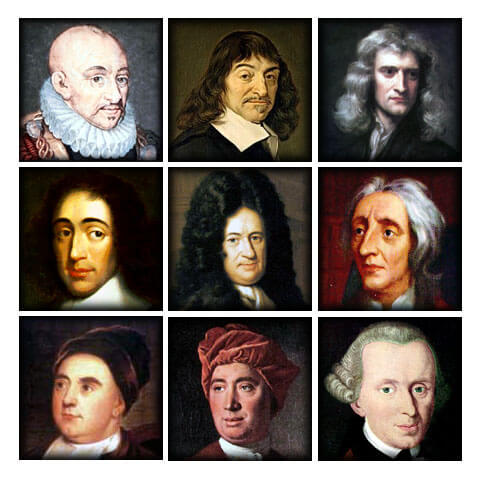
With an earlier book, The Growth of the Liberal Soul (1997), a particular summit is reached when the reader discovers that the heart of the liberal construct is the recognition of persons as the center of value.[2] Building upon this foundation, one begins to trace the philosophical foundations more lucidly with Walsh’s The Modern Philosophical Revolution: The Luminosity of Existence (2008)[3]. This courageous dive into the deep mines of Modern Philosophy has yielded a hermeneutic with which to read the Moderns, the hermeneutic of personhood. This leads Walsh to an even deeper historical and analytical review of Modern Philosophy as a whole.[4] In this philosophical tome Walsh travels from the German Immanuel Kant (1724-1804) to the Danish Soren Kierkegaard (1813-1855) in a reappropriation of Modern Philosophy in its entirety as a search for existence and personhood. Each philosopher Walsh examines contributes to the search for personhood, some more fully than others, but each one contributes, and each one builds upon the other, despite the limitations of each. One can see as one follows Walsh on this journey that something illumining is happening in the mighty, somewhat flawed, and grace filled attempts of each of these thinkers to arrive towards illumined personhood. From a Classical and Christian perspective Walsh leads us to the conclusion that philosophical discussion should not be “about the person,” but on the other hand, should emerge “out of the life of the person who speaks.”[5]
A Metaphysical Proposal of Personhood for Catholic Theology: Proceeding A Posteriori from the Incarnation of Jesus Christ
In Walsh’s The Priority of the Person: Political, Philosophical and Historical Discoveries (2020) he reminds us that all that is meaningful in our lives flows from persons whom we know and love.[6] With a tinge of a reminiscence of Derrida, the language that we use in our attempts to master the world is humbled and essentially defeated in the encounter with persons who come to master us. Walsh observes that we can never master or control a person, but they do master us. The thou with whom I speak, and the who that addresses me, is indeed a who and not a what. Walsh recalls here again that the modern philosophical search inexorably points toward the person as a whole. History is the apocalypse of the person, and modernity enables the moment of its realization. Each and every person is prior to all else that is, and the person is the pivot around whom everything else revolves, thus making personhood the inexhaustible pivot of all things.
Walsh notes that the Jewish Martin Buber (1878-1965) initiated the radical de-centering of the self, and this work culminates in Levinas where we find the priority of the other over oneself. Walsh’s reappropriation of Kant in a more positive light, due to the latter’s prioritization of practical reason over theoretical reason, has reached its denouement, according to Walsh, in the prioritization of the person, in his or her, concrete existence, over all other considerations. Dasein for Heidegger is that which holds itself apart from being, and by this, Walsh concludes, the former intended the person. Persons are ends in themselves, beyond the whole. Rights are transcendent when they are approached from the perspective of community, as we all become implicated in the rights of others in the political community.[7]
The political community for Walsh, and I include the Church herself, are mutually called forth to the recognition that each of its members is an inexhaustible center of meaning and value. For Levinas, in the face of the other we see most clearly who we are. For Kierkegaard, the individual exceeds the universal.[8] The Scholastic theologians and philosophers by no means lacked an interior life, but they were not able to readily connect it with the form of disputation that their thinking had assumed. Walsh acknowledges that the necessity of saying that the person is “beyond being” seems contrary to all of our established conventions of metaphysics. The process of developing a more existential philosophy eluded the scholastics. Yet, Walsh notes, it would become the fruit of the modern turn toward existence, one that promised a new underpinning of faith, no longer conceived according the external forms[9]. Yet Revelation confirms these proposals inchoate in the Moderns, as The Annunciation of the Archangel Gabriel to Mary manifests how Revelation occurs only when it is glimpsed through the self-revelation of the other; in this case the Archangel Gabriel to Mary. Every person is unique, irreplaceable, knowable, and incommunicable in his or her self in relation to the other.[10]
With the Aquinas Lecture at the University of Dallas in 2023, Person Means Relation, Walsh reminded the scholars of Saint Thomas Aquinas that the late Joseph Ratzinger had called for a transformation of metaphysics in the Western world[11]. Upon this premise, I do propose that philosophy must begin with Christ in the Incarnation, and proceed a posterioi from that eternal historical moment so as to capture these deeper philosophical truths. Saint Thomas held steadfastly, Walsh keenly observes, to the authoritative substance based definition of person handed on to him from Boethius[12]. Walsh asks the pressing of whether Saint Thomas, with his vulnerable and authentic admission that all he had written was “straw” may have been prompted by a glimpse into the infinite mystery of the divine communion between the Persons of the Holy Trinity[13]. If this were to be true, it would certainly turn the metaphysics of Boethius on its head!
The Freedom of the Person within the Liberal State
A poignant apex in the realm of political communities relating to each other in communion came in the Twentieth Century in the year 1948, when on December 10 in Paris, France the United Nations drafted the milestone document the Universal Declaration on Human Rights. For the first time in a universal document created by diverse nations, creeds, and ethnicities, the world was able to come together and agree philosophically upon the dignity and rights due to every created human person. The universal document exemplifies a profound and illuminative convergence of the best of modern philosophical accomplishments, post-ideology in the language of rights. Similarly, Professor Walsh’s illumination of the person as “before being” reflects the sacred and transcendent value of every human person, and the rights that they must be accorded due to this dignity.”[14] Without rights there would be tyranny in the political community, and one could also add tyranny in the Church. All of the modern Popes since Leo XIII have subsequently appropriated the language of rights, which manifests both the interpersonal communion within the Church and the relationship to secular authority and constitutional governments.
The French Revolution certainly saw the abominable murders of religious persons and priests, as the Church was brought to her knees; nevertheless, from the ashes of these unspeakable crimes against Catholic persons, the human person does emerge out of the ashes. Yes, Napoleon rose as a Dictator in France, but so also the United States of America also rose from the same philosophical and political principles as the French Revolution.
German sociologist Hans Joas, in his The Sacredness of the Human Person: A New Genealogy of Human Rights (2013), analyzes the genesis and history of human rights beginning with the French Revolution, wherein he observes that the narrative of human rights as anti-religious is mythical, and he argues that the proponents of this view are likely “reactionary clerics, aristocrats, and allied intellectuals.”[15] The fact that the ties were loosened and cut between the throne and the altar does did not in any manner lessen its religious intensity, as the French Revolutionaries sang the Te Deum and had objects blessed as often as possible.[16] Joas notes that scholars have become increasingly more skeptical about the Enlightenment’s perceived constitutive a-religiosity or anti-religiosity,[17] as he argues that the French Revolution bears the seeds of reforming Catholicism and not abolishing it. Joas, a French sociologist, refers to the French Declaration of the Rights of Man and of the Citizen (1789) which, is the product of the earliest phase of the Revolution and refers to human rights as “sacred.”[18] Walsh makes a similar point on rights when he states that the concept for Hobbes and Locke was not subjective, but rather rooted in the transcendent.[19] It is known that the Americans in Paris, particularly Thomas Jefferson and Benjamin Franklin, played a massive role in the production of this French Declaration.[20] Upon this foundation, and together with religion, Joas argues for the support of the sacredness and inviolable dignity of every human person against the depersonalizing forces of modernity.[21] Joas then makes the illumined proposal for the “sacralization of the person” so as to protect and enshrine this reality in modern constitutional society.[22]
The principle reason for this project, which is in the full acceptance of the premise that ethics must precede ontology, lies in the truth that the dialogical principle is essential to the relational structure upon which the human person is created, and that this is not only a truth of philosophy, but a truth for the ecclesial person as well. The first obligation of the human person, in the order of philosophy, is to responsibly accept that their being is constituted by the other and that they are obliged to enter into the horizon of responsibility and thus become a contributing part of the political community. Every person is an “I” and every other person, regardless of race, ethnicity or creed, particularly within the political community is a “thou.” The collective political community, according to Walsh, is a transcendent force and always outlives the particular person. Every person becomes a sacramental presence to the other within the context of community. The French throne did not enable the human person to be fully developed within the polis. The sacredness of the political community is not simply rooted in the nation defined in itself apart from the persons that comprise it; rather, it’s sacredness is realized only in the capacity of the authority to reverence and actualize the freedom that is the person’s right as a moral agent.
In an analogous manner to art as a manifestation of personhood in matter, so the secular is a manifestation of the sacred in the form of an immanent transcendence[23]. As a canvas is open to the creative work of the artist, so the secular is not truly the secular unless it remains open to the transcendent[24]. This is essentially why Walsh argues that atheism is impossible in practice, because it essentially includes the primary referent of God for its very understanding[25]. Secularity is indeed a rich canvas, as God is no longer present in the religious forms that we have inherited, as people no longer find God where they had sought him before. People seek God himself, but they seem to often believe that they have already found him, outside of churches and palaces[26].
Walsh provides the Ratzinger-Habermas exchange to provide an illustration of how we live in a world where the secular and sacred live side by side, and accommodation is generally peaceful[27].We continue to live as if there was a God, as if he exists, and we live in relation to a God that we do not know[28]. This brings us to the affirmation of the Dutch Hugo Grotius (1583-1645), whose famous etiamsi daremus “even if we concede” meaning natural law would continue to have validity even if God does not exist. Grotius offers this as a nonchalant concession to atheism[29]. Again we are brought back to the presence God in absence, which Mother Theresa of Calcutta lived in her spiritual experience of desolation, and made Saint John of the Cross a Doctor of the Church[30].
Walsh goes so far as to say, as Nietzsche came close to saying that it is God himself who is first atheist, as to be God is to set God aside. “My God, My God, Why have you forsaken me” Jesus cries from the Cross for all of humanity[31]. For Grotius, Walsh observes, God cannot be charged with injustice, as he was by Ivan in Brothers Karamazov, because he (Grotius) was so close to the Christian tradition that he knew that God could never be charged with injustice because of what he suffered on the Cross, as his justice is infinite[32].
As ethics is prior to ontology, law now becomes the path in secular society whereby we arrive at God. We can also state based on this Grotian claim, and upon this principle, that persons in communion, which are arguably the highest expression of a natural proof for God, essentially lead other persons into belief in God, as law is created and established by persons, so that those persons may live in peaceful political communion with each other. This is where modernity is needed, because the Scholastic mind could not have posited such a claim, but the claim may now be posited by Grotius in the early 17th century, which proved to prescient with regards to the religious revival that took place after the French Revolution., up to the 19th Century which offered spiritual awakenings, that in many instances resulted in ideology in the 20th Century, they nevertheless, as Walsh claims, drew on a desire or longing of impressive spiritual depth[33].
Walsh argues that faith cannot be found when it is confused with mastery, and this is why there may be deep spirituality behind ideological movements, as those who see clearly and want to control and dominate have no need for faith[34]. Walsh can therefore claim that it is where faith is absent that it prevails all of the more, as what truly defines faith is the awareness of what is missing, presence in a mode of absence[35]. One can clearly see, when it comes to the totalitarian ideologies of the 20th Century, that the invisible saves us from the reign of the visible[36].
For Walsh, each person is a unique recipient of God’s Self-Revelation. For example, Walsh values each character developed in Brothers Karamazov insofar as each writes their own historical narrative, and each character is faced with the questions of life giving virtue or death ending vice, the choice of each character has infinite value, as the person carries the universal within his or her self.[37]
Being carried on the shoulders of these great thinkers preceding him, Walsh, in maintaining that ethics precedes ontology, understands that the language of rights is proper for ethics, as it properly emphasizes the horizon of the person, and that the priority of ethics does not abolish ontology. Insofar as freedom is understood properly in the context of the other, and the other is always understood in the political community as being closer to me than myself, than the language of rights is able to flourish in the context of a virtuous community.[38] If each person, according to Walsh, embraces the whole of reality, and “being” is actually understood by all to be “one person,” then we have nothing to fear.[39] In fact, the only access to history, thus avoiding the historical dangers of nihilism and ideology, is through the lens of the human person, who both writes and analyzes history only through the rational lens of his or her same personhood.
Liberal democracy, in fact, opens up new horizons for the person that a monarchical state could not provide, because in the latter, the free individual response with the totality of one’s heart, mind and will, the response of the total person, was less possible. In a monarchical state, and prior to that in the Medieval state, the human person, we argue, was more constrained and thus less free to make individual moral choices that contributed to the development of his or her own personhood and the common good. The artistic splendor of personhood continues to be painted on the canvas of the secular. Could it be that the less tangible signs that we have of God, that we are actually are discovering him all of the more?
NOTES
[1] PPPB, 157.
[2] See GLS. See also PP, 48-49.
[3] MPR.
[4] See also MPR.
[5] MPR, 60.
[6] PP, 86.
[7] PP, 155-179.
[8] PP, 221-233.
[9] PMR, 21.
[10] PP., 219.
[11] PMR, 13.
[12] PMR, 8.
[13] PMR, 18.
[14] PPPB, 187-205.
[15] H. JOAS, The Sacredness of the Human Person, Georgetown University Press, 2013, 11.
[16] Ibid., 12.
[17] Ibid., 15.
[18] Ibid., 16.
[19] PPPB, 46-51.
[20] H. JOAS, The Sacredness of the Human Person, 19.
[21] Ibid., 31-32.
[22] Ibid., 37.
[23] ISA, 126. Walsh captures what Charles Taylor was only capable of beginning to grasp, that is the reality of immanence in the transcendence.
[24] ISA, 115.
[25] ISA, 73.
[26] ISA, 54.
[27] ISA, 51.
[28] ISA, 114.
[29] ISA, 105
[30] ISA, 104.
[31] ISA, 104.
[32] ISA, 105-106.
[33] ISA, 125.
[34] ISA, 127.
[35] ISA, 126.
[36] ISA, 127.
[37] PPPB, 78-86, The individual exceeds the universal.
[38] PPPB, 44-45.
[39] PPPB, 123-155.


Related Posts