The Bulwarks of Unbelief
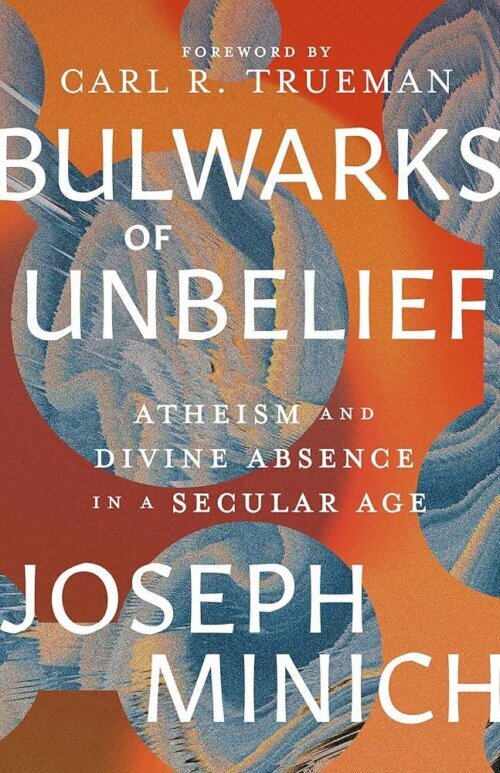
I owe my acquaintance with Joseph Minich’s Bulwarks of Unbelief to an intellectually ambitious member of the women’s book club at our church. It’s fair to say that she bit off more than they could chew, however interesting and compelling his subject—the plausibility of atheism (as opposed to faith) in our time—may be. The book is a monument of scholarship, with a bibliography that is 33 pages long. Minich, a teaching fellow at the Davenant Institute, is writing for pastors and scholars (indeed, principally the latter), not for most of us sitting in the pews.
Minich’s approach is also distinctive, at least for someone who presents himself as a theologically conservative Protestant. I’m accustomed to seeing references to Marx, Marcuse, and Heidegger (among others) on the Left, but not in the work of a self-professed traditional Protestant, unless it be to warn readers away from the bugaboo (and, often, straw man) of “cultural Marxism.” In the latter case, such references are usually unhelpful and certainly not meant to eliminate a problem religious, conservative readers are supposed to find interesting, not to say compelling.
But Minich seeks to deploy these thinkers in service of his project, a kind of phenomenology of unbelief, aimed to help the thoughtful faithful come to grips with one of the leading challenges of our time. In this respect, he is writing in the vein of C.S. Lewis (whom he gives the last word in the book’s final pages), who says in “Learning in War-Time” that “[g]ood philosophy must exist, if for no other reason, because bad philosophy needs to be answered.”
The question is whether this book qualifies as “good philosophy.” I have some doubts.
Minich’s work is meant to complement or be a counterpart to that of Charles Taylor, whose term “bulwarks of belief” describes the cultural conditions that once made faith plausible in Christendom. For Minich, the principal fact of our age is a certain sense of divine absence, supported by “bulwarks of unbelief” (“technoculture” and alienated labor), which result in a “loss of a sense that one belongs to, and is caught up in, a history that transcends one” (p. 6). I say “certain sense” because while “divine absence” could be understood theistically (as God having forsaken someone or some people), in our time, as Minich notes, it is often understood as a proof of God’s nonexistence. Rather than leading our lives as if (als ob) God exists, a significant proportion of us have come to regard ourselves as capable of leading our lives as if there is no God. Some of this is familiar even to those unacquainted with the authors in Minich’s bibliography. How many times have we heard this claim, for example: “I can’t believe in a God who permits the innocent to suffer”? Or have we seen the bumper sticker that proclaims “no justice, no peace,” which doesn’t for those who affix it to their cars describe St. Augustine’s city of man, but rather offers an exhortation to political action, sometimes even violent action, on behalf of what they conceive as justice.
Minich explains that, thanks to technoculture, we regard our world as non-agentic, as mere stuff to be fashioned according to our wills. We think that “reality…belongs to the order of the manipulable,” rather than of “dreadful mystery” (pp. 147, 139). We might experiment (itself, to be sure, a kind of action) before we act, but many of us surely do not pray or seek divine guidance.
In my view, Minich is more or less right about how our engagement with or dependence upon technology affects our attitude toward the world. We’re so accustomed to seeking and finding human solutions for our problems and challenges that many of us can regard prayer as superfluous or merely pro forma.
I’m less convinced by his treatment of “alienated labor” as a contributor to our predicament in large measure; I cannot see how that conception can in any way be squared with a theistic or monotheistic or Christian worldview. There is of course a Christian view of work, in which we respond to God’s call or engage in what Tolkien calls “subcreation” (see p. 152). But Marx’s view of labor is more Sauronic (to stick with Tolkien for a moment) or, if you will, Lockian. Labor is, for Locke, self-expression, creating value out of the “almost worthless” materials provided by “nature.” He ceases referring to God over the course of the pivotal chapter 5 of his Second Treatise. The problem with alienated labor, as Marx conceives it, is that I cannot find the self in my work. Indeed, my work contributes to the production of something that negates the self. Recovering that self might restore my “species being,” but never in a million years my (mediated or unmediated) relationship to God or to what God has called me to do.
We should also not forget that Marx’s understanding of what is required to overcome alienation enables us to make ourselves at home in the world. In his view, the “city of God” is only conceivable thanks to alienation, whereas (it almost doesn’t need to be said) being a pilgrim or sojourner in this world is an essential part of what it means to be a Christian.
Furthermore, most laborers throughout history have experienced something that could be regarded as alienation. Serfs and enslaved people work for others and contribute to a structure that perpetuates their domination. That some may be craftspeople who fashion things with their hands or with tools does not obviously make their work any more self-fulfilling. Yet, Minich seems not to regard this kind of labor as a bulwark of unbelief. It is, after all, consistent with a world that remains enchanted and hence “agentic,” even if most people experience nothing like agency.
Perhaps we might say on Minich’s behalf that technology, especially industrial technology, makes all the difference in establishing the conditions (e.g., routinization and scripting) of the kind of alienation to which he refers. This is plausible, but then it’s hard to see precisely what “alienation” adds to “technology.” Indeed, it’s even harder to see what Minich’s analysis adds to C.S. Lewis’s prescient claim that “what we call Man’s power of Nature turns out to be a power exercised by some men over other men with Nature as its instrument” (Abolition, ch. 3).
To be sure, Lewis’s argument in Abolition is self-consciously not theistic. Furthermore, it is almost aporetic: “Is it, then, possible to imagine a new Natural Philosophy, continually conscious that the ‘natural object’ produced by analysis and abstraction is not reality but only a view, and always correcting the abstraction? I hardly know what I am asking for” (Abolition, ch. 3). But That Hideous Strength supplements and elaborates the earlier argument, imagining a world that is in fact “agentic” while appealing to a deeply embedded common sense that can be obscured by an ambitious scientific project, but also recovered without supernatural assistance. I have dealt with these matters before, and so will limit myself to a brief quotation from that previous work:
There are, to be sure, non-human “animal” phenomena, but they are intelligible as part of an order in which there is a lower and a higher, and can be understood in the light of the latter without engaging in an inappropriate anthropomorphism. But the human must be understood in the light of and as an inkling of the divine, which is not a spirit as opposed to a body or nature, but as a being whose force leaves its imprint on everything. As Ransom says, “there’s no niche in the world for people that won’t be either Pagan or Christian.” One can perhaps see what is wrong with modern science without “ascending” to “theism,” but eventually getting it right requires an openness to the divine.
Minich is, of course, answering a somewhat different question, but, as aforementioned, I cannot see what the discussion of alienation adds to the treatment of technology as a “bulwark of unbelief.”
We might say that, despite his immense learning and engagement with philosophy and theory, Minich is less interested in theory than in practice, less interested in what the learned think than in what the faithful do or should do. Dealing with arguments, he says, is only a small part of his task (see p. 182). This seems to be connected with his view that listening (and hence speaking or storytelling) is more important than seeing. To overcome the problems associated with technoculture and its bulwarks of unbelief, we have to engage in “world re-narration” (p. 207). I sense a debt to Heidegger and Postmodernism here. Rationalism is connected with theory, which gives rise to modern science and technology, which (yes) alienates us from the created world. We have to reintegrate ourselves into that world through listening to the logos articulated in Scripture.
At the risk of adding to Minich’s bibliography and making his argument even more complicated, it seems to me that his treatment of sight and listening is insufficiently nuanced. Not all theory (related through its Greek root to sight) amounts to modern rationalism, which Heidegger (unlike, say, Leo Strauss) assimilates to classical rationalism. Among the ancients, even someone like Plato’s Socrates thinks that examining and cross-examining arguments (that is, logos) might be a “theoretical” undertaking, even if “theory” is primary. I do not deny that, for Christians, attention to the story told in Scripture is central and that they have to orient themselves and their reason (their theory) to that story. Perhaps we can call that “world re-narration,” so long as we do not lose sight of its connection with (fallen) reason and theory. Still, good philosophy is not just “re-narration.”
Minich presents himself as providing a sober alternative to conservative and progressive responses to modernity and its bulwarks of unbelief. Neither of the other approaches represents a mature response to our conundrum, as he understands it (p. 183):
Conservative thought easily concocts an idealized phantasm of a past, risks ingratitude for many present goods, and, most importantly, bears an immature relation to the unbounded—the adventure and journey of learning to navigate the unexpected and surprising. Progressive thought…easily dismisses and misunderstands the past via its own ideological projections and scapegoating, fails to be honest about some goods that risk being lost in late modernity, and, most importantly, bears an immature relation to the limits that structure our relation to the unbounded.
He proposes “four important acts of remembrance” that “re-narrate the world to the Christian mind,” achieving in effect “a re-enchantment of the mind” (p. 192). Among these are two dealing with human freedom and its misuse. Human beings “were made,” Minich says, “for meaningful and free labor in order to cultivate order out of non-order” (p. 197). However straightforward it is to develop an appreciation of technology (if not necessarily technoculture) from such a claim (see also p. 203), it is somewhat harder to square it with God’s observation that creation is very good (Gen 1:31). From this point of departure, Minich develops a measured appreciation of “collective action” (p. 215), more hopeful, perhaps, than what conservatives would expect from a fallen and broken world, but more measured than the high hopes of progressives. There are passages (e.g., p. 223) that contain echoes of the Roman Catholic doctrine of subsidiarity, or perhaps of Adam Smith’s argument in Theory of Moral Sentiments.
I was in the end gratified by Minich’s sobriety about the limits of human action in work and politics, though I have to confess that I’m not convinced that that he breaks much new ground, despite the forbidding character of his complicated, not to say in some instances convoluted, arguments. He ends up pretty close to where someone working in the tradition of St. Augustine, St. Thomas Aquinas, and Martin Luther might be expected to end up.
As I mentioned earlier, Minich gives C.S. Lewis the last word. That is appropriate, as (to my mind) Lewis’s commonsensical engagement with that tradition when thinking about technology and modern science produces conclusions that bear a strong resemblance to those we find in the last chapters of Bulwarks of Unbelief. This tempts me to regard the bulwarks of unbelief as much less forbidding than Minich makes them. Traditional Christians should certainly adhere to the Word, and not seek to withdraw from or flatly reject modernity. It wouldn’t be altogether unreasonable to hope and pray that some of the Mark Studdocks of this world might also recoil from the overweeningly anti-theistic and humanistic projects associated with modern science and technology.
It just isn’t clear that they need the theoretical and phenomenological apparatus Minich constructs to assist in reaching this end.
Bulwarks of Unbelief: Atheism and Divine Absence in a Secular Age
By: Joseph Minich
Bellingam, WA: Lexham Academic, 2023; 311 pp


Related Posts