The Collapse of Judah: The Institutional Disorder as the Disorder of Being
Deuteronomic Reform: An Attempt at Institutional Restoration
Political instability, intensified by Manasseh’s failed syncretic project and Assyrian domination, plagued Judah and drained its energies, generating social disorder and popular discontent, with tragic results. Manasseh was succeeded by Amon, another tyrant, who was assassinated by palace officials in a liberation conspiracy. Upon his death, his son Josiah, then eight years old, was crowned, initially as regent, eventually succeeding him in representing the Davidic Dynasty.
Under an eight-year regency (2 Chr. 34:3), Josiah maintained a state of provisional homeostasis in Judah, a relief from past disturbances and also a sign of frigidity. During his twelfth year, he initiated the Deuteronomic Reform, allegedly after the rediscovery of the “Book of the Covenant” among the Temple archives.
The rediscovery and reintegration of this tome into the Torah was the beginning of a cultural project, which proved to be the very essence of the subsequent reform: to revive the experience and understanding of Mosaic symbolism among the Jews. Through the renewal of the Mosaic berith, Josiah carried out a political project based on his anagnorisis. He realized, by reading the lost writing, that the civilizational foundation of Judaism lay in Mosaic literature, as it was the genesis of their superior culture and the embodiment of their Volksgeist, while at the same time the root of Davidic dynastic symbolism lay in Mosaic religious symbolism. Therefore, a revitalization of the popular spirit and of its government was necessary, based on the common principle that formed them.
Thus, the Deuteronomistic Reform acted on two levels:
1) Cultural: To bring about a reinterpretation and return of the Jews to the Mosaic revelation, transmitted as an example of Yahweh’s order and the founding myth of the nation. Its aim was to revive among the population a more solid and authentic sense of identity, which would be the central connection between the popular spirit and the Davidic monarchical symbolism, creating through common fidelity to the Mosaic writings a bond of trust between ruler and people, the basis of his royal legitimacy.
This was already the cultural project of Prophetism, which sought, in reflection of Elijah’s legacy, to keep alive the order of Yahweh and the continuity of the Mosaic tradition. All Josiah did was adapt it for his political implementation, gaining immediate support from Jewish intellectuals and the priestly order, the subject of the next point.
2) Politics: Josiah did more than implement ethical reform, repeat the deeds of his ancestors, or centralize worship under his jurisdiction. Observing how the pious kings of Judah attempted to implement Yahwism through positive means – patronage of culture (Jehoshaphat) – and negative means – eradication of idolatrous customs (Hezekiah), Josiah sought a combination of these methods accompanied by an institutional restructuring of the kingdom, seeking to repair the errors of the monarchical political structure that resulted in previous tyrannies.
Under the Hebrew monarchy, one evident fact is the lower frequency of cycles of repentance and return, compared to the period of the judges. Here, the same sins were repeated, but the restoration of the Covenant was slower and increasingly less solid. This is due, in a traditional Jewish theological sense, to the centralization of social order in the figure of the king. Even with the implementation of Davidic symbolism and the recognition of the order of transcendence above the monarchical institutional order, the political order still depends on the figure of the king. Thus, divine leadership over the social order is indirect; it depends on the monarch submitting to the transcendent order in the first place.
Under the Judges’ regime, collective Teshuvah (repentance) was spontaneous, as the subordination of social order to ontological order generated a return to the principal order, the natural path of being. Now, under the monarchy, social order centered on royal decrees that organized it. If royal consciousness was marked by inner fragmentation, the organizational structure of society would reflect an internal disorder, resulting in social disorder. Faced with social disorder, it was necessary for the common citizen to adapt to it in order to survive in society.
Clinging to ontological principles in circumstances hostile to those same principles would be viewed, at best, as idealism. This was the essential error that hindered the progress of all previous religious reforms in Judah, which the Deuteronomic Reform attempted to end, without simply abolishing the monarchy as a simplistic solution.
To solve the problem of monarchical mediation, there was the presence of counter-political forces – the prophets. They were the charismatic support necessary to compensate for the deficiencies of traditional rulers lacking charisma, such as Josiah himself. However, the presence of the prophets was disorganized in civil society, and the immediate institutionalization of a prophetic government was unfeasible, both because of the need to maintain the Davidic monarchy and because of the likely result of such a measure: the abolition of the symbolic difference between political order and divine order.
To that end, Josiah did not establish or present himself as a new regime, but prudently identified his government as a reformist monarchy. This monarchy did not seek to erase or rebuild, but rather to bring innovative additions to the existing regime within its institutional system, so that it would have a more genuine and stable continuity of its original heritage.
In the Jewish social structure, in addition to royal power, there was the public action of the organs of proto-civil society, already mentioned above (Temple, religious elite, prophetic class), which was supra-state and a potential counterbalance to royal authority, and was nonexistent in other Eastern monarchies.
Seeing this potential, Josiah decided to co-opt the religious leadership as a new Jewish institutional elite, so that the form of government in Judah would cease to be an absolute monarchy and become a coexistence of monarchy and supra-monarchical institutions as unofficial powers in the conduct of the State; agents of civil reforms, whose royal decrees assigned them the powers to execute royal policy. Thus, the power of these institutions increased, since their new status as royal enforcement placed the fulfillment of royal policies in direct dependence on the will of this new elite, elevating it from civil leadership to an organized establishment.
The replacement of the old institutional elite of the Jewish monarchy, composed of officials appointed by the king or through nepotism (Jehoshaphat’s younger sons administered influential cities, for example – 2 Chron. 21:3), by a new class composed of autonomous national civil leadership was clearly a sophisticated improvement. Its focus was on religious leadership in the abstract, formed by formal leaders (High Priests, heads of the Levites) as well as informal ones (Prophets, intellectuals, and charismatic figures without official function), who in partnership would conduct the administrative changes of Judah, making its official policy reflect its religious culture.
Thus came the formation of a hybrid system of government, with an aristocratic class ruling through delegated governance, alongside the monarchy.
The End of an Era: Battle of Megiddo
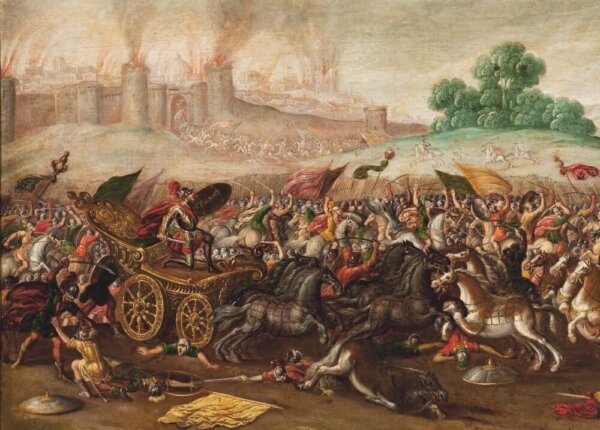
Tensions increased between Nabopolassar and the Saite pharaohs. Taking advantage of Assyrian decline, Josiah led a process of national liberation, allying himself with the pro-Babylonian party. In defense of Babylon, Josiah fought against Pharaoh Necho II at Megiddo, perishing on the battlefield.
Regarding the succession, Jehoahaz was appointed successor by Josiah, to the detriment of his firstborn son Jehoiakim. Jehoahaz was quickly captured by Pharaoh Neco and deported to Egypt, where a coup d’état financed by foreign forces established Jehoiakim’s reign.
With the end of Josiah’s reign, the Deuteronomic Reform came to a close. The new institutional elite did nothing against the rising tyranny, nor could they, due to some flaws in Josiah’s plan: The power of proto-civil society institutions in matters of government derived from royal delegation, not from a constitutional statute or anything similar.
In the same way that, due to Josiah’s previous legislation, the Jewish state was powerless without the support of these institutions, since they were the new legal enforcement mechanism, these same institutions could not govern autonomously or in parallel with the king. Ultimately, his participation in the government was not a change in the form of government, but merely an addition to the existing regime, a pressure force that the king would now have to contend with.
Therefore, these entities were not sovereign and depended on royal approval, just as the functioning of the State proved inefficient without their approval as a class. Along with Josiah’s death, there was a shift in this institutional elite, composed of the national religious leadership. Of Josiah’s contemporary prophetic generation (Huldah, Zephaniah, Jeremiah), most died during his reign, and few charismatic leaders remained. The formal religious leadership remained, but degenerated into an oligarchic class.
This change is not due to exposure to public power, but to the loss of moral qualities in formal religious leaders that justified their position. The succession of leaders from one generation to another was a succession of offices; their authority was purely institutional. Thus, positions of high symbolic and social prestige came to be occupied by decadent individuals unfit for these roles. The elite retain aristocratic powers, but lack the aristocratic virtues that would justify their status as superior men.
A leadership was then created, based exclusively on formal structures, which allied itself with the ruling tyranny (the crown) and used the mechanisms established by the Deuteronomic Reform to maintain its own power and censor dissenters. Thus, new individuals were prevented from rising in both the state and civil spheres if they were not approved by the ruling elite, and the few aristocrats who did not conform to the new social order were excluded from the regime.
One of these marginalized dissidents was Jeremiah, excluded from the priesthood (Jer. 26:7–10) and from social life because of his anti-oligarchic discourse. The political effects of the Deuteronomic Reform are a perfect example of Hegel’s historical dialectic, where when an attempt is made to materially impose an abstract idea on the historical plane, the limits of its internal contradictions tend to generate its opposite: The construction of a political structure that sought to guarantee the participation of charismatic leaders in political power degenerated into a structure that deliberately deprived charismatic types of obtaining power.
The degeneration of the aristocratic class into an oligarchy is a natural and common process in history, revealing that the problem of the crisis of legitimacy is more complex than it appears. Charismatic types are the more genuine authorities and should be preferred over bureaucratic ones. But, to perpetuate a charismatic government it is necessary to institutionalize the collective of charismatic individuals in formal organizations (academies, political committees, research societies), which will transmit the prestige and power of these individuals to inferior successors, constituting an establishment formed by small powerful groups, the definition of oligarchy.
Josiah’s political mistake was attempting to form a religious establishment that was simultaneously formal and charismatic as a mechanism to prevent corruption within the Davidic monarchy. In fact, the mixed regime allowed the monarchy to serve as a potential moral counterbalance to the establishment and the force that prevented its total degeneration. With the reforming king dying and his heir indifferent to moral-religious issues, the ruling elite had the freedom to follow their own inclinations, already nurtured before Josiah’s death, explaining the speed of their ethical change.
As a political force, the new oligarchic class was largely responsible for the Babylonian siege and the destruction of Judah. This is because the successive Babylonian invasions were caused by Judah’s geopolitical alignment, decided by the king, which was anti-Babylonian most of the time. This position in international diplomacy came about both from external pressures (imposition by the Saite pharaohs) and from internal pressure from the establishment, which encouraged and coerced the last kings of Judah, most notably the reluctant Zedekiah, to wage war against the rising empire (Jr. 38:4–5).
The biblical author, theologically aligned with reformist principles, denies this line of causality, preferring to attribute it to the reign of Manasseh (II Kings 21:12–15), although such a line of reasoning also brings an implicit critique of Deuteronomism: if the political instability of Manasseh’s reign had not been caused, the Deuteronomic Reform would not have existed.
While we can say with relative certainty that the political results of the Deuteronomic Reform were disastrous, the same cannot be said of its cultural effects. The renewal and restructuring of Yahwism had a lasting effect on the sense of Jewish identity, strengthening it sufficiently to withstand the cultural disintegration of the 586 BC siege, preventing Judah from suffering the same fate as Israel in 722 BC and allowing it to one day reorganize itself as a nation.
“If Jerusalem had fallen to Assyrian power in 721 along with the Northern Kingdom, the upper class of a southern tribe would have disappeared from the Asian landscape in the same way as that of the ten northern tribes, leaving no trace other than them. The contingency of Jerusalem’s survival in 721 allowed the brief period, until 586, in which the national substance of Judah gained sufficient strength to survive the Exile.” – Voegelin, Order and History vol. 1, pp. 451
Thus, while Josiah’s political restructuring failed to prevent oligarchic capture, his cultural renewal of Yahwism achieved what no institutional reform could: the strengthening of Jewish identity to survive the Exile. The lesson for Voegelinian political science is this: no institutional design can guarantee charismatic legitimacy, but the noetic differentiation achieved through prophetic revelation endures beyond any single regime’s collapse.


Related Posts