The Promise of Waiting: Spiritual Maturation in The Sycomore Fig Tree
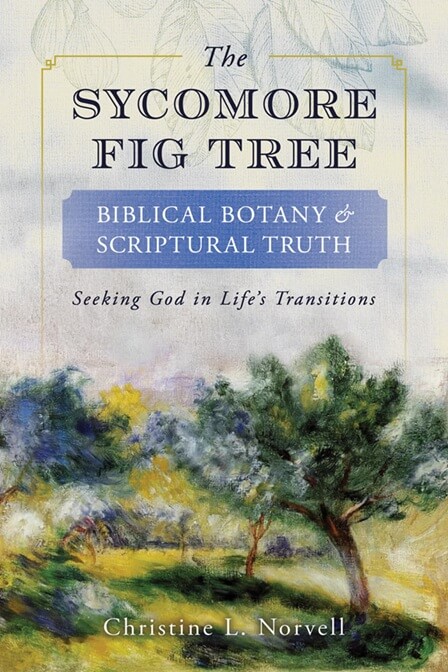
Nature is an active participant in Christine Norvell’s new work, The Sycomore Fig Tree: Biblical Botany and Scriptural Truth. The book opens by discussing the literary and ancient tradition of treating nature as a character, referencing Willa Cather referring that the land was “essentially human,” meaning it was “never neutral and never static” and “could change its mind.” Norvell examines how the sycomore tree performs as a character, not necessarily as a backdrop but as an active participant intervening in the lives of people from ancient time to the present. She carefully weaves the story of the prophet Amos into the historical conversation, referencing his true occupation and societal status. He declares: “I was no prophet, nor a prophet’s son, but I was a herdsman and a dresser of sycamore figs.” Cultivating sycomore figs was a strenuous task reserved for the most impoverished individuals. This highlights his focus on a practical, grounded life and how his humbling labor among the fig trees was self-definitive.
Norvell utilizes a multi-disciplinary approach to the conversation. Her unique structure is part biblical study of the law, part botany research, part testimonial. As a widely published freelance writer of literature, education, music, and biblical subjects, Norvell is uniquely suited to deliver this multi-disciplinary approach. The book is easy to follow and the application of the metaphor and symbol of the sycomore tree is evident in its application to how Norvell’s life has transcended from her experience of displacement.
Norvell emphasizes that the sycomore-fig was prized for its wood. Her insight into this species is described with precision: “The sycomore-fig is not some rare or colorful or stunning botanic gem,” but rather a “wild fruiting shade tree where every single part of it holds value.” The book uses this tree to show how “its maturity over decades and centuries is a picture of enduring fruitfulness, a steadfast hope of what a fruitful life in Christ can become.”
The book effectively connects ancient agricultural practices to modern spiritual life, bringing the ancient word of God to bear witness to the symbolism of one of God’s creations. According to biblical law, a newly established tree was not to be harvested until its fourth year of growth. This mandate was not due to a lack of productivity during the initial three years, but rather because the tree was not yet considered ready. This period is dedicated to rooting and maturation, suggesting that the phase of waiting is inherently filled with promise. It represents a state of expectancy rather than mere expectation—a comprehensive cycle that, while perhaps not yet witnessed firsthand, holds significant potential. This is what we learn from God’s law in Leviticus and how it is relevant to us today.
Chapter 1 introduces the sycomore fig tree as the personification of humility because it is a common tree that grows wild, much like believers who are found by Christ “as tender saplings.” Norvell argues that great faith is not about magnitude, noting that Christ’s command to uproot a sycomore tree by faith demonstrates that even the smallest, most humble faith can overcome the most entrenched, immovable obstacles in life. The sycomore tree’s majesty is documented in the words of Christ in Luke 17:6 where it states: “And the Lord said, If ye had faith as a grain of mustard seed, ye might say unto this sycamine tree, Be thou plucked up by the root, and be thou planted in the sea; and it should obey you.” True greatness in faith is characterized by its authenticity and power. The sycamine [sycomore] tree, a sturdy and valuable resource prized for its wood and fruit, a tree with roots that dig deep and spread wide makes the act of plucking it up by the root all the more powerful.
Norvell asks profound questions in Chapter 2 about her own displacement. She questions her station, considers what it means to be tended by God as He protects and secures the one who trusts in Him, the one who will be planted near water, with luxuriant foliage, yielding fruit, not anxious in the droughtful year. She longs to be the earth God prepares for its due season: “What are my expectations? Am I, too, a transplant? Am I thriving in the soil where I am?” Norvell realizes her strength mirrors the sycomore fig tree, which “regrows from its trunk, not from a shoot,” symbolizing strength in Christ. The theme of regeneration and resilience is palpable across the entire kingdom of God. A modern, biological analogy could be examined in the life of the axolotl, an animal famous for its remarkable regenerative powers that can perfectly regrow missing limbs.
Chapter 3 looks at Levitical law, where a fruit tree is not to be harvested until after three years, and in the fourth year, the fruit was forbidden but sacred to God. Norvell uses this to critique modern impatience, observing that “waiting, truly waiting, and allowing time and space to generate growth was not something I was used to.” She reminds readers that trusting God’s timetable for tending to the growth of his creation, be it horticulture or human, is a forgotten practice.
Norvell identifies our deepest insecurities within the body of Christ and the lived experience of isolation. She incorporates a powerful quote from Henri Nouwen: “Suffering for the wrong reason…is born out of the false expectation that we are called to take each other’s loneliness away,” reminding believers that no community can completely fulfill our deepest cravings for wholeness.
Chapters 5 and 6 tackle shedding and pruning. Norvell notes that “we can’t let the past linger… we have to shed, be pruned, or we might break.” She adds: “I let go of expectations and judgments. I had to for my own well-being. I offered both repentance and forgiveness, and I still do when things come to mind.” This is quite a remarkable exploration of self-awareness and humility. Pruning is required when we are carrying too much rot, too much excess, or too much of what keeps nourishment from taking place. Though this process brings grief, God trims extraneous branches to increase fruitfulness and remove us from spaces that have stunted our growth.
The Sycomore Fig Tree: Biblical Botany and Scriptural Truth is easy to follow and anchors the reader successfully with the metaphor and symbol of the sycomore tree to her own personal experience of displacement. Norvell’s willingness to ask hard questions and share vulnerable details provides comfort that is borne from adversity, resting in the knowledge that God’s purposes hold true even when our identities in a specific place are stripped away.
Norvell’s hand at thoroughly researching her topic is noteworthy and makes this a true treasure to add to the reading repertoire of anyone interested in biblical botany. Because Norvell is a veteran educator, her book is recommended to a wide audience and would make a great unit study for any naturalist who educates at home. Furthermore, farmers, paleobotanists, botanists, agriculturalists, naturalists, arborists, would all benefit from this exquisite work.
The Sycomore Fig Tree: Biblical Botany and Scriptural Truth
By Christine Norvell
Middletown, RI: Stone Tower Press, 2026; 117pp


Related Posts