The Cover Stories
‘Well may we walk in blacks, but not complain.’ (John Donne, To the Praise of the Dead, and the Anatomy)
The term “cover story” has two meanings, and both are problematic. A cover story is usually the top story that is placed on the cover of newspapers, or headlines on the first page. These stories lure us in and capture our attention; exactly in the way the fabricators of such cover stories intend. But a “cover story” also means a story that covers something – it covers our real concerns, what we should really be wondering and thinking and worried about.
Cover stories are thus tricks, invented to fool us, made up of lies and false statements: all these being false accounts for hiding, alternating intentions. Lies, fake alibis hiding actions. Cover stories are invented; fabrications created to stop people asking questions. But this does not work in the animal kingdom. Animals look through the cover-story-like alibis, they protest such pretexts, discover the subterfuge and demonstrate against the ruse. They consider us deranged and crazy in all our ambitions of flying in twilight, like bats among birds, like suspicions among honest thoughts.
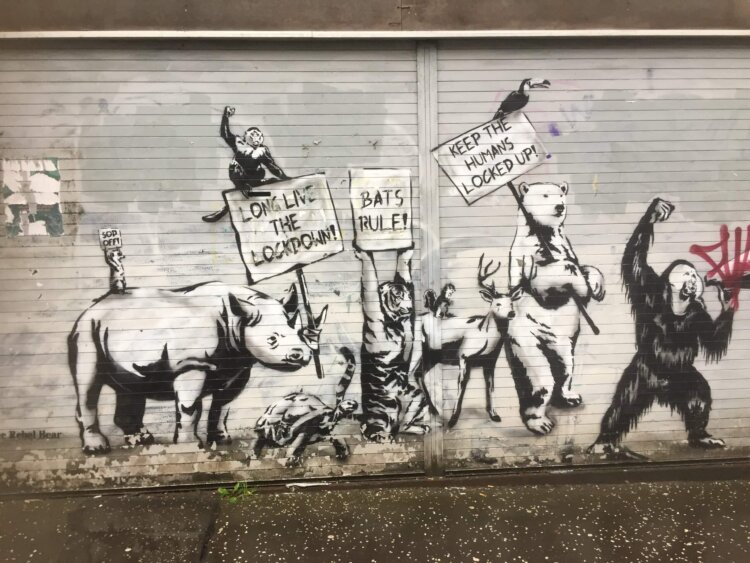
The street graffiti above, taken by ourselves in a high-street of Glasgow during Covid, portrays getting rid of the ‘bats rule’ (see image), keeping humans locked down, and wishing the lockdown to continue indefinitely. This graffiti assumes that humans can be closed away from further fooling and wrongdoing. For the animals, humans are like bats under one common roof, in vast knots far away from light. Humans have packed themselves together with Covid measures, EU regulations, permanent wars, sex changes/gender issues and AI/AGI bubbles. As if the lights would disturb them, they are flocking down, squeaking and darting furiously at the candlelight.
Cover stories are the Brussel-ian Union, a politically centralized, homogenized, or technocratic cover, which erase essential regional and cultural identities, throwing endless manpower into it. It is building our demise, where it is impossible to restore identity to its former state and consequently saving our sour judgments that for termination its identity may be given to the Union. Permanent wars are similarly cover stories, where nothing can grow at the increased death rates. Defending liberty is a pretext, hiding the real intention of these wars. As John Donne once said: “may we walk in blacks, but not complain.”
AI/AGI is a similar subterfuge, a digitalized panopticon, grown à la Bentham on a crony capitalism, that generates junks and bots. All these examples have the same character; they result in wearing down our individual capacity to fight back, to resolve our own problems and to respond properly to life’s challenges and arranging its natural coexistences.
Cover stories are wearing down collective conscience and eclipse principles. Cover stories are convulsions, fits that agitate our being, where the essence and purpose of these occurrences lie not in explanation or in the logic of their dramaturgy. Soon, not only shall we see exceptional ability and genius in technology or political skills in the Union, but the concepts of sex and gender will be left completely redundant from an age without memory. We shall be obliged to have recourse to chance for an idea of progress (in reality bubbles). In cover stories bubbles there are neither a demand for a politically united Europe exists, nor for an AI/AGI pretext of false reason that impossible to meet. There will soon be superhuman systems that can hack anything, replace any field overnight, and thus acquire immense power and resources. This is nor for fighting wars for subterfuge, more an ecological terrorism, that harms everything nonstop, which led to fatigue, financial crash and collapse of all the fundamental needs of life. Nothing from our great scope for wildlife, livestock, pets, lakes, landscape, children, families, good feeling of living in the world remains, nothing for worth of smiling when we are ‘tying back the broken threads of European culture’ (Hofmannsthal’s The Idea of Europe, 2011), in respect for the physical world and its inhabitants in the animal kingdom.
Covering a story of ‘Big Monies’ in destruction, of gaining energy from decay, is not simply a matter of speculative capital anymore but an omnipotent gigantic enterprise with its priest merchants (See Albert Camus’ speech in December 14, 1957 at the University of Uppsala in Sweden), and operative clerus eliminating and spiritualizing matter (including the material man into the non-material one, yet refined and sensitive/sensual to impulses, composed in imitation of such thing as matter forms) in order to establish the kingdom of death (the authentic seat of mechanical energy).
References:
Donne, John (1950) John Donne, London: Penguin
Camus, Albert (2025) Create Dangerously: Albert Camus, Penguin Classics
Hofmannsthal, Hugo (2011) Hugo von Hofmannstahl and the Austrian Idea: 1906-1924, West Lafayette: Purdue UP.


Related Posts