The Hopeful Majesty of Aurora Borealis
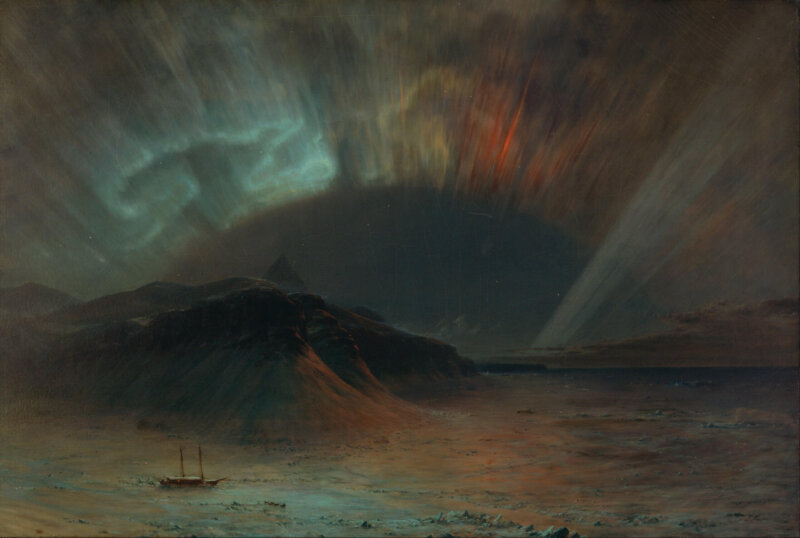
Civil War Richmond was soon to fall. Union forces were just outside the city, cannons bombarding the trenches of the Army of Northern Virginia at Petersburg. Meanwhile, the famous Arctic expedition Isaac Israel Hayes had undertaken prior to the outbreak of the Civil War was soon to be published now that the explorer-turned-surgeon had finished saving the lives of tens of thousands of Union soldiers wounded in battle. His friend, Frederic Edwin Church, was finishing a monumental painting based off the sketches Hayes had given him upon his return to America in 1861.
The Civil War is America’s Iliad and Odyssey, a sad and tragic episode in America’s history where the young republic tore itself apart over the issue of slavery. Westward expansion had become a contentious issue. Anti-slavery and abolitionist activists were on the ascendancy. Although the old Whig Party had fractured, the newly formed Republican Party with its ideology of free soil and free labor, was taking a more restrictive approach to slavery. The slave states, believing the northern states had nullified their constitutional obligations, seceded to form their own government with the expressed purposes of protecting “the peculiar institution.” War erupted.
From 1861-1865, the fields of North America filled with the blood and bodies of young men fighting a war like no other. By 1865, though, it was apparent that the Union was about to win the war. Sherman had just made Georgia howl. Atlanta had fallen. Meanwhile, in Virginia, the Army of Northern Virginia, led by Robert E. Lee, was experiencing its final breaths. Attention was turning to healing and renewed optimism—what would America do and achieve with the war finally over? The landscape of North America which had once inspired so many with its beauty and grandeur had become soaked in a muddy crimson brown, beaten down by blood and rain.
Frederic Edwin Church might well be considered America’s painter. Influenced by the Romanticism of Europe, Church’s landscapes are famous to American eyes even if many do not know their names. The descendant of a Puritan colonial family, Church’s other great paintings include Niagara (1857) and Twilight in the Wilderness (1860). His works capture the Americanized iteration of Romanticism: Transcendentalism.
Part of the Hudson School of painting, founded by Thomas Cole of “The Course of Empire” fame, Church was also an avid explorer. Born in Harford, Connecticut in 1826, Church quickly pursued his artistic talent and became a direct pupil of the aforementioned Thomas Cole who recognized Church’s talent. After spending a couple years learning from the master, Church became embarking on what we might nowadays call backpacking adventures, venturing into the wilderness of opportunity and painting about his experiences. He made several journeys into South America and painted about his voyages, culminating in The Andes of Ecuador (1855) and The Heart of the Andes (1859), the latter of which won him renown and recognition as one of America’s great painters. His paintings reflect that quintessential American idyll, the New World Eden, where the beauty and majesty of nature could offer healing grace to wounded souls.
Church was a man of many friendships. With the Rev. Louis Legrand Noble, he ventured into the icy wilderness of Newfoundland and Labrador. Noble would write about this journey in a book and Church would paint The Icebergs (1861) to commemorate his wintry wilderness exploration. The painting would eventually find a home in the United Kingdom before disappearing, it was then rediscovered and later sold at auction for $2.5 million in 1979. But his friendship with Isaac Israel Hayes would give him the material for the grandest painting of the Aurora Lights.
On the eve of the Civil War, America was entering into a new phase of life. The agrarian republic that Thomas Jefferson had envisioned as a virtuous empire of Yeoman democrats was fading. The bourgeois and commercial empire of Alexander Hamilton was becoming a reality. The Northern states controlled more than 75% of the country’s wealth, its vast network of factories, banks, and railroads meant it was an increasingly urbanized and industrialized region supported by its own rural agricultural base. The Southern states were being left behind. Amid the emergence of this techno-scientific empire backed by new capital, the United States, even in 1860, was becoming an imperial power. Hayes’s expedition to the Arctic is evidence of this. Numerous other expeditions had already been mounted, leading to the discovery of the Northwest Passage in 1851. America, though late to the game, was getting its hand involved. Hayes privately-funded his journey and Church wished him luck as the intrepid explorer sailed into the frozen frontier.
As the Civil War ended, another exuberant wave of westward expansion was gripping the country. A spirit of returning to nature was roaring across the republic. The people who had been gripped by the jaws of death over the five years wanted healing and hope. Church offered them that healing and hope as he painted the sketches of Hayes’s expedition.
It is not accidental that Church took a northern landscape for his work as the Civil War drew to its close. He had renamed The Icebergs to The North when the war broke out, giving the painting a double-meaning and revealing his allegiance. Although Church had become America’s painter by painting about South America in its tropical and rocky glory, a southern landscape was not what the country needed having just been through hell and back. The Norther Lights of the Aurora, eyes turned north and to the heavens, not south and into the dirt, was what the hopeful spirit of postwar America desired.
Aurora Borealis is, in many ways, an allegory of the new American optimism and its hope for healing grace. The ship, the aptly named “United States,” is alone in an icy wilderness. Desolation is all around. Yet there is an unmistakable beauty to the Arctic landscape the ship is surrounded by. A lofty peak juts high into the sky in the background. Hayes happened to christen the peak “Church’s Peak” after his friend when he first set eyes on it. The viewer’s eyes are moved from the frozen and dark ice below to the spectacular kaleidoscope of colors above. In the heavens the Aurora Lights shine forth: red, white, and blue, the colors of the United States.
Church brings artistic life to the watercolor sketch from Hayes, a remarkable portrait all things considered, but one that is monocolor, a bland icy white, and therefore devoid of light. Church’s painting captures the ecstasy of Hayes’s writing of the night sky:
The light grew by degrees more and more intense, and from irregular bursts it settled into an almost steady sheet of brightness… The exhibition, at first tame and quiet, became in the end startling in its brilliancy. The broad dome above me is all ablaze… The colour of the light was chiefly red, but this was not constant, and every hue mingled in the fierce display. Blue and yellow streamers were playing in the lurid fire; and, sometimes starting side by side from the wide expanse of the illuminated arch, they melt into each other, and throw a ghostly glare of green into the face and over the landscape. Again this green overrides the red; blue and orange clasp each other in their rapid flight; violet darts tear through a broad flush of yellow, and countless tongues of white flame, formed of these uniting streams, rush aloft and lick the skies.
Thank God for Frederic Edwin Church!
The painting reaches into the soul of the viewer. Desolate, yes. Beautiful, absolutely. Inspiring, absolutely. Although one could succumb to despair in such a situation—shall we ever see home again?—imbued into the painting is that call for adventure, for hope, for a new beginning. This is a place where none had been before. Now, with the war over, another new world calls for our attention and demands the very best in the human spirit. Life must answer that call.
To the eyes of those who had just lived through the pains of the Civil War, the painting does evoke that memory. But amid the desolation there is beauty. Despite the darkness there is light. And where beauty and light are found there too hope is found. There is hope in desolation, hope in the darkness, hope in the future. Despite the cold, frigid, darkness surrounding the edges, Aurora Borealis is sublimely hopeful.


Related Posts