The Education of the Poet Dante
Dante Alighieri (1265-1321) is widely recognized as one of the greatest poets of Western civilization. As the author of renowned literary works such as the Vita Nova and the Divine Comedy, some writers have even asserted that he is among the best poets ever to write. Centuries after his death, Dante’s images and characters in the Inferno, Purgatorio, and Paradiso continue to shape the imaginations of readers across the Western world. Even today, Dante continues to move and inspire us, showing us the beauty of truth and pointing us to the permanent things that make us truly human. He is a poet and author who continues to enrich our culture and nourish our souls. As T.S. Eliot once stated, “Dante and Shakespeare divide the world between them. There is no third.”
Even from a strictly historical standpoint, Dante is a poet of great importance. At a time when most poetry was still predominantly written in Latin, Dante helped popularize the use of the vernacular in literature. His On Vernacular Eloquence, in fact, was one of the first and preeminent defenses of the vernacular in literature. As a poet and writer, he helped pave the way for vernacular poetry in Italy and throughout Europe. Above all, in terms of his historical significance, Dante is a “great books” author in the Western literary tradition. He is to Christian poetry what St. Thomas Aquinas is to Christian theology. On occasion, Dante’s greatest poem has even been called “The Summa in Verse.” Much like the Summa Theologica of Aquinas, this poem would not have been possible without the grand edifice of Western learning and culture that had developed from antiquity to the Christian world of the thirteenth-century. Like the Summa, the Comedy gave voice to this living inheritance.
Dante as Student
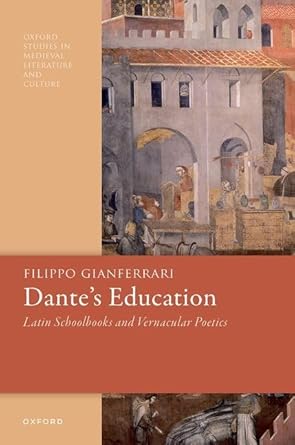
In his new book, Dante’s Education: Latin Schoolbooks and Vernacular Poetics (2024), Professor Filippo Gianferrari has furthered our understanding of Dante and why he is so often considered a preeminent poet of Western civilization. As a professor of literature with a Ph.D. in Medieval Studies from the University of Notre Dame, Gianferrari has written an interdisciplinary study on the topic of Dante’s intellectual formation. This new book continues his previous work related to Dante, Petrarch, and Boccaccio, as well as related to lay education and political theology in the Middle Ages and the Renaissance. Published by Oxford University Press, Dante’s Education explores the poetic genius of Dante within the context of the growth of lay education and literacy in the Middle Ages. More specifically, Gianferrari explores the content and practice of Latin instruction in urban schools in Florence in the late thirteenth-century and shows how Dante engaged with this education. Dante, he notes, contributed to the expansion of vernacular literacy and education. At the same time, he was influenced by this education within his prose and poetry.
In addition to being a “great books” author, Professor Gianferrari suggests that Dante can be understood within a cultural context. In Dante’s time, writes Gianferrari, “a vernacular readership of laypeople, both men and women, was coming into existence as a social reality.” A growing number of professional laymen—including lawyers, physicians, notaries, clerks, and officials—were rising to prominence. New families were growing in wealth and wanting to provide their children with access to education. Given this fact, exploring Dante’s poetry in the context of this expanding access to education is not inappropriate. Gianferrari believes it is helpful to examine the education that Dante received and the one he wished to impart to his readers.
Unlike most treatments of Dante, this new book does not primarily discuss the poet’s higher education in universities, religious orders, and libraries. Instead, Gianferrari discusses Dante’s early education, especially the grammar studies he received as a boy. Rather than exploring the influence of “major” authors like Aquinas, for example, Gianferrari explores the significance of “minor” writers like Aesop. Gianferrari insists that the influence of the minor authors on Dante is not unimportant or irrelevant to understanding his literary genius. The memorization of minor poems in the grammar stage of schooling was formative to virtually all educated people in late medieval Europe, Dante included. This early formation, the argument goes, influenced Dante’s poetry.
Importantly, Gianferrari suggests that the minor authors furnished a “cultural literacy” shared by a growing number of educated readers in late medieval society. Drawing on the scholarship of E.D. Hirsch, Gianferrari defines this idea as a “stock of background information that enables individuals in each society to communicate effectively through reading, writing, and speaking.” Education in Dante’s time was premised on the idea that children should be taught a common body of texts and be provided with shared cultural knowledge. “Learning to read and write provided the basics of language and ethics, a rudimentary introduction to literature, and some notions of biblical and classical antiquities,” Gianferrari writes. “School texts and their exegesis at the hand of medieval teachers constituted the repositories of the cultural literacy shared by most literate individuals in Latin Christendom.” If this is true, then more should be said about Dante’s poetry in relation to the common culture that he received through his early school studies.
What, then, did Dante learn from his formal school studies? What influence did his school readings have on his moral and literary formation? To answer questions such as these, Gianferrari focuses primarily on the Vita Nova and the Divine Comedy. He also selects eight Latin poems that were popular readings in late medieval Florence. These texts include Henry of Settimello’s Elegia, Prosper of Aquitaine’s Liber epigrammatum, the Disticha Catonis, the fables from Aesopus latinus, the Ecloga Theoduli, Statius’ Achilleid, and Claudian’s De raptu Prosperpinae. Although some of these poetic works are less known today, they were likely some of the first compositions that Dante learned by heart and that introduced him to Latin literature. Texts such as these influenced Dante’s poetry, especially insofar as Dante himself read them and would have acknowledged them as texts that most of his readers would be familiar with. Gianferrari explores Dante’s references and allusions to these works throughout seven chapters.
Dante as Teacher
As has been said, Dante is a pre-eminent poet of the Western world. He is an author who explores fundamental questions, helping readers to consider ideas that transcend a single time and place. However, as Gianferrari points out, he can also be considered a kind of late medieval teacher. In other words, Gianferrari suggests that Dante can be studied as someone engaged in the intellectual, moral, and spiritual education of his contemporary readers. This was especially the case in his preeminent text, the Divine Comedy. “Unquestionably, the explicit and unifying aim of the Commedia is the spiritual and moral education of the reader,” writes Gianferrari. Dante’s “deep concern with the political and spiritual struggles of his time is evident throughout the poem and has been acknowledged by medieval and modern readers alike. Less obvious for a modern reader is the fact that Dante’s spiritual and moral reformism hinges on the reading of literary texts and entailed a literary education of his contemporary audience.” Dante, in other words, wanted to provide formative poetry for his readers. These readers, in the meantime, shared a common body of literature that they had usually read during the duration of their early school studies.
There are numerous other reasons why Dante can be studied as a teacher. Dante’s literary works were educational in that they were addressed to all who could read, as opposed to being reserved only for scholars who could read in Latin. These readers “populated the intermediate space between the two extremes of the literary spectrum—non-Latinized and advanced Latinized readers. They could, in some cases, reach advanced reading proficiency in the vernacular but had little understanding of Latin or experience with literary criticism. Besides dealing with professional writings, however, these lay literates were interested in reading for pleasure and self-instruction.” Thus, given that it was not only advanced scholars who were reading his texts but also the lay public, Dante had to act as a teacher. Because these lay readers might be challenged when reading his poetry, Dante had to provide “pedagogical tools” to “guide readers.”
Dante was also a teacher insofar as he understood the highest aims of education and embodied those aims in his poetry and prose. He believed that a genuine education begins with the study of grammar and the other liberal arts, continuing to philosophy and then culminating in theology. The study of grammar was a way of introducing students to the fundamental questions and the life of virtue through an immersion in a common body of texts. Reading these texts was never a private or morally neutral activity. Instead, it was understood to be a public and formative experience. Throughout the history of the West, literacy was never seen merely as “the perpetuation of the alphabet.” Instead, it was always ordered to “the formation of moral habitus.” To use contemporary language, the purpose of education was cultivating virtue through immersion in time-tested books, especially those written by the ancients, and the study of the liberal arts and sciences. At its best, education was intended to serve a moral and spiritual purpose; it was ordered to the perennial aim of human flourishing rather than some utilitarian purpose. This higher purpose of education was something that Dante believed in—a fact that is evident, Gianferrari believes, in his prose and poetry.
The Importance of Education
In Dante’s Education: Latin Schoolbooks and Vernacular Poetics, Professor Filippo Gianferrari has provided a helpful treatment of Dante’s poetic genius within the context of his unique educational culture. To be sure, from the standpoint of the general reader, Gianferrari sometimes gets too bogged down in scholarly literature and in discussions of the relationship between Dante’s poetry and certain minor poems. At such points, he neglects to point out how this educational influence contributed to the timelessness and genius of Dante’s poetry. Regardless of such a shortcoming, Gianferrari’s new book is helpful for those interested in learning more about Dante’s education. The poet, after all, wrote within a specific literary context, one where readers were educating themselves through vernacular texts rather than formal learning in Latin. Dante sought to educate readers in the best of Western thought and literature from the ancient world to the present of his lifetime. He was formed and influenced by his education, including the grammar studies he received in common with others in Florence during the late thirteenth-century. In return, he sought to teach his readers—pointing them through his poetry to what is good, true, and beautiful.
Readers of this book will not only learn more about the education of Dante. In addition, they will also consider the influence of school readings on individual persons and culture more generally. “As readers close this book, my hope is for them to appreciate what a complex and longstanding influence school readings exert on individuals throughout their lives and on culture more broadly,” writes Gianferrari. “Even an innovator such as Dante did not entirely wish to ignore what he had read as a pupil.” What we read, Gianferrari knows, contributes to our understanding of self and to who we are as a culture. There is a strong connection, in other words, between education on the one hand and humanistic and cultural renewal on the other.
Dante’s Education helps us gain a deeper and historically informed appreciation for this great poet of our civilization. In this new book, Dante the student and Dante the teacher are explained to us, and as a result, we can better appreciate Dante the poet. Above all, thanks to this new book, we can better elucidate some of Dante’s most remarkable literary masterpieces, the Vita Nova and the Divine Comedy. Lovers and scholars of Dante who read this new volume will feel encouraged, one hopes, to pick up and read Dante himself with a new set of eyes. Dante the student and Dante the teacher, after all, still speaks to us across the ages. He still teaches us, even from the grave, why we should live a life of virtue and pursue the highest wisdom. The reading public of our own time, as in the late Middle Ages, needs what Dante can teach us.
Dante’s Education: Latin Schoolbooks and Vernacular Poetics
By Filippo Gianferrari
Oxford University Press, 2024; 286pp


Related Posts