The Labors of W.H. Auden
As a poet, I often spend time deeply reading the work of bygone wordsmiths. Any good apprentice knows that study and imitation of a master is key to developing their own craft. The craft of literature provides the benefit of a master work being readily available for study, even if the master himself is far removed by either time or distance.
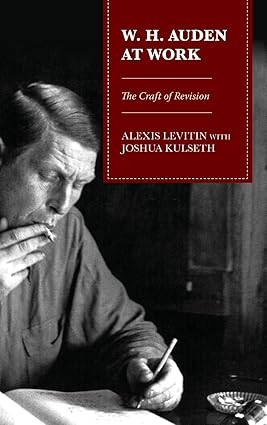
This is often accomplished via deep reading of finished or published works and time spent analyzing and assimilating them. There is a separate value, however, in having access to and reading drafted and revised poems to see how a work changes over time, including the effects of those changes. A student is given the chance to see what originally didn’t work and how the final form was reached. Studying finished poems taught me how to write poetry. Studying poems through their revisions taught me how to revise poetry. Alexis Levitin’s W.H. Auden At Work is a book of the latter. In it, Levitin considers Auden’s collection of poems, primarily sonnets, from Journey to a War and compares them to later revised versions in Collected Shorter Poems, 1927-1957. It tackles 31 poems and presents the originally published poem, its revised counterpart, and commentary on the nature of the changes.
In the preface, Levitin shares that this project was originally a doctoral dissertation project, pulled out and polished into book form years later with the help of Joshua Kulseth. It is certainly an academic work: focused, detailed, and highly technical. This is not a book for the occasional dabbler, but for poets deeply interested in honing their craft, particularly the craft of revision.
Levitin addresses every element of change in the sequence of poems throughout this study in exhaustive detail. He notes the changes in sequence, as Auden reorganized and even omitted some poems in the later publication. He notes word changes and their effects on atmosphere, focus, and intent, and it is not just major nouns, verbs, and adjectives getting analyzed, but also the minutiae of punctuation and replacement of indefinite with definite articles.
Levitin provides this same level of detailed analysis for every poem in the sequence. This is useful for the serious poet, or the reader deeply interested in the work of Auden specifically, although I suspect it might be less so for a reader less interested in either of these subjects.
Largely, Levitin focuses on the changes in Auden’s technique and form as he revised these poems. Journey to a War was written as a sort of war journalism poetry collection, and some of the evolutions of Auden’s moral or political thoughts and philosophies may be traced, but Levitin elects not to speculate on those. In the preface, Levitin notes Auden’s description of poems as “verbal contraptions” and mirrors the poet’s desire to figure out how they work.
Something interesting that Levitin noted in the introduction, before diving into the detailed analysis, is Auden’s assertion that the growth from a poet’s earlier work to later work is what separates a minor poet from a major poet. The arc of a poet is revealed through the two spheres that Auden was most interested in—the technical, inner workings of the poem, and the way the poem reflects the poet’s worldview. According to Auden, being able to take an earlier poem and a later poem and recognize their correct chronological order is a sign of the poet’s staying power. Levitin wonders if this presents a problem for poets—poets like Auden, himself—who revise and republish their works. If they obliterate their history, their past writings, covering them up with their newer, better craft and refined worldviews, how can they then be correctly judged? Amusingly, Levitin doesn’t provide an answer. He presents the problem that Auden set for himself, and then moves into the analysis.
A reader might be forgiven some feelings of frustration that the more philosophical aspects of poetry are left untouched in this study. After all, philosophy is often deeply tied into poetics, and the second half of Auden’s own interest in poems are the worldviews that they reveal. Levitin knew what he wanted to study and write about, and he stuck wholeheartedly to it. This set the necessary room to dig deeply into the specific craft. There are books written on the life and history of Auden, or collections of his letters and papers to show us the man. This is a book for his work, and a useful tool for poets wanting to know how his verbal contraptions work.
W.H. Auden At Work
By Alexis Levitin
Lanham, MD: Lexington Books, 2023; 180pp


Related Posts