The Many Layers of Nikolai Gogol’s Overcoat

Since its publication in 1842, Nikolai Gogol’s “The Overcoat” has attracted readers who see the story as a critique of the treatment of poor people in society and who view its main character, Akaky Akakievich Bashmachkin, as a downtrodden hero. As Jesse Zeldin notes in Nikolai Gogol’s Search for Beauty, a socio-political reading of “The Overcoat” appealed to the socialist intelligentsia of the 19th century, and remained the standard Soviet interpretation of the story into the 20th century.
Though the Soviets thought they had a handle on the story, “The Overcoat” has ideas that transcend any particular ideology. In his essay “The Composition of Gogol’s ‘Overcoat,’” Dmitrij Tschižewskij observes, “Gogol’s works—the more one studies them, the more evident it becomes—are of such abundant content, with so many artistic facets, that one can scarcely presume to say anything conclusive about them, especially without reference to the entirety of his work.” Based on insights from Zeldin, Tschižewskij, and several other perceptive literary scholars, I believe that one especially fruitful reading is a religious one, for “The Overcoat” is full of Christian imagery. In the end, we will see that Gogol’s story raises awareness not only of injustice in society, but it also shows us how, in attempting to improve our situation, we may place our hopes in counterfeit forms of salvation instead of in Christ.
Summary of “The Overcoat”
“The Overcoat” opens by introducing us to Akaky Akakievich Bashmachkin, a copyist in an unnamed department of the government bureaucracy. He takes delight in his work as a scrivener and even brings documents home to copy for pleasure while his colleagues attend parties.
Akaky is content with his humble occupation and his modest salary until he visits a tailor, Petrovich, seeking to patch some holes in his old overcoat against the harsh St. Petersburg winter. Petrovich insists that further repairs are impossible, and that Akaky must have a whole new overcoat, which would cost 80 rubles—one fifth of Akaky’s annual salary. After much hesitation, Akaky agrees to have Petrovich make the new overcoat and, in order to save the money, lives an even more austere life than before, fortified by “the dream of his new coat,” which gives him “spiritual nourishment.” (Note: all quotations from “The Overcoat” are from Christopher English’s translation in the Oxford World’s Classics edition of Gogol’s Plays and Petersburg Tales).
When his new overcoat is finally paid for and ready to wear, Akaky is proud. His co-workers make much of the new overcoat, and a senior official in their department throws a party to celebrate. But Akaky’s happiness does not last long: on the way home from the party late at night, Akaky is mugged and his new overcoat is stolen.
Akaky seeks help from several officials in an attempt to recover his overcoat. He goes first to the constable on duty, who claims he did not see anything amiss. Next he tries the police inspector, who blames Akaky for being out so late. Finally, following advice from a co-worker, Akaky seeks out a so-called “important personage,” who scolds Akaky violently for not following the proper bureaucratic procedure before coming to him. Following his dismissal by the “important personage,” Akaky becomes ill and raves about his overcoat until he dies.
But the story is not over; it has what Gogol’s narrator calls an “unexpected and fantastic ending.” Reports of an overcoat-stealing ghost resembling Akaky soon circulate. The “important personage,” while on his way to see his mistress, is accosted by the apparition, whom he recognizes as Akaky. Akaky’s corpse-like ghost demands to have his overcoat, which the “important personage” throws off before fleeing in terror. After that incident, the “important personage” is somewhat chastened in his behavior.
The Significance of the Name “Akaky Akakievich Bashmachkin”
There are many ways to approach this complex tale, and this essay cannot do justice to them all. Julian Graffy, a University College London professor, has compiled the best resource I’ve found on “The Overcoat,” a whole book describing many facets of the story as observed by critics of the past two centuries. One aspect Graffy covers is the meaning of Akaky’s name. There are several possibilities ranging from puerile associations (Akaky sounds like kaka, a child’s word for excrement) to profound spiritual suggestions – such is Gogol’s brilliance that multiple meanings may be in play.
The narrator gives a humorous account of how Akaky’s mother considered eight saints’ names before deciding to name him Akaky, after his own father; thus his first name matches his patronymic (his second name, which in Russian culture derives from the father’s name). As some readers have noted, Akaky’s name is also a prophecy of his future occupation: his name is a copy of his father’s, just as his work will be to copy documents. Another layer to the name is that it derives etymologically from the Greek akakos, which means “without evil” or, more positively, “innocent.”
There is a further allusion in Akaky’s name to several Christian saints named Acacius; this also is a fruitful source of meaning. In his article “Gogol’s ‘The Overcoat’ as a Travesty of Hagiography,” John Schillinger argues that Gogol is most likely alluding to St. Acacius of Sinai, a 6th-century monk whose story would have been available to Gogol from several sources. As Schillinger summarizes it, Acacius had an elder who beat him over a period of nine years, and then Acacius got ill and died. Five days after Acacius was placed in a tomb, the abusive elder went to a priest and mentioned that his disciple Acacius had died. The priest said, “Acacius did not die.” They went to the tomb to investigate and the priest asked, “Brother Acacius, are you dead?” Acacius answered, “I have not died, father. He who is an obedient toiler cannot die.” The abusive elder then repented. The legend’s parallels with “The Overcoat” are obvious.
The connection to St. Acacius also raises the possibility that Akaky represents a traditional type of character known in Russian culture and literature as the “Holy Fool,” the yurodivy. As Caryl Emerson explains in The Cambridge Introduction to Russian Literature, “the yurodivy was a wanderer, an ascetic, a renouncer of goods, home, family, social standing, even the resources of reason . . . He was foolish (or feigned madness) not for his own benefit, and not always even for the sake of some concrete good, but in order to stimulate others toward a moral reassessment of their actions or attitudes.” Though Akaky’s colleagues in the office make fun of him and attempt to distract him as he copies, Akaky remains steadfast in his work ethic. When extremely provoked, Akaky would cry out, “Leave me alone, why do you torment me?” Only one of his co-workers, the narrator points out, is upon reflection able to discern in Akaky’s words a deeper message: “I am thy brother.”
Akaky had not only been content with his humble occupation of copying words—a time-honored monastic occupation—but he loved his work. As the narrator notes, “It would be an understatement to say that he served with diligence; nay, he served with love. In his work, he beheld a world that was colorful and attractive.” He delighted in the language, even reflecting that delight by forming the letters on his lips as he wrote them.
Akaky’s surname is Bashmachkin, which in Russian would denote a shoe worn by a female. Graffy suggests that Gogol may be alluding to the fairy tale Cinderella: in both stories, the poor protagonist is given new clothes and attends a party, only to leave in haste and lose that article of clothing—in Cinderella’s case, her slipper; in Akaky’s case, the overcoat. The resemblances between the “The Overcoat” and Cinderella, hinted at through the invocation of the name meaning “female shoe,” only heighten the contrast in the end, for “The Overcoat” does not have a redemptive ending with marriage as Cinderella does; instead, there is simply revenge by Akaky’s corpse.
A Fall from Innocence into Idolatry
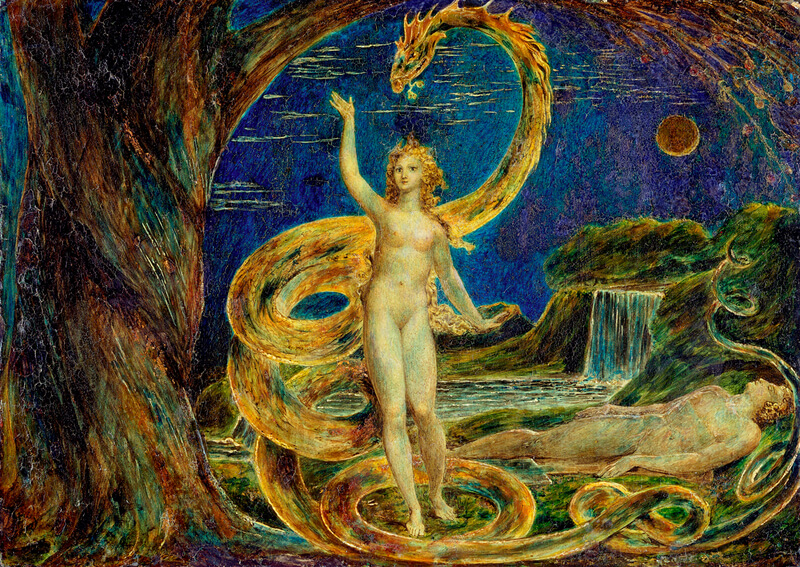
Based on these links with Akaky’s name, associated as it is with innocence, St. Acacius, the Holy Fool tradition, and yet a lack of redemption, we may, as Jesse Zeldin does, see “The Overcoat” as a story of the Fall—of man’s loss of innocence. But within that interpretation, literary scholars disagree about the agent of temptation to the fall from innocence. Is it the brutal St. Petersburg winter that drives Akaky to his downfall, or is it the tailor, Gregory Petrovich?
I would suggest that we cannot blame the winter, any more than we can blame the wilderness for Christ’s temptation by Satan. The real tempter in the story is the tailor Petrovich, who is associated with the devil in several ways, which Graffy details in his book. For one thing, the tailor’s wife refers to him as the “old one-eyed devil.” When Akaky asked if he could save money by merely having the coat repaired, Petrovich responded “as if the devil had got into him.”
There are hints that Akaky was ripe for a fall; in fact, Gogol may have written “The Overcoat” as a “travesty of hagiography,” argues Schillinger. We would call it a travesty because there are ways that “The Overcoat” mocks the conventions of saints’ lives as commonly told. One contrast is that in the account of St. Acacius, the monk spoke eloquently, while in “The Overcoat,” Akaky “expressed himself for the most part with the use of prepositions, adverbs, and all sorts of particles which have absolutely no meaning at all.” In addition to Akaky’s incoherent speech, there is a meaninglessness to Akaky’s world overall; as Tschižewskij shows, the language the narrator uses—especially the frequent use of “even” as an intensifier—creates an aura of absurdity.
We may also observe – as Anthony Hippisley does in his article “Gogol’s ‘The Overcoat’: A Further Interpretation” – that unlike a medieval monk, who would copy sacred texts or other documents important to the Church, Akaky copies government documents as a clerk in a bureaucratic system. Akaky takes special pleasure in copying a document “not for the eloquence of its style, but for the unusual identity or importance of its addressee.” So Akaky does not copy documents for the beauty or truth of the words they contain, as medieval monks did in service to God, but more for reasons of vanity.
The Overcoat as a Counterfeit of Redemption
What about the meaning of the overcoat itself? In light of Gogol’s later work Meditations on the Divine Liturgy, Hippisley suggests that the overcoat draws on the meaning of the priest’s vestments in preparation for the Divine Liturgy in the Orthodox Church. In the liturgy, as the priest puts on his vestments, he recites Isaiah 61:10, saying that God “has clothed me with the garments of salvation; he has covered me with the robe of righteousness” (ESV Translation). In Hippisley’s reading, Akaky’s sacrifices make sense, as a parable of seeking salvation in Christ. His great insight is to draw on Gogol’s later work about the Divine Liturgy, but it raises a problem: if the overcoat does indeed represent salvation, it is troubling to think that it could be stolen so easily.
On the other hand, if Petrovich represents a Satanic tempter, the overcoat may not represent true salvation in Christ, but instead is a counterfeit salvation. Even if Akaky had been truly innocent before purchasing the new overcoat (which is open to question, considering that he found delight in a bureaucratic imitation of holy work, rather than in holy work itself), after the encounter with Petrovich he misdirects his love toward the overcoat, so that it becomes a snare to him.
We may observe how Akaky’s love for the overcoat takes on erotic overtones: as he saves his money to purchase the overcoat, “his whole existence became somehow more fulfilled, as if he had got married, as if there were some other person with him, as if he were no longer alone but attended by some fair companion who had agreed to step down life’s path with him—and this pleasant companion, this soul mate was none other than his heavy, padded overcoat, with its long-wearing and robust lining.” While the longing for and love of Christ as the true Bridegroom pervades Scripture and other Christian writings, for Akaky that love does not bring redemption. Instead, as Graffy and others observe, the narrator suggests that after getting the new overcoat, Akaky is now drawn to worldly erotic encounters. On the way to the party, Akaky gawks at a picture in a shop window of a seductively dressed woman removing her shoe and revealing a shapely leg. After leaving the party, Akaky briefly runs after a lady who crosses his path as he heads home.
Despite all the possibilities inherent in the Christian imagery of clothing, the Petrovich-made overcoat does not direct Akaky to salvation; in the end, after he dies, Akaky’s corpse snatches people’s overcoats. Zeldin sums it up well when he writes, “Akaky [. . .] falls prey to a falsity that destroys him, symbolized by the overcoat and the attitude that he adopts towards it [. . . .] Harmony, beauty, and truth are traded for material deception; integrity is exchanged for appearance in the eyes of others.”
How Gogol’s ‘Overcoat’” Speaks to Us
There is a saying that has become a commonplace in Russian literature: “We have all come out from under Gogol’s ‘Overcoat.’” Though the quote is apocryphal (it was often attributed to Dostoevsky, but others have suggested it was actually Turgenev who said it, according to Graffy’s research), it certainly invites comparisons between Akaky and characters from Dostoevsky like the Underground Man and Raskolnikov, both of whom long to achieve respectability in the eyes of others, or at least in their own self-conception.
But “The Overcoat” speaks to us today as well. We might ask ourselves: how are we attempting to clothe ourselves against the cold winters, literal or metaphorical, of this world? How do we react when our coverings (our security, our comfort) are stripped from us? At what point does a quest for things – even things which are good and necessary on their own – become idolatry? Could our way of grasping after those things become so much a part of us that it continues even after death? Therefore, more than just a socio-political tale about a downtrodden victim seeking justice, Gogol’s story raises spiritual questions that challenge us even now.


Related Posts