The Meaning of Economic Freedom: The Emergence of the Economy
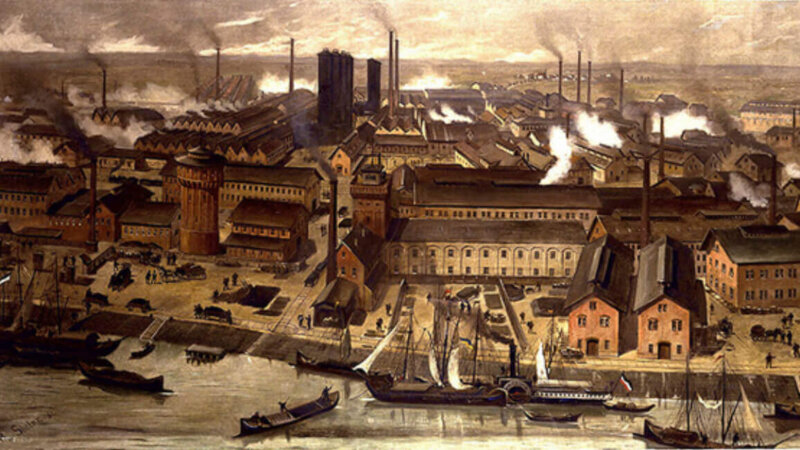
We, all of us in the modern world, are used to consider the existence of something like “the economy” as a trivial fact of life. In the world in which we live there is certainly something like “the economy,” whether it is the “global world economy,” the national economy of a state, to which anything that we call an “economic activity” belongs. However, this banal triviality hides the intellectually crucial fact that “the economy,” as we mean the term, is something very recent; and that any other people in any other time and place did not have an “economy,” or were not part of an “economic system.” This is because “the economy” means a very special modality of organising the co-existence of a group of people, and people anywhere else than the modern world were not organised in this way: they had something like a “culture,” a “society,” or a “community,” in most cases even some kind of political organisation, and most certainly did activities to assure their continued existence, but most definitely did not have an “economy.”
This might seem like an impractical riding on words, but this is not so; it is a major, and even vital issue. We must understand, in order to regain our freedom and the meaning of our lives, what it means to live in a world in which we as humans are “fundamentally” integrated or “brought together” by something like an “economy.”
Church, State, Economy
For this, we first of all must realise that “the economy” is the third in a line of crucial words that capture basic institutions that are exclusive characteristics of Western civilisation: church, state, and economy.
The first point is a trivial fact of religious history: no other culture ever had something like a church (meaning the institution, not the building), except Christianity. Most, probably all cultures worthy of the term have religious authorities, like priests; they have temples and sanctuaries, rituals and even monasteries; but they simply don’t have a church, just as they don’t celebrate masses. Any sociological or anthropological extension of the “church” as a general concept is meaningless. Anthropologists sometimes exaggerate the point by claiming that “religion” itself is a modern Western construct, but this idea is meaningless: every culture had something that we can call “religious belief”; and most cultures also had various magical beliefs and practices. It is not possible to go into further detail here; the central point is to state, and repeat, that to talk about “Christian Church” is a pleonasm: there is no church which is not Christian.
The reason for the existence of a church is simple, and is to be searched in the Trinitarian nature of Christianity: the Church is not part of a “monotheistic” cult, to venerate a distant deity, but in a very close and etymological sense “represents” Christ, who in Christian religion is considered as the Son of God. This is not a theological argument; it simply explains, historically and sociologically, why an institution like the “church” exists.
Now in a very direct and close sense, the same can be said about the state. As it is well-known, Carl Schmitt claimed that all the major terms of modern politics are secularised theological terms, and he is trivially right. This can be illustrated by alluding to a few words: the main functionaries of a modern state are called ministers, while minor administrative employees are clerks, and both words originate in the Church. Giving only one further example, modern democratic politics, and the modern state, is based on the idea of representation, and this idea is not rooted in the Greek polis, but is again medieval and Christian. The denial of this fact by ideologues of modernity like Hans Blumenberg has no relevance: it is just a piece of ideologically motivated argument. A related point concerns the idea of representation: modern democracy is representative and not direct democracy, thus its roots are in medieval Christianity and the idea of representation, the Church as the representation – in the literal sense of “bringing into presence” – of Christ, and not in Greek democracy.
The same can be said about the economy. In one of his major books (The Kingdom and the Glory) Giorgio Agamben presents arguments for a “theological genealogy” of the economy. This led to an important contemporary intellectual-academic current called “economic theology.”
However, in this article I’ll focus on the way the term “economy” gained its modern meaning.
The Meaning of the “Economy”
“Economy,” as a word, is a mirror translation of Aristotle’s oikonomia, visible in an even better way in French économie than in English “economy” – and, in fact, the modern European use of the word originates in French.
Here the first thing to notice is that, in spite of the seemingly mirrored identity, the two words mean something very different, even in kind or type. Aristotle’s oikonomia stands for a normative discourse, the word literally meaning the “rules” or “laws” (nomos) that should govern something like a “household” (oikos), and not a particular area of social life, as “the economy” is.
So how could the “rules that govern household” become “the economy”?
This is again evidently a very long story that require sustained research; I can only indicate two central moments of this story; two main “conceptual historical” (Reinhart Koselleck) developments in between Aristotle and “the economy”: the coining of the terms “economic life” and “political economy.” Both these developments took place in France.
Rabelais and “Economic Life”
The first of these sounds astonishing, hardly believable to anybody, I’m sure; and it is that the term “economic life” was first coined by no one else than Rabelais, or the first modern novelist; and in his Prologue to the Gargantua, the second novel of the series of five.
We can make sense of this truly radical innovation by considering Rabelais as a major figure of European intellectual history; the character of the writing in which this term appears; and the time and place in which it was written.
Concerning the first point, I can only indicate that Rabelais was not a “novelist” in the modern sense of the term, rather a Renaissance humanist and Franciscan monk (Étienne Gilson, a French theologian and historian of ideas much appreciated by Voegelin, wrote a short book entitled Rabelais Franciscain), who read Plato in Greek and had a major formative influence on modern French language, comparable to Shakespeare’s influence on the formation of English.
Concerning the second, a Prologue or a Preface, especially to a second book, is not just a trivial kind of self-publicity or a way to introduce the work, but belongs to the very important genre of “spiritual exercises” (Pierre Hadot) or “techniques of self” (Michel Foucault) by which an author attempts to come to terms with one’s own work, reflecting on the meaning and purpose of what one was doing. Foucault actually developed his term on the basis of Hadot’s ideas. Encountering the work of Hadot was one of the most important catalysts of the last period of Foucault’s work; Foucault even succeeded to bring Hadot into the venerable Collège de France. Hadot’s most important book is Exercices spirituels et philosophie antique, published in s collection of “Augustinian Studies”; Foucault was particularly impressed by his essay on “conversion,” which for some reason was left out of the English edition of the book. The importance of such “late Prefaces” can be demonstrated through the case of Nietzsche, who in 1886, after the failure of his Zarathustra to reach an audience (its first edition sold 7 (seven!) copies), decided to republish his works at another editor, rereading them for writing new Prefaces, an exercise that culminated in the Preface to the Genealogy of Morals. Foucault in his famous essay “Nietzsche, Genealogy, History,” introducing his genealogical method, makes ample references to this “Preface” by Nietzsche, though not yet having encountered the work of Hadot, he does not make this point explicit there.
Thus, drawing the conclusion for Rabelais, his Prologue to the second novel was a way to reflect on his own undertaking. The key event in the second novel is a war which developed out of a conflict between bakers and shepherds: the bakers refused to sell their bread to the shepherds they encountered on the road, preferring to reserve their “supply” for the fair, where they would not simply sell their “product” to “customers,” but could also profit from playing on something like a “futures market.” The shepherds, understandably, fail to appreciate this act of financial wizardry, beat up the bakers, which then escalates into a war. It is this episode, and of course his real life experiences that enabled Rabelais to write this story, that led him to coin in his prologue the term “economic life” (vie économicque), after promising that the work would reveal a secret or occult doctrine (doctrine absconce) about “high sacralities” and “horrific mysteries,” concerning three areas: “economic life” – which is this first ever mentioning of this term; “our religion”; and the “political state” – note that Rabelais singles out for attention exactly the three areas, church, economy and state, which I argued to be uniquely Western.
Concerning the third point, Rabelais published this book in 1534 in Lyon. Now, the Lyon stock market, second in the world, was only opened in 1540, but the Antwerp stock market had already opened in 1531; the connections between the two fairs were manifold; and so Rabelais in 1534 in Lyon was in a perfect position to reflect upon the kind of developments that were about to result in the founding of the Lyon stock market and, in a broader sense, in the imminent emergence of something like “the economy.”
The Emergence of “Political Economy”
The term “political economy” first emerged also in France, and the story is just as intriguing. As a start, note that in this expression “economy” does not mean “the economy” as we understand it, but still in the classical Aristotelian sense stands for a normative discourse.
Standard historiography, like the classic 1954 book of Schumpeter, History of Economic Analysis, credits Montchrétien’s eponymous 1615 book with the invention of the term (p.167), but it actually goes back to Louis Turquet de Mayerne’s 1611 Aristo-democratic Monarchy. This book is interesting for several reasons: due to its evidently Aristotle-inspired title; by showing preference for a “mixed” political system, recalling the Venetian model, and very influential before to rise to dominance of Hobbes’ gloomy Leviathan; because it was the first comprehensive manual of police regulation, a model for the later absolutist police forces (the reason why it was discussed by Michel Foucault in his most important 1979 Stanford lectures, about which Paul Caringella briefed Voegelin), still indicating Aristotelian orientation, in a way, as the word “police” was derived from Aristotle’s term politeia. There were two further books, published around the same time, which also pioneered a discussion of economic life, by Barthélemy de Laffemas and Olivier de Serres; most importantly, all four were of Huguenot affiliations, thus providing additional support for Weber’s thesis about the connection between Calvinism and the spirit of capitalism.
However, and perhaps even more importantly, these works, and authors, also demonstrate a close connection between the emergence of the economy, of the discourse of political economy, and the fairs. Thus, before writing his 1611 book about “police” and “political economy,” in 1599 Turquet published Traité des negoces et traffiques, arguing that a new regulating agency or a “bureau of merchants” is necessary for cities with fairs, due to the large number of foreigners present there. Laffemas, in 1598, published a treatise against the Lyon merchants, charging them to fiddle with the Italian trade in the interest of their own fairs; and in 1601 against charlatans, impostors and enchanters. Thus, there is direct connection between regulating fairs, the rise of the police as a new state force, and the emergence of a new discipline, political economy. In fact, in the period, the proper conduct of merchants was a central concern of public authorities, as the old “gentleman merchant” was evidently threatened, all around Western Europe, by a new kind of foreigner trickster-trader, as shown for e.g. by the 1582 publication of a book by Benedetto Cotrugli, devoted to the ideal merchant, written originally in Italian around 1400.
The Absurdity of a “Political” Economy
As it was repeatedly argued, the term “political economy” emerged in a strictly Aristotelian context. Yet, for Aristotle, the expression would have sounded simply absurd, as the distinction between polis and oikos was fundamental for Greek thinking – just like the distinction between the public and the private for modern thinking.
Yet it is exactly this confusion, of conflation, or mixing together, promoting a certain hybridity, that was central for the kind of “modern” thinking, and acting, that led, in a parallel or connected way, to the emergence of “political economy” as a discourse, and of “the economy” as a new field of life. The meaning of the term “economy,” whether in “political economy,” or in “economic life,” around 1600 still hovered between dealing with long-distance international commerce, the original business of fairs; the household management of the king’s estate, which around the period was turning into something like the “state” – Laffemas, for e.g., was a personal servant of the King, while Olivier de Serres wrote his book at the request of the king, in order to help state finances, while in French “state” and “estate” are the same words (état); and the more regular business of town markets and the related traffic. In fact, in the period, together with the raging religious and civil wars, due to the ongoings of the Reformation, one can witness a thorough and recurrent confusion of the public and the private, of fairs and market, from the court to the towns, with the rising stock-markets serving, in a true alchemical manner, as instigators of both dissolution and confusion, and of reintegration: coming with a background in international trade, often being foreigners – and in our guess many of direct or more distant Byzantine origins – the agents of the new stock-markets increasingly penetrated the local markets and producers, integrating them, through the stock-markets, into the emerging economy.
The central feature of these developments, and our failure to know about them, can be understood through the character of more recent processes, like the rise of the various medias, and especially the internet – in general, the rise of the modern public sphere. The central aspect of the public sphere and of the stock-market – two institutions that always developed closely together – is the joint presence of full public openness and closed conspiratorial secrecy. This is the way practically every media operated, from the emergence of the first printed presses, through the rise of the newspapers and the television, up to the present. On the one hand, there is absolute openness, or its pretence – anybody can publish or say anything, freely; on the other hand, what actually becomes published, or is effectively read and heard, is controlled by a small minority who in this way promotes its own agenda. Great figures of culture, often novelists, like Goethe, Heimito von Doderer, Hermann Broch, or Béla Hamvas, have seen through this, already a long time ago.
The best example is the genuine history of the favourite hobbyhorse of Jürgen Habermas, this unashamed ideologue of the public sphere, coffee houses. For him, these were places where the true free spirits, promoters of cosmopolitan enlightenment came together, discussing freely and openly the burning issues of mankind, his favourite and idealised example being England in the 18th century. The evident problem, for Habermas’ own story, is that the same England is also the birthplace of modern “capitalism,” and so Habermas had to invent a narrative, worthy of the worst Hollywood movies, where the “bad guy” capitalists are continuously abusing and curtailing the “good guy” coffee house intellectuals who are promoting the free public sphere and the Enlightenment project – where, strangely enough, he forms an odd couple with Karl Popper. Popper, actually, is more right than Habermas, as for Popper capitalism and the free public sphere belong together, and it is indeed so, in a way – though not as Popper imagines it.
It is so because coffee houses and the stock-market are two sides of the same coin. This can be seen in a simple fact of London geography: one of its most famous streets, location of many historical coffee houses, is ‘Change Alley,’” which is named because it was a side-street to the nearby stock-market (Royal Exchange) that is close there. Its coffee-houses served as much the stockbrokers who were plotting there as the artists, actors, pamphleteers and various similar figures who were engaged in their own plotting. The term “plotting” is self-evidently used in historical accounts about both.
The modern world emerged because the activities around “our” lives (“us” meaning Europeans and North Americans, and then increasingly “everybody”) have become increasingly integrated, and thus effectively enslaved, by the activities of the stock-markets. About this, we had very little knowledge, as all this happened in the background. Life, on the surface, was the same as ever. The same people were in the shops, the fields, the institutions; but the control over these activities was step by step removed from those who performed these activities, and who thus just became pawns in a game – in their game.
The Absence of the Stock-Market in Political Economy and Economic Theory
We are in the dark about the collusion between the stock-market and the public sphere, and about the way the stock-market effectively integrated, into the economy, the world in which we live because the stock-market has been basically cancelled, almost from the start, from economics. This is one of the most amazing of the many outrageous absurdities of the intellectual history of the last centuries – comparable to the rise to dominance of Marxism, especially in historiography and sociology; of Freudian psychoanalysis; and of their joining in Frankfurt School critical theory. This was possible because economic theory increasingly appropriated and used the terminology of “markets,” without specifying what kind of markets is it talking about – small-scale markets in the town square; the supermarkets in which we now buy food and various other items; or the stock-markets where normal mortals participate as frequently as in the activities of the Parliament – or the star-chambered room. It continuously shifts between these perspectives, with the skill of an illusionist, offering trivial examples about buying butter or oranges, and then with a vortiginous speed jumping to the level of property investments, or economic policy.
Let me finish this article by a contemporary example – but arguing that projecting this example back to the past is not a blatant anachronism, rather helps to shed light on what has remained in the dark in the past. How did the systematic destruction of academic-university life, which we all witnessed in the last decades, happen? Who were those people who called up – evidently, as we have no information about this, only vague anecdotes, and some third-rate personal experiences – all university heads, in closed meetings, where they were instructed about how to “reform” the universities? How were these mindless destructions justified? By economic reasoning? Budgets? But where these economic reasons had no place whatsoever, whether in arts, humanities, the social “sciences,” or the sciences! Or by winking with the right eye about cutting down on politically-correct leftist-Marxist loonies, while the left eye was winking on the politically correct leftist-Marxist loonies, promising them – and effectively delivering this – to create an open space for them by all but clearing existing universities of genuine intellectual and academic interests, controlling academic appointments by advertisements defining profiles that only non-entities, of one kind or another, could fill?
Nobody knows how and why, but Professors who were rightfully appointed due to their excellence, over long decades, could only watch haplessly how the new “reforms” were stream-rolled, through academic councils which were “democratised,” and do absolutely nothing, as any action would only have them pigeonholed into the position of the enemy of progress – of this kind or another.
My central point is that the rise of modernity took place at every period and in every level in a similar way – with wide-open public sphere ideologies pushed into the front, and secret plotting and machinations conducted by the persons publicly pronouncing openness in the background. I cannot write this real story as I have no information about it – nobody has; I am only trying to connect here some of the bits and pieces that occasionally surface, and so perhaps can help others to add their own “tuppence” worth.
*The next articles will be about the further stages of this process – starting with the breakthrough of English economic theories, in the 1620s.


Related Posts