How Should Christians Interact with Great Art?
Is there a point in studying old books that were written hundreds or even thousands of years ago? Can such books relate to contemporary life? Can they help us to grow in faith? These are common questions for many Christians when confronted with the challenge of reading great literature. And all too often, these questions are met with a resounding “no.” All we need is the Bible, some say. Anything else is superfluous at best and harmful at worst.
*
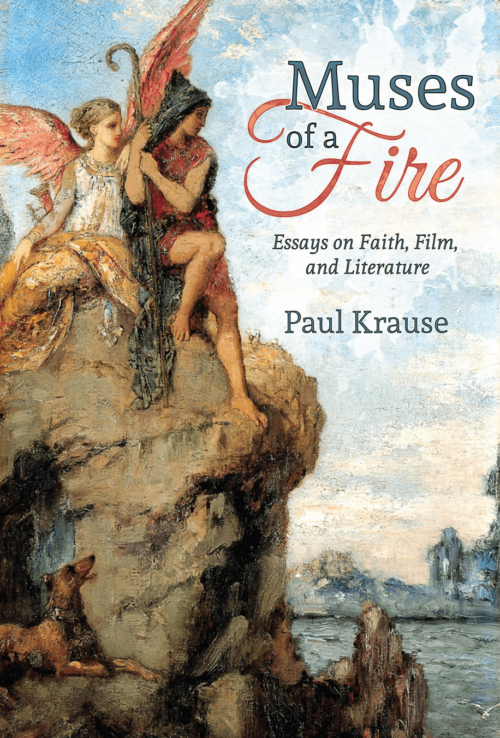
In his new book, Muses of a Fire: Essays on Faith, Film, and Literature (2024), Paul Krause provides a better answer to these questions. Krause answers the above questions with a resounding “Yes!” He believes that great literature, especially from classical and Christian antiquity, is a wellspring of the good, true, and beautiful—and that an education in the humanities is not insignificant to the life of faith. The classics, he knows, were rightly understood by the early Christian fathers as a preparation for the gospel. They prepare the way for Christ and are just as much a part of the Western tradition as Christianity. More generally, great literature gives us a better relationship with reality, the past, our ancestors, ourselves, and what Krause calls the “creative spirit of humanity.” It situates us in time and history and shows us what it means to be a human being, fallen yet made in God’s image—a creature of tragedy and splendor.
Of course, this only brushes the surface of why we should, as Christians, read great literature. Krause provides additional reasons throughout Muses of a Fire. In doing so, he asks those Christians who see little value in great literature to reconsider their position. Christianity, he is convinced, is a religion of mission. We are not called to keep to ourselves the spiritual treasures we find but are instead called to share them with others. “Literature has much to offer this pursuit,” he writes, “and we have much to profit from our engagement with it and sanctification of it.” Krause knows that insofar as the best of literature is a bearer of the good, true, and beautiful, it orients us to the Goodness, Truth, and Beauty revealed in Christ.
Therefore, Krause argues that in our esteem for the Bible, we should not ignore other sources of wisdom. “It is easy to be a philistine and say Christians should not read literature,” he writes. “We have the Bible, after all. Why be concerned with literature? Such people answer ‘nothing’ to Tertullian’s famous query: ‘What has Athens to do with Jerusalem?’” As Krause sees it, those who disregard literature cut themselves off from the broader sources of wisdom.
Instead, “a better response begins by recognizing that Christians have always read and written literature.” According to this view, our cultural inheritance is a repository of the wisdom and imagination of our ancestors—both classical and Christian. “Truth, wherever it is found, however it can be ascertained, belongs to God. We have nothing to fear from literature and much to gain.” If we ignore literature as a source of wisdom, then we do so to our detriment.
Krause is well-qualified to write on the topic of why we should read great literature. A passionate conservator of Western culture and a former student of Sir Roger Scruton, Krause has dedicated a lot of his most recent years promoting and defending the arts and humanities. The author of other books also dealing with this theme, his many essays have been collected in previously published books including The Odyssey of Love: A Christian Guide to the Great Books (2021) and Finding Arcadia: Wisdom, Truth, and Love in the Classics (2023). Additionally, he is an instructor of the humanities, teaching courses in literature and philosophy and publishing many lectures on YouTube.
Muses of a Fire aims to rouse readers with an appreciation for our cultural inheritance. In this way, Krause believes that more Christians should explore the human condition through the great works and artistic achievements that are foundational to Western culture. The unexamined life is not worth living, taught Socrates. Nor, adds Krause, is the unread life. According to this view, Christians will find their lives and faith enhanced by the best of Western literature and by what Krause calls the “beauty and marvels of our cultural inheritance.”
*
Muses of a Fire is a collection of fifteen essays. Despite these essays being written for various publications over a period of time, readers will find that this book has a high degree of cohesion. In every essay, Krause introduces readers to the idea of love and its centrality in the Western tradition. Readers of this book may choose to digest the entire volume from cover to cover or read particular sections discussing authors or pieces of singular interest. Regardless, readers will encounter the “mystifying spirit of awe and wonder” required for the flourishing of the human person and of a culture.
The layout of this new book is simple to follow. In addition to an introduction and afterward, the book is divided into three parts. In Part One, Krause discusses the theme of love in the writings of Saint Augustine, Dante, and Peter Paul Rubens; all three figures being important Christian “artists” whose works informed the Christian faith. In Part Two, Krause addresses the idea of love in certain films, such as Interstellar and Star Wars, focusing on science-fiction films that go as far back as the 1950s and 1960s while also bringing his critical eye to more recent films of the 2010s. Krause does not believe that popular and high culture are at odds with each other; moreover, he believes that love is a helpful standard by which to examine both. In Part Three, Krause moves back to literature, exploring the theme of love in the works of Shakespeare, Jane Austen, Emily Brontë, Charlotte Brontë, Richard Wagner, J.R.R. Tolkien, C.S. Lewis, and others.
Again, the unifying theme in Muses of a Fire is the centrality of love in Western literature. “I hope the gentle and generous reader has profited from this book to see the beauty and marvels of our cultural inheritance in matters relating to love, the quintessential reality to which we, as humans, belong,” writes Krause in his afterword. Love, according to this view, “begets all things and brings all things back to itself. Love is the alpha and omega, the beginning and end of all things.” From Dante to Shakespeare, Saint Augustine to Lewis, and Wagner to Tolkien, the idea of love has been treated with great attention and insight throughout our tradition. Krause’s aim in Muses of a Fire is thus to explain the central place of love in the works of writers and artists such as these.
Krause argues that Christians are best positioned to explore this theme in Western literature. With “Christian eyes”—that is, with “eyes formed by the good news of Christ’s love”—we can see important truths in the great stories of civilization that might go unnoticed by others. One of these truths, Krause believes, is that love is the highest aim of human life. The Apostle John teaches us that God is Love. As Saint Augustine reminds us, we are put into this world to love and be loved. We are commanded in the Bible, moreover, to love God and to love our neighbor. With this truth in mind, Krause examines various pieces of great literature.
Understandably, some readers will approach Muses of a Fire with skepticism. After all, the idea of “love” has become deeply distorted in a way that would be unrecognizable to many of the writers and artists whom Krause discusses in this book. Such readers, however, should remember that Krause does not define love like the activists of sentimental humanitarianism who pervade our institutions and even some of our churches. These humanitarians wish to impose a love without reason and without truth, and, in doing so, they reduce love to mere kindness, inclusion, or feelings. In the name of love, they would toss aside the old wisdom and normality defended by so many of the writers and artists whom Krause admires. In the name of love—indeed, a false love—they advocate for a culture of death and perpetual revolution.
In contrast, Krause defines love in the tradition of thinkers like Saint Augustine and Dante, a tradition that extends in the present day to figures like Sir Roger Scruton. In this way, Krause understands love as a theological virtue and a sacrificial demand. It is what creates and orders the cosmos. It is the beginning and end of all things. It is the deepest yearning of the human heart. Christianity teaches the doctrine of imago Dei, that all human beings are made in God’s image and created in love and for love. And as the Catechism says, to love is “to will the good of the other.” Krause knows, furthermore, that no man can rest until he gazes upon Love. But to gaze upon love, he must, like the pilgrim Dante, purge himself of disordered desires and appetites. In many ways, Krause mirrors the understanding of love put forward by Pope Benedict XVI in his 2005 encyclical, Deus Caritas Est.
*
To return to our question, is there any point in reading old literature? Is there a satisfactory reason for Christians, in particular, to read literature? In response to these questions, Krause answers with a confident “Yes.” Things beautiful and truthful, he knows, have long been foundational to the universal faith and to Western culture. If we desire cultural renewal and human flourishing, we must conserve and transmit these beautiful and truthful things to the next generation. Certain books and pieces of art participate in the fullness of beauty and truth more than others, and these works of literature and art are what we call great. The unity of beauty and truth, together with love, is what makes many of the great works of Western culture so inspiring and moving. Christians ignore this inheritance to their detriment. Indeed, by ignoring it, they neglect their own history and their own high achievements.
We need more books like Muses of a Fire, written for a popular audience but infused with deep learning. Indeed, we need more books that combat the tendency in our time to attack and to take our cultural inheritance for granted. We need new defenders of our heritage, reflective men and women like Krause who are eager to share the riches of our living tradition. This new book is the product of a writer and teacher with an obvious passion for Western literature and culture—who, much like Roger Scruton, desires to transmit a great tradition to generations living and to generations yet to come. After reading this book, perhaps a few men and women of the next generation will choose to “pick up and read!” the books and authors he discusses therein.
Muses of a Fire: Essays on Faith, Film, and Literature
By Paul Krause
Middletown, RI: Stone Tower Press, 2024; 228pp


Related Posts