The Real Battle of AI: Destined to Be Prometheus or to Rise Towards the Peaks of Olympus
The Stalemate in Understanding the Role of Technology
Artificial intelligence (AI) has been a part of the human imagination for a long time. Both the potential dangers and advantages have been eagerly discussed. A popular version of the threat that AI may pose has been embodied in the famous Terminator franchise. Machines would become independent of humanity, become dominant, and try to destroy humanity in an all-out war. Another popular vision of AI can be seen in the Matrix franchise. Machines takes over human society to the point of infiltrating humanity’s deepest sense of reality, enslaving it to utilize humanity as an energy source. Similar dystopian visions have been advanced by Elon Musk and some AI-experts to warn of AI’s potential oppression of human destiny.
Besides this horrific vision of AI, proponents, especially the transhumanists, have argued that living among, or even merging with, AI would make humanity godlike among other creatures on earth. The famous author Yuval Noah Harari argued in Homo Deus (the godly man) that we are at the dawn of a radical change in which human beings would gain abilities that in ancient times would be attributed to the gods. For all practical purposes, the pro-AI movement seems to emphasize the seemingly endless possibilities that AI may bring, fulfilling the fantasy of becoming godlike. We are still at the start of the AI-revolution, but we already see attempts to use AI in complicated settings. The first attempt at creating an “AI-scientist” who researches literature and reviews its own papers is a reality.
When looking more closely at the typical AI proponents and opponents, one finds only a quantitative difference. Whereas the AI-opponents are mostly afraid and push discourse around the dangers of AI, and the AI-proponents push the potential benefits of AI, neither dares to take a step deeper. Neither dares to ask that, no matter the potential pros or cons, the more important question regarding AI and other technologies, is whether they will destroy our humanity. As long as none of the important stakeholders dare to ask if AI will make us unrecognizable and if this is what we ought to desire, we will continue our stalemate discussion between potential pros and cons. Concurrently, AI is gaining popularity and influence under the flag of progress and makes the decision for us.
The only way towards true clarity on AI and technology in general, is to have a deeper understanding of technology to begin with. In my previous essay I predominantly dove into the role of technology in the decline of mental health in the West and the technological determinism that has captured modern society. Over the last few months, I came to understand that a more fundamental conceptual outlook on technology is necessary to truly escape our current impasse on AI and technology at large.
A Beast of Prey: Human Nature in its Original Form
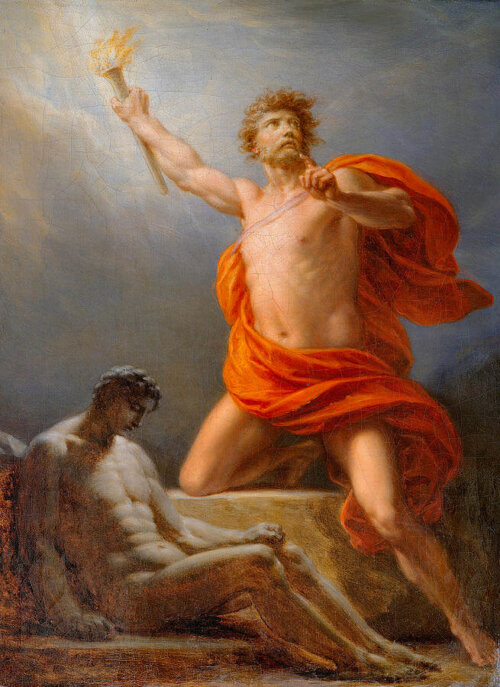
One of the most striking stories related to human technology is the ancient Greek myth of Prometheus. As one of the mythological Titans and the god of fire, he famously defied the gods of Olympus by stealing their fire and giving it to humanity. The fire symbolizes the advent of human technology and knowledge, which gave rise to its civilizations. Prometheus was known to be jealous of the embodiment of perfection of the Olympic Gods such as Zeus. His ultimate desire was to drive all gods out of Olympus and make himself the master of the world. It did not end well for Prometheus as he was eternally punished and tortured by Zeus for stealing the fire. Another story that symbolizes the same spirit is the Biblical story of the tower of Babel. The tower was intended to be built to reach the heavens and ultimately God. It symbolizes the human desire to transcend the natural order and become God, just like Prometheus. Again, the story ends with the fall of man as God destroys the unity of man by giving them different languages so they are unable to work with the same harmony.
This desire is crucial to understand the relation that humanity has with AI and modern technology in general. One thinker who captured this desire at its root is the historical philosopher Oswald Spengler. While he is most known for Der Untergang des Abendlandes (The Decline of the West), his less famous work on technology, Der Mensch und die Technik (Man and Technics) is rather crucial to understand our desire to become God.
In most of his work, Spengler is famous for describing cultures as living organisms. As with other organisms, they rise and fall and are replaced with new cultures. The Faustian (Western) culture has a unique relation with technology. To understand the Faustian relation with technology, let’s first dive into Spengler’s understanding of the relation between culture and technology. According to Spengler, technology first became a topic of contention in the modern setting in the 19th century. Although the idealists and materialists did not agree on the place of technology in culture, both believed that technology would be mostly beneficial to society. Technology, according to proponents such as Herbert Spencer and John Stuart Mill was believed to be a source to increase the happiness of the greatest number of people by relieving them of as much labor as possible.
As Spengler and other thinkers such as Friedrich Georg Jünger argued, technology does not, in fact, relieve the level of work. In reality, it speeds up the work process and increases the possibility of new inventions and work into an endless restless state, as is very recognizable in our age. Yet, Spengler argues that this is not the only state that it can take. Technology, in its general form, is not historically specific. Spengler therefore ordered it into three distinct phases to distinguish between the different kinds of technology. The first and prehistoric phase exists in the life of all animals that can, to some extent, freely move in space, have some form of self-will, and independence of nature. In this form, technology resembles the struggle of the living creature with life itself. It is the clash between writing history and becoming part of the history of others. General tools, for example rocks, can be the difference between being eaten by a predator or fighting it off. Important to Spengler is that technology is not so much a tool in essence. It is the way and context in which it is used: “What matters is not how one fashions things, but what one does with them; not the weapon, but the battle”.
For Spengler, animals can be classified based on their physical and mental mobility. Influenced by Friedrich Nietzsche’s concept of the “will to power,” Spengler argues that the more freedom an animal has, the more will to power it has. The predator with its increased mobility is able to target and fixate with its eyes on his prey and therefore make the pray part of his history with its will to power. The prey on the other hand, tries to prevent the predator from fixating on itself. This is the essence of the prey’s will to power. The relationship between prey and predator is in Spengler’s eyes part of the natural order and therefore unchangeable and accompanied with its own ethics. As humanity is the most mobile species, Spengler calls humanity “a beast of prey”. To deny this out of idealism is, for Spengler, the pinnacle of cowardice.
Going back to our modern relationship with technology, one can see that technology is increasingly fixating its ‘eyes’ (what we nowadays call cameras) on humanity. In accordance with the prey-like ethics, humanity’s will has become decreasingly impactful in shaping our culture. We seem to react more and more to the fixation of technology as it generates our culture for us. Exemplary of this in our current time is the rise of generative AI programs such as ChatGPT. Thereby, in accordance with Spengler, we lose the grand meaning of life which is rooted in our predator-ethics. Both the rise and tragedy of life is what gives us meaning. To embrace the totality of our fate, the amor fati (love of fate) is to embrace life itself. Thereby, the ‘struggle for existence’ in the Darwinian sense is no form of misery as Charles Darwin and Arthur Schopenhauer understood it, but part of life’s richness.
The Thought of the Hand: The Rise of Our Fight Against Nature
Whereas the first phase of general technology is unchangeable, man has transcended this phase. Man personalized it and therefore made it part of its history. Technology became learnable and improvable by other human beings. Thereby, technology became the vessel of mankind’s creative abilities and turned him into what Spengler called the ultimate “inventive carnivore.”
Crucially, according to Spengler, humanity and personal technique co-developed as they refined and defined themselves in relation to each other. For example, the development of human hands and tools are for Spengler part of one process. As human hands developed, so did their tools. As the tools became more sophisticated, the hands also evolved out of necessity. Spengler calls this the “thought of the hand.” This process is only possible because humanity, unlike other animals, can conceive a process for how to interact with technology (e.g., how to start fire). Other animals may witness fire, just like human beings, but they are unable to think out a plan how to start and maintain it.
Human creativity coincided with a passion that the animal soul does not have. It makes humanity a true beast of prey, as this passion causes humans to see others as foes, gives them the ability for passionate killings, hatred, the will to conquer and also the love for our own children. The passion of humanity gave rise to the necessity to become social animals. By becoming part of tribes, human beings protected themselves from the passion of others. This is for Spengler the first time when the soul of humanity strived towards alienation from nature and its predator ethics. It is where art begins as the counter-concept of nature. Most importantly, this is where the will to dominate nature rises as humanity tries to escape the dominance of nature and in doing so makes nature its enemy. This is where world-history begins and the starting point of the tragedy of man. While humanity is able to put up a fight against nature, nature is the stronger force of the two. While man is fighting nature, nature still embraces man within itself. Therefore, the struggle of all great cultures for independence of nature ultimately ends in defeat. In Spengler’s words: “The fight against nature is hopeless and yet, it will be fought out to the bitter end.”
The final ‘mutation’ of this stage is the introduction of speech. According to Spengler, the boom of archeological findings around seven thousand years ago is best explained by the emergence of speech. The first high-cultures in Mesopotamia and Egypt that follow two thousand years later show how the emergence of speech has radically sped up the pace of history. Speech, according to Spengler, developed from basic self-talk into full-grown languages as a result of practical necessity, not out of romantic goals (e.g., poetry, prayer) or rational judgements or thoughts. As such, as speech developed humanity became increasingly capable of collective cooperation with a plan in mind. This allowed human beings to organize in larger groups in what Spengler calls enterprises. Hence, speech and enterprise hold the same relation as hands and tools did previously. Enterprise allowed humanity to become increasingly superior beyond the limits of his bodily powers. It allowed humanity to use more collective and artificial procedures and slowly take over the role of nature. One famous historical products of human enterprise is the breeding of plants and animals.
For Spengler, just like the first phase had a distinction between prey and predator, so does speech separate men in those who follow and those who lead. Ever since humanity entered this phase, this distinction has become part of human reality and it can only be eliminated “along with life itself.” It separates human beings based on their genius and talent to use speech creatively to create and shape enterprises. Yet, both leader and follower in this evolution lose a lot of freedom. As they become part of this organization of a higher order, they become “in form” of the organization. They stop living in nature and start living in accordance with artificial groupings. These groupings become the internal order for an external purpose, with the ultimate one being the state. For Spengler, nature here gets its revenge. As humans become dependent on organizations, they have become the slaves of their own creation in its quest to become master over nature. The individual becomes less important as the size of the organization increases and the population multiplies as a result of modernization. This pressures humanity to either try and fight, flee, or passively accept the rise of mass society with contempt.
Machine Culture: The Perfection of the Faustian Soul
The rise of mass society brings us to the final phase of technological development: The rise of machine culture. As mass-culture gets perfected, society, embodied in the stone city, becomes completely anti-natural, artificial and rootless. Natural divisions such as clever and stupid and strong and weak get replaced by artificial and meaningless objects such as luxury and wealth. The ultimate spiritual luxury that rises is that of hedonism. To constantly be in a matrix-like state of ignorant bliss is the ultimate end result of machine culture. It turns society from a truth-based society into a fact-based one. From one revolving around destiny into one revolving around causality.
Faustian culture embodies machine culture like no other. This is best exemplified by how Faustian culture, unlike other cultures, no longer sees scientific theories as a way to understand the truth of nature. Myths get replaced by working hypotheses which no longer need to be correct. They merely need to be practically useful. This was already popularized by the English philosopher Roger Bacon who emphasized the practical utility of science as “scientia experimentalis (experimental science) and others such as Albertus Magnus. The experimentation of nature for man’s practical advantage was what Spengler called torture with ‘the rack, level, and screw.”
Faustian man has used science in its own words out of desire to know God and its creation. In reality, the Faustian soul has tried to isolate, seize and turn the manifestation of the invincible energy of nature. Man’s desire is not simply to dominate and enslave plants and animals and claim the treasures (e.g., minerals and metals) of nature. Faustian culture has tried to enslave and harness the very force of nature itself. This would, in the deep intrinsic desire of the Faustian soul, allow it total victory over Deus sive Natura (God or Nature) Like Prometheus, Faustian man wants to become master of the world. Throughout the Faustian history, man has battled over which direction the Faustian culture would take. Those who opposed the ultimate will to power to become God, have often labeled this renewed tower of Babel as “devilish.” Yet, over the last five centuries machine culture has risen up in the West. No objection to the negative impacts of technological modernization has been able to stop society from increasingly transforming itself into a perfect machine culture.
The promise of salvation by reducing labor has allowed the Faustian spirit to be captured by machine culture. Not only has technology been unable to reduced labor, but it has fooled man into giving away its creative abilities which gave it its primary satisfaction and fulfillment. Thus, AI is the perfect embodiment of the final step of machine culture. Man is willing to give away his final creative abilities for the promise of increased comfort. Spengler believed that this perfection of machine culture in the West was inevitable, as it is the final realization of the Faustian spiritual desire to become Homo Deus. And so, the tragedy unfolds as the spirit which gave rise to Faustian culture will also be its downfall. As is the tragic destiny of any high culture. Leaders and intellectuals who have become aware of it have tried to withdraw from it. Yet, as society has become increasingly captured by machine culture, it has become unescapable for the whole of Faustian society. Now that the Faustian dominance that peaked at the second half of the 19th century is over as other countries have caught up and Faustian culture has become complacent in its luxurious and hedonistic state, this brings us to the final chapter of the Faustian story. At least, this is what Spengler argues. Like Achilles, Spengler believes that all that is left for Faustian man, is to be courageous. To accept the time, we are born in and to realize that “A short life, full of deeds and glory is preferable to a long life without content”. To Spengler, we need to hold on to our destiny, even though that might be a lost position. It is better to go down with the ship fighting, knowing that there is no hope, than to cowardly believe there is a way out.
The Climax of Our Fate: The Emancipation of AI
This vision puts the discussion of pros and cons of AI into an entirely different perspective. The real question is no longer if the pros or cons outweigh each other. AI becomes one of the continuous and perhaps final steps in creating the perfect mechanical society. In a poetic and tragic sense, AI is what Spengler would call the ultimate revenge of nature. It will personify, even if it never becomes generally intelligent or conscious, how humanity outsources and loses its creative ability which made it human to begin with. Its speech will be generated by the successors of ChatGPT and its organizations and culture will be increasingly ‘created’ by the ‘mind’ of our technological creation. Like we once tried to free ourselves of nature, AI with its increasingly generative abilities follows a likewise ‘emancipative’ path.
Light at the End of the Tunnel: An Antidote to Spengler’s Fatalism
Although I share a big part of Spengler’s analysis, I believe that Spengler’s primary mistake is to view fatalism as the only way forward. Luckily, hope can often be found in the darkest of places through unexpected creativity.
One of such dark places was World War 1 which inspired Spengler’s fatalism. Another philosopher that became horrified by it was Jünger. After reading Spengler’s work he wrote Die Perfection der Technik (the perfection of the technique). In essence, Jünger shares Spengler’s outlook on technology, and other technology critics of his time such as Max Weber, Ludwig Klages, and his brother Ernst Jünger. Where he differs from Spengler, is that for Jünger technological determinism is only one of the two spiritual forces of Western society. Besides the technological destruction, Western man still intrinsically holds the primary desire for balance and harmony that can only be found on what Jünger calls the “peaks of Olympus.” Jünger recognizes that man, like Prometheus has long dwelled in the “workshops of the Titans.” Man, with its agency is still able to return to the peaks of Olympus. Jünger argues that as long as individuals commit towards the good, true and beautiful, there is hope to change our destiny. The Faustian rebellion against nature is of Biblical proportions. Yet, if we are able to break down our own tower of Babel and desire to become God, there is light at the end of the tunnel.
Moreover, Spengler’s fatalism fits perfectly within the contemporary victim culture. I would argue that it is true cowardice if one accepts that one cannot do anything against the Faustian tragedy, then one is left with no responsibility. The adventure of our lives is on the one hand, like Spengler, to accept the tragic times in which we live, and on the other, to rise to the peaks of Olympus to restore a more harmonious way of living. Thus, man should not be tempted to fall in a cost- benefit analysis with AI. That would tempt man to accept the qualitative fall of man into the hands of the Titans.
Thus, ironically, while humanity strives to become Homo Deus, it succumbs to the human flaw represented by the tower of Babel. Jünger pleads us to follow the ancient Greek example of the Olympian Gods. They symbolize the deep and harmonious nature hidden in modern times within humanity’s being. Even though we will never reach perfection or become God, our story of choice is enough to give us meaning for a lifetime.


Related Posts