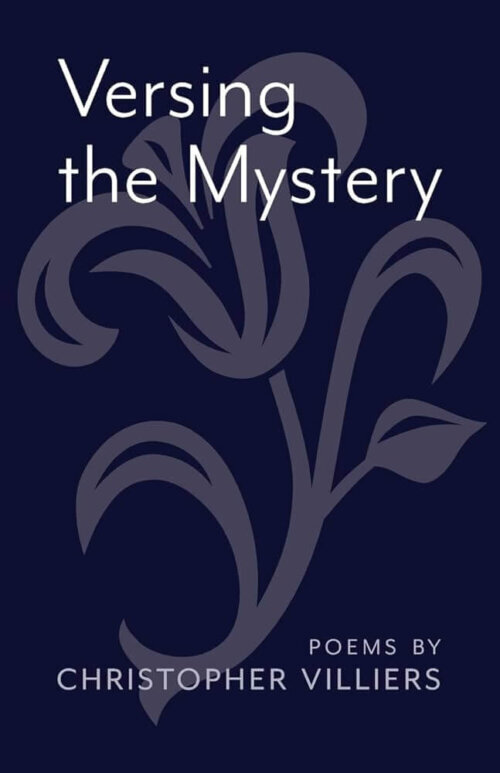
Versing the Mystery
How small that is, with which we wrestle,
what wrestles with us, how immense?
~ Rainier Maria Rilke, Book of Images
Christopher Villiers’ newest book of poems, Versing the Mystery, spans human history as well as a sizable portion of Villiers’ own history. In the title, Villiers gives his readers a roadmap for the book: to put into verse the cosmic mystery of God’s plan. As such, this book requires the reader to embrace the almost 200 poems as one narrative working towards this goal.
It’s significant that this collection of poems spans several years. When I asked Villiers about this, he said, “I like to think that over time, I have broadened my range of form and subject matter, mixing the lyrical and the narrative. Perhaps a progression in thought and technique is also discernible, but that is for the reader, not the author, to decide.” His commitment to formal poetry flows throughout, and while some of the rhymes are stronger than others, his use of the formal techniques like rhyme and meter build upon the book’s foundational theme of order. He splits his book into three parts: “Sonnets from the Spirit”, “Petals of Vision”, and “Another Odyssey” where each section offers a variation on the theme of order and mankind’s relationship to it.
The opening poem pushes off where all good stories should—at the beginning. What follows is an account of the Biblical narrative captured in the form of a sonnet. This in and of itself is an impressive feat! The first poem is titled “My Eve” and begins with the words “I named….” When Adam names the animals, it’s the first instance of man mimicking God; Adam names the creatures thus bringing more order to God’s creation. A few poems later we encounter “Samson.” Samson is the speaker, and we find him at the end of his life. His hair has been cut, his demeanor reflective, and his prayers a call to God to keep his promises: “A false god praised by a false people proud / Mocking us both, You must defend Your Name….” Samson admits a higher order in the world oriented around God, and in his own small way Samson plays a part in that order. He understands that God must prevail over His enemies. His hair returns, and we read, “Death shall deliver what my life did lack.” God’s plan proceeds regardless of life and death; Samson, known for his strength, must perish in order for God’s plan to be carried out. In this final line, Samson realizes that mystery.
In a later poem, we see that the same voice that called Samson into the mysterious will of God calls John the Baptist into his role as baptizer of Jesus Christ. He asks,
Who will he be? Who is this messiah?
Who I must proclaim? What shall believe him?
No voice informs me, a crow low flyer
Goes before me to the horizon-rim.
Jordan’s banks are waiting, I must baptize
Whoever is sent to open earth’s eyes.
I love the marriage of man and nature here. Villiers plays upon the fear and lack of knowledge in John the Baptist, but he reaffirms John the Baptist’s faith through signs from the natural world. The mysterious “crow low flyer” appears before him to show him the way to the banks of the Jordan river. Could this be a prefiguration of the Holy Spirit? While Villiers takes these liberties with the Biblical narrative, he does this to stress both the humanness of scripture, as well as the goodness of God to help his people.
In the second part, “Petals of Vision”, the poems become much more personal. The poet speaks of heartbreak and a longing for things that have passed him by, but he also includes some curious animal poems. “A Party Political Broadcast” assumes that a group of owls are running for public office and are in the process of making a campaign pitch. “A Seal” takes us into the poet’s mind as he observes a seal and wonders how, despite his intellectual superiority, he cannot fully understand the seal nor can he follow it when it dives down into the depths. “A Seal” is also a sonnet, and the couplet at the end zeros in on the poet’s questioning of the seal: “But there still swims deep the seal’s vision rare, / In my mind’s eye still hunts the seal’s sharp stare.” The action of the seal to swim deep into the water—into a place where the poet cannot go—is coupled with the mysterious “seal’s vision” that allows the animal to navigate in the dark depths. It is this vision that the poet seeks. It is also a vision that Villiers provides us with; his aim is to verse the mystery and, implicit in that statement, is a belief that through poetic verse one can better understand God’s ways. In Plato’s Ion, he says, “I am persuaded that good poets by a divine inspiration interpret the things of the gods to us.” Villiers accomplishes this not only through recognition of his need for this kind of vision, but through his craft and endeavors to articulate it to us in verse.
In “Another Odyssey”, we see Odysseus’ sailors grumbling at the seemingly fruitless wanderings of the Greek king. As I read through this final part, I got a sense that we are all still wandering, and that we will be continually setting out on odysseys until the end times. Human understanding will only take us so far—we need Divine intervention. Villiers captures this feeling in the final lines of the poem “Hagia Sophia.”
To gods known or unknown we feel in blood
Beyond ourselves a grace time can’t defy
More than a tourist’s interest we cherish
Sense of Holy Wisdom which won’t perish.
The knowing that runs through blood is the most fundamental kind of knowing, the kind that we humans were born with. This is the feeling one gets when they return to their childhood city or home after a long time away and instantly pick up where they left off. It’s more than the tourist’s sense of novelty that leads them to see so many things without actually knowing anything. It’s Holy Wisdom, God’s wisdom, that Villiers is seeking here. The poem ends in a prayer and rightfully so. We can never arrive at the point of Holy Wisdom on earth, but we can pray and work to get there. We can push out on another odyssey.
Return to Rainier Maria Rilke’s lines before we conclude; Christopher Villiers is wrestling with a forces stronger than any human art or intellect. This section of Rilke’s poem is about the Old Testament instance of Jacob wrestling with God; he wrestles with a being infinitely stronger than himself, and he ends up with a broken hip.[1] However, Rilke takes pains to point out that this defeat is not simply an end for Jacob, but a defeat that increases him through his encounter with God. God raises him up and Jacob goes on to do great things with his life after this.
Villiers undertakes a similar task. He asks difficult questions and wrestles with them. Ultimately, he doesn’t find the final answer, but perhaps he is better off because of it.
Versing the Mystery
By Christopher Villiers
Arouca Press, 2024; 202pp
NOTE:
[1] From Jean-Louis Chrétien’s essay “How to Wrestle with the Irresistible” found in his book Hand to Hand.


Related Posts