The University Before the University
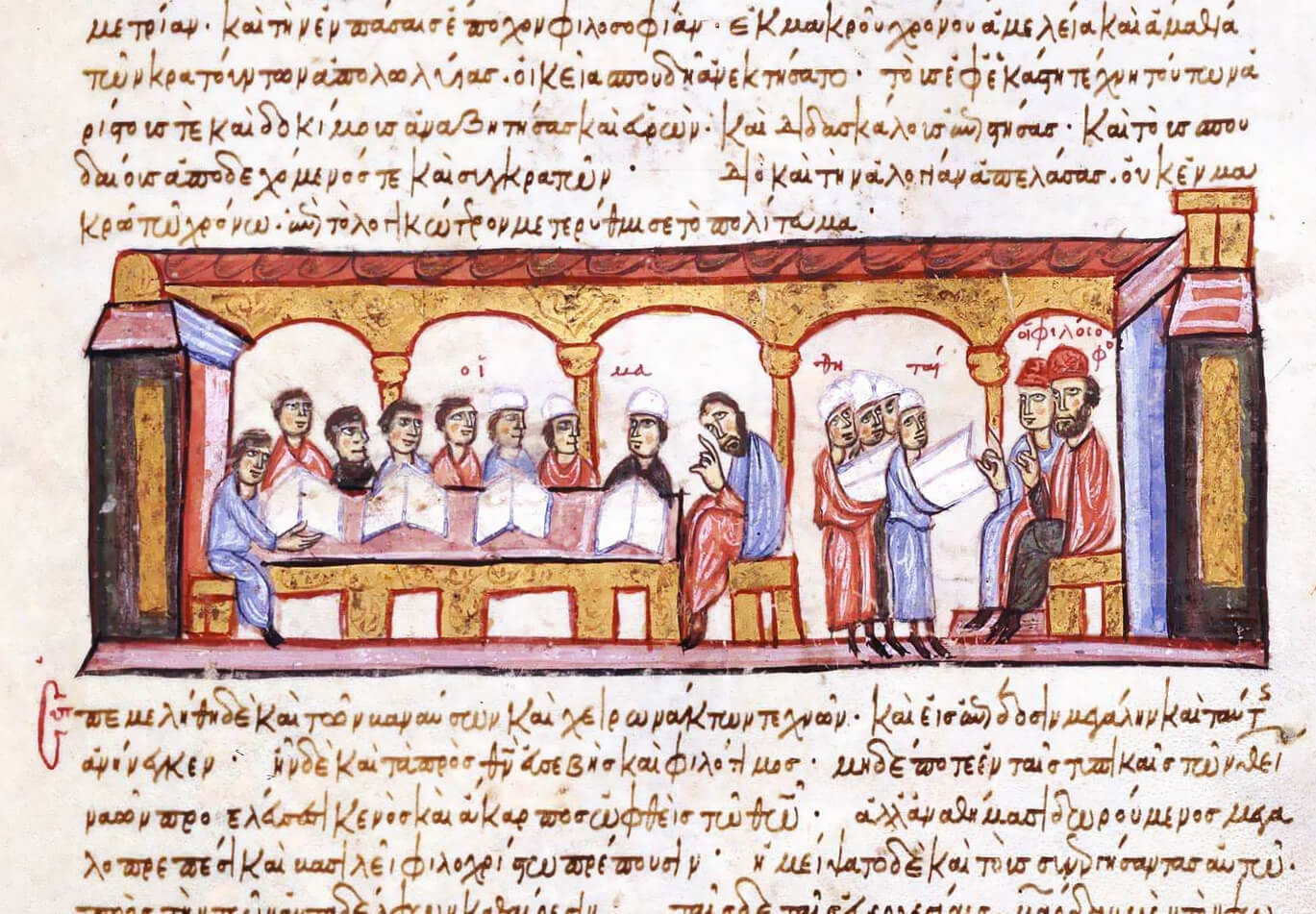
Some years ago, while I was working on my own doctoral dissertation, my chair gave me a short list of professors linking our program to the founder of modern psychology, Wilhelm Wundt. This was linked from one primary professor to another in a genealogical chain spanning over a century. This casual relationship between different generations of students was curious enough that I found myself tracing it back further. During the height of the Enlightenment, it snaked around professors with mixed competencies- Lutheran ministers, Mathematicians, Physicians, sometimes all three. Before that came the great Renaissance scholars, touched by the Byzantine genius Gemistos Plethon, who renewed the interests of the universities. Before that, the line of educators moved through various generations of monastic schools before settling with Michael Psellus, the courtier to Emperor Constantine X. After this point, it became impossible to identify student-professor relationships. However, in landing on Michael Psellus, it became apparent that the figures in this academic genealogy were largely surrounding a salient regional institution. As a graduate student, it was one that I was unfamiliar with, but it has touched every aspect of every subsequent university, and it has influenced many of the intellectual institutions that shaped the modern West. That is, the now lost University of Constantinople.
Traditionally, when the origins of the university are discussed, they usually begin with places like the University of Bologna, which claims continuity of operations since 1088. Other claimants to being ancient universities include the Schola Medica Salernitana (Medical School of Salerno), which was founded at the time of Charlemagne and operated for a thousand years. Some institutions, like the University of Paris, have a contestable origin point, operating as a university since 1150, but not receiving papal or royal approval until the next century. The origins of the University of Paris are further clouded by the continuity of Cathedral schools, which had been operated by Augustinian Canons in the city from an unknown nebulous point in the Dark Ages. However, centuries before any of these institutions formally emerged, Constantinople possessed an Imperial-sponsored center of higher education that preserved the intellectual traditions of classical civilization for over a thousand years. It trained imperial administrators, who in turn, would help direct the emerging Italian republics of Venice and Genoa, and indirectly become the grandfather of Modern Democracy. And, saliently, it would help shape the intellectual foundations of Christianity through its preservation of patristic and biblical texts. Even after its death, the corpus of its archival texts would find their way to the West and trigger both the Renaissance and the Protestant Reformation.
The University of Constantinople, also known through its formal Greek name as the Pandidakterion, stands as one of the most consequential institutions in Western intellectual history. Yet, its legacy today is largely unknown. Modern universities, which can trace their history back centuries, are assumed to be the rediscoverers of a lost intellectual tradition from antiquity. However, in truth, this tradition was only lost in the West. The light of learning continued unabated in the Roman East until the last days of the Empire. Its lecture halls and libraries would be the mother of all such institutions, and serve as a template from Oxford in England to Al-Azhar in Egypt.
The year 2025 would have been its 1,600th anniversary, having been founded by the Roman Emperor Theodosius II. The institution was intended to centralize education into a single locale. Its Imperial charter was intended to educate the civil servants necessary for governing the culturally pluralistic Eastern Roman Empire. Contemporary sources from the 5th century describe thirty-one professorial chairs devoted to the two primary languages of the empire, Greek and Latin, with respective subdisciples for grammar, rhetoric, law, philosophy, mathematics, and astronomy. Unlike previous educational institutions in the ancient world, such as the famed Academia of Plato, it enjoyed direct imperial sponsorship and was fully integrated into the administrative affairs of the Eastern Empire.
The cultural significance of the university extended beyond the bureaucratic training of civil officials, in part because of its strategic political position. Constantinople became the principal heir of the Greco-Roman intellectual tradition. While much of Western Europe experienced political fragmentation following the collapse of the Western Roman Empire, Byzantine scholars continued the study of Homer, Plato, Aristotle, and they explored the ancient art of rhetoric, law, and medicine unabated. The city itself functioned as a vast textual repository of classical learning, cataloguing and transmitting texts that vanished from Western institutions.
There was some moral irony in the construction of such an institution. Famously, Aristotle’s Lyceum was destroyed by the Roman Empire during the sack of Athens in 86 BC. His library and the body of works from the Peripatetic school were sent to Rome by right of conquest, and partially circulated in the Latin speaking world for several centuries. Yet, with the collapse of the apparatus of the Western Roman Empire, the light of learning was largely extinguished for several centuries. The 6th-century polymath Boethius and Alcuin, scribe to the Emperor Charlemagne, both knew of Aristotle in a limited, fragmentary form. However, Aristotle was never lost in the Greek East. The University of Constantinople would preserve the works of Aristotle in his native tongue for centuries, until the time that William of Moerbeke came upon them in the 13th century and translated them into Latin. In doing so, he exported the repository of Greek knowledge back to the West, influencing the young Thomas Aquinas and a wave of European intellectuals known as the Scholastics.
The university’s transitional role was particularly important because the Eastern Empire never experienced the dramatic cultural rupture that defined late antiquity in the West. The structure of the empire required ongoing maintenance, and so, a professional bureaucracy was formed, which was given an advanced education rooted in the traditions of the Classical world. Eastern Roman intellectual culture developed not as an isolated academic exercise, but as part of a broader civilizational project. Their aim was largely one of continuity. In an epoch defined by cultural loss and political confusion, the University of Constantinople’s fundamental mission was to preserve and govern a Christian Roman order. Unlike the pagan academies of Greek antiquity, the university not only sought knowledge of the material world but also its integration into a Christian framework of reality. The university exemplified the broader social and cultural mission of the Eastern Roman effort to reconcile Athens and Jerusalem.
The university also served as one of the principal engines of legal and literary continuity throughout the medieval world. Under the Emperor Justinian, in the 6th century, Imperial scholars associated with Constantinople played a central role in the compilation and interpretation of the Corpus Juris Civilis, the monumental codification of Roman law. This is to say, the entire body of Roman case law, a thousand years of the opinion of state jurists, was collected and simplified into a single cogent legal directive. The scope of such a project would not be attempted again until the time of Napoleon, but its codification would permit Roman law to be both systematic and exportable. As a major work of the Roman world, it would later be rediscovered in Western Europe. In turn, it would serve as the foundation of the civil law traditions across the continent.
In an era when there was no formal medical education on the continent, the university also functioned as a center for medical study. Byzantine physicians were able to continue their practice in continuity from antiquity, partially aided by the new metropolitan hospitals funded by Christian bishops. They preserved and expanded upon the works of ancient physicians: Hippocrates, Galen, and Dioscorides. They produced medical manuals that would circulate the Mediterranean, laying the foundation for Islamic Medicine in the 9th century, and remained authoritative in the Latin West for centuries. The 11th-century physician, Symeon Seth, and later medical scholars combined classical learning with practical empiricism. The city’s various hospitals, most of which were attached to monasteries, became centers of clinical instruction. Monk-Physicians created a relationship between academic scholarship and medical practice that would anticipate the later development of the university hospital.
There is no clear death certificate for the university. Its utility did not suddenly end, but faded with time. The birth of Catholic universities and Islamic houses of study made the University of Constantinople a less unique phenomenon. However, its ethos was exported to its various academic children. Following the Latin occupation of Constantinople in 1204 and the gradual decline of the empire’s political power, the institution increasingly became less of an academic instrument and more of a conduit through which Greek learning flowed westward. Scholars like Manuel Chrysoloras carried the Greek language to Southern Italy, allowing Renaissance humanists to read ancient texts in their original form for the first time since the height of the Roman Empire. Basil Cardinal Bessarion, the last generation of Constantinople’s scholars, amassed one of the greatest collections of Greek manuscripts in Europe and donated them to the Most Serene Republic of Venice, helping to create the Biblioteca Marciana. His efforts represent the last wave of Greek scholarship for several centuries. Through him, the intellectual inheritance of Constantinople seeded the young Renaissance.
The University of Constantinople endured as the axis mundi of Western intellectual life for more than a millennium. It survived the shifting landscape of antiquity and the birth of a newer, more unstable medieval world. For centuries it seemed as a permanent fixture of the empire that had long sustained it. However, its accomplishments have vanished from our cultural consciousness. Its libraries were scattered by the fortunes of war. Its lecture halls are largely urban ruins now. Its great scholars dispersed to distant foreign lands. Modern universities often speak as though they stand at the end of history, immune to the same strange and irrational forces that have swept away the great institutions of the past. The University of Constantinople testifies otherwise. The achievements of any civilization, no matter how grand in scale, or sweeping in their intellectual accomplishment remain fragile artifacts of human life. “We are but of yesterday, and know nothing, because our days upon earth are a shadow” So spoke Bildad, friend to the Biblical Job, and his insight is as sharp today as it was some thirty centuries ago. Familiar institutions that once appeared as permanent cultural fixtures have vanished before, leaving behind only a name and a few ambiguous memories; and perhaps our own contemporary universities will belong to that same forgotten company, remembered only by God and by a few fragments of the wisdom they once preserved.


Related Posts