The Victory of Hyper-Nihilism

A few choice words (“Keresetlen szavak”) on László Krasznahorkai’s Nobel Prize
The first, and still perhaps most famous, novel of László Krasznahorkai, Sátántangó (Satantango) was published on 10 April 1985. At that moment I was still working on my PhD in Austin, Texas, so obviously have not been aware of this. I returned to Hungary, having not yet finished my thesis, the first time in three years, on a very momentous day, May 29, 1985, the day of the Heysel Stadium disaster. The festive week of the books took place just around that time, which was always a major event for me, but at that moment I was occupied with other things. Krasznahorkai’s first novel was not among the major publicised novels in that year. The event rather showcased the publication of Béla Hamvas’s monumental novel, Karnevál, written 1948-1951 but not published until that very moment, when it became an instant success; or the ninth book, and seven’s novel, of Péter Esterházy, A szív segédigéi (“The auxiliary verbs of the heart”). Esterházy was only a few years older than Krasznahorkai but by 1985 was already the most highly regarded Hungarian novelist. I immediately bought Esterházy’s novel, just as most of his previous books, helped by the fact that I knew him personally: he played in the same football team (Csillaghegyi MTE) where I played, first in the debutant and then the junior team, and for about two years we played together in the adult team. His younger brother Márton also played there earlier – he went ahead to become an internationally known striker, scored the last goal for Hungary in a World Cup (in 1986; in 1982, when Hungary beat El Salvador 10-1, still the only team which scored ten goals in a single game, he was not yet selected). I could not get hold of Hamvas’s book, as it was sold out immediately. Krasznahorkai, I ignored.
Still, I read the book quite shortly after, perhaps already in the summer of 1985, but certainly by the summer of 1986. Somebody – I can’t remember whom – gave it to me as something I must absolutely read. I have quickly perused the book, but was simply shocked by it. Travelling from Hungary to Texas in August 1982 was quite a culture shock, and returning after three years was certainly another, in many senses, but I was still unprepared to read something like Krasznahorkai’s novel. I just could not understand what was going on. The publication of such a novel was certainly unthinkable in 1982, to the best of my knowledge; and its publication together with Hamvas’s novel, which was sitting in a drawer – and for long was sewn into a mattrass – for almost 35 years was certainly not accidental. But this was not simply an occasion to celebrate the evident disappearance of censorship – at least, in its previous form. Concerning Krasznahorkai’s novel, I was certainly not lamenting the disappearance of the censor, calling for its return, but found the novel dishearteningly terrible – a kind of apocalyptic nihilism at its worst. I can’t remember much if anything of what I have read, only my – not so much ‘feelings’ as matured judgment that the work was revolting. I was reflecting seriously and for long on what could have given rise to its writing. Was it due to just the steam coming out of a pressure cooker, after having been kept inside for long decades? The metaphor of the pressure cooker would become one of our favourite ways, with Agnes, to explain the experience of Communism, but that came years later. However, even then, I had somewhat similar premonitions. I came to consider this terrible nihilism as the effective outcome of almost four decades of Communist experience, and was wondering how long this will last. It was something completely new and most perplexing for me. I went back to Hungary then, and again in 1987, having finished and defended my PhD, in order to help the arrival of something better, assuming that the evident existential corruptness of the Communist regime must lead to its eventual downfall. But now a new fear assailed me: what to do if, after the collapse of Communism, we’ll be left with the mentalities and worldviews of people like Krasznahorkai? And while at that time Krasznahorkai was just a starter, he evidently was appreciated by some people – even by people I respected – like the person who suggested me to absolutely read this book. I’m sure I cannot remember now who that person was as I could not believe that that person could suggest me to read this.
While I cannot remember further details, I do remember more about a similar art experience I had not much later. In 1988 I saw Béla Tarr’s film, Kárhozat (Damnation), filmed in 1987. The film had the exact same impact on me as Krasznahorkai’s Sátántangó, and this was not accidental, as Krasznahorkai was the dramaturg of the film. Thus, after I wrote in a major Hungarian film journal an article on Peter Weir’s films (published April-May 1987), I submitted an article to the same venue on current Hungarian films, giving a prominent place to Kárhozat. My main argument was that evidently, Hungarian directors over the past, long decades made films with the censor in their mind. This was not in a Freudian, but in a very real political sense: films that simply told the truth of reality would certainly not pass the office of the censor – there were indeed some important films in the previous decades, like the 1969 A tanú (The Witness), or the 1974 Bástyasétány hetvennégy (Bastion Promenade 74), which for long years were prohibited to be shown; but films which would be judged easily acceptable by the regime were not worth making. Thus directors – just as, for that matter, novelists, or any philosopher, historian, social scientist or intellectual – continuously had to navigate at the borderline of what was still reasonably true and real, but which yet had a chance to pass the censor. Once the censor, evidently, disappeared – and this in Hungary happened just around the time when I was not there, 1983-85 – writers and directors lost their ‘measure’ concerning the ‘limit’, and produced apocalyptic nihilistic garbage which only prolonged the deadly impact of Communism. At least, this was what I felt and wrote then – and, strangely enough, this was deemed as unpublishable, not by some official censors but the editors of the journal who happily published my previous writing, but who now claimed that the tone and content of the article is insulting for Hungarian film directors.
I left it there, for a long time; my next article concerning films was about Tarkovsky, in a 2022 issue of International Political Anthropology; and then, about American films, in 2025 for VOEGELINVIEW. But I wrote books about novels; and the – for me – unimaginable Nobel Prize of Krasznahorkai spurred me to write this essay.
It will not be about his novels, as I did not chance to read him again; but about the much shorter, and ‘theoretically’ relevant, speech given on 5 December 2025, on occasion of his acceptance of the Nobel Prize. I was curious what he had to say, though did not have high expectations. Unfortunately, I turned out to be right.
The speech, ostensibly, was about hope. At least, this is how he started: originally, he wanted to share his thoughts with the audience about hope, but as he had lost his hope for good (in italics in original; in Hungarian, végleg, a very conclusive word, as vég means the end, while kivégez ‘execute’, a quite important term, with its connotations), he would talk about something else – about ‘angels’; then, about ‘human dignity’, and finally, about ‘rebellion’.
The first point everybody should have been concerned with – and I hope many were concerned – is that he does not say anything either about hope, or why he had lost it – even for good! After all, this is quite an important point. Hope is something central for living, for everybody, anywhere. But it is especially important for a man of culture, like an artist; especially for one who gained such a major recognition. ‘Hope’ does not mean, to be sure, credulity and stupid, unwarranted optimism. It cannot be an empty rhetoric. But the refusal of hope, by a supposedly major figure of culture, and at such an important moment as the acceptance speech of a Nobel Prize has its own rhetorical character. And a declaration of the end of all hopes at such an occasion is also nothing but an empty rhetoric.
In this our case, this is even technically the case, as Krasznahorkai never makes us privy into why he has lost all hope. He just states it, at the beginning; returns to the word, occasionally; and even closes his speech by this word – without giving any reason. His rhetoric is thus indeed literally empty, void, saying nothing substantial – and so it is actually, adding paradox to paradox, is more that ‘just’ rhetorical. This is what I mean by hyper-nihilism.
It is also worse than empty rhetorics because hope is not just any word, or value, in our culture, but is one of the three cardinal virtues of Christianity, together with faith and love. Thus, basically, culturally-theologically, it is just as important as faith and love – and the two latter value-words are really the most important values in any culture: fundamental for the possibility of living a meaningful life. Hope is also not ‘simply’ a Christian value. Pierre Hadot, one of the most important philosophers of the last half a century, devoted one of his last books to Goethe, with the telling title ‘Don’t forget to live’, and one of its central themes was the importance Goethe attributed to hope – being, among others, the last of his famous Urworte (Primal Words). And Goethe was not a standard ‘certified’ Christian.
So giving a Nobel Prize Speech about the end of hope, without even giving a reason for it, is not just unacceptable, but just defies belief. It is revolting. It is worse than unjustifiable.
One might say that towards the end of his speech, Krasznahorkai gives a short aside that might be considered as kind of a justification: he states that ‘between Good and Evil there is no hope whatsoever’. This passage is indeed revealing, though enigmatic, and in more ways than one. The context is relevant, as it renders the statement ironic. This context is given by his reminiscence of a policeman chasing in Berlin a clochard across the tracks in a train station. The policeman stands for ‘Good’, and the clochard for ‘Evil’, of course with tongue in cheek. The second enigma concerns the ‘between’, which of course can – and even has to – be interpreted as liminality, the liminal ‘in between’ – and it is this ‘in between’ that excludes hope. One could interpret this as a statement about ‘permanent liminality’, alluding to the hopeless ‘permanent liminality’ of modernity, but I doubt this was Krasznahorkai’s intention. At any rate, the ‘permanent liminality’ of modernity does not mean that there is ‘no hope whatsoever’, but that perhaps there is no hope for modernity. But Krasznahorkai does not limit his hopelessness, explicitly, to modernity.
The third enigma, or perplexity, concern the sudden appearance, out of the blue, of ‘Good’ and ‘Evil’, rendered particularly emphatic by the capitalisation. The designation of the clochard as evil is explained by the purported purposefulness of his act, to urinate publicly in a prohibited place around the tracks (or course, in an ironic key). Still, the evocation of such a dualism of ‘Good’ and ‘Evil’, in a Nobel Prize Acceptance Speech, has a much higher profile. It is Manichaean and apocalyptic, especially together with using this for reconfirming the lack of hope.
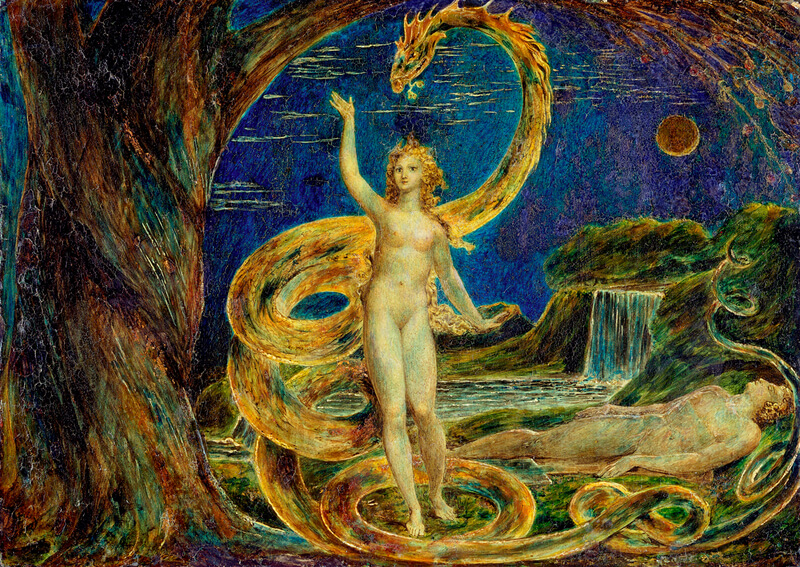
However, before interpreting further this enigmatic in-betweenness of hopelessness, we need to bring in the three key themes of the speech, instead of hope, ‘angels’, ‘human dignity’, and ‘rebellion’. First of all, ‘angels’ and ‘rebellion’ do have an evident and close connection, which at the same time also evokes the apocalyptic struggle between ‘Good’ and ‘Evil’ indeed, and this is the fight of the Fallen angels, especially the arch-Fallen-angel, Satan or Lucifer (but one can evoke several other names, like Belial, the one used by Aldous Huxley in Ape and Essence; Beelzebub, ‘Lord of the Flies’, title of a famous and similarly apocalyptic novel by William Golding; or Mephistopheles, as in Goethe’s Faust – not forgetting Leviathan), against the created world. And this fight, at least for a Hungarian ‘figure of culture’, has an evident connection with ‘human dignity’ as this term was handled by Krasznahorkai. This is because the second part of Krasznahorkai’s speech is an extended, parabolic interpretation of one of the most famous works of Hungarian literature, The Tragedy of Man by Imre Madách (1861), which offers a history of mankind, indeed the history of the entire planet, from its creation, against which Lucifer rebelled. Most of the play is about Lucifer accompanying Adam throughout world history, with Adam (and of course accompanied by Eve) appearing in various roles, from the Pharaoh through Miltiades and Tancred up to Kepler. I can only mention here the very ending of the play, where Adam, once liberated from Lucifer and talking to God, laments that ‘If only I could forget that end (Csak az a vég! – Csak azt tudnám feledni! –)’ – the end meaning the eventual cooling of the Sun and the extinguishing of all life on Earth. To this, in the final line of the play, God responds: ‘I told you, man, struggle, and trust!’ The word ‘trust’, in fact, is a double last word, as the Hungarian is bízva bízzál, or ‘trustingly trust’, which in Hungarian does not sound as a pleonasm, but certainly is to be read as a note of hope. So the three key words of the talk, beyond hope, ‘angel’, ‘human dignity’ as a short history of mankind, and ‘rebellion’ capture together the meaning of Imre Madách’s great play, except for reversing it and so completely emptying it out meaning. Another emptiness, another void, another circle of nihilism – which in a way only a Hungarian can properly understand: but they have to understand it, and also make it accessible for others – rendering this Nobel Prize an even greater cultural and moral scandal.
But this is not all – as the dualism of Good and Evil, just as the angels rebelling against creation has a strong Gnostic tone. And, indeed, Gnosticism comes out quite explicitly in the talk, and exactly once, in the penultimate page, Krasznahorkai evoked the fight of Good and Evil. As he starts the last paragraph of his talk, explicitly intended as a solemn corollary, by claiming that ‘every rebellion addresses the whole’. But this whole which the rebellion of angels is addressing, whether through Madách’s work or in general, is nothing else but the (created) world itself. The rejection of the whole, of the world, is nothing else but verbatim Gnosticism. Krasznahorkai’s speech is therefore not just nihilistic, but technically Gnostic.
In this context, it matters little that the style of the entire talk imitates Esterházy, especially the style Esterházy introduced in his 1981 novel Függő (meaning indirect or suspended speech), as that whole novel was one long sentence.


Related Posts