The Future of The Social Contract
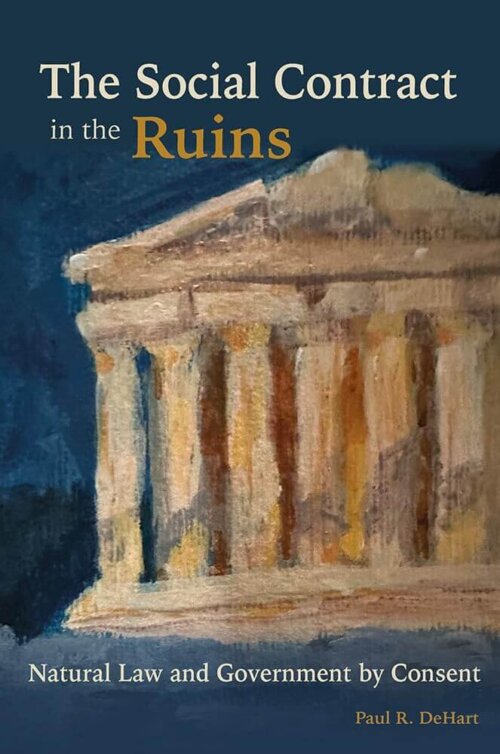
Social contract theory is now a foundational pillar of modern political theory. Any student of politics, political philosophy, and political theory will know the origins of modern social contract theory through names like Thomas Hobbes, John Locke, and Jean-Jacques Rousseau. However, Paul DeHart, a professor of political science at Texas State University, argues in his new book The Social Contract in the Ruins that we have badly understood social contract theory and what actually provides its support which is desperately needed in our contemporary world. It is not consent through equality but classical natural law, DeHart articulates, that gives social contract theory its true power and lasting endurance.
The notion that social contract theory rests on classical natural law rather than consent will strike many readers as new, novel, even dangerous. Apart from students following Leo Strauss, the general representation of social contract politics is that there is some sort of equality in human nature—whether it is in human reasoning or simple dignity—that confers the social contract its authority, legitimacy, and endurance. Opening his work, DeHart makes the provocative claim, “I contend that conventional social contract theory—a variant of social contract theory that makes agreement and therefore will the ultimate ground of political authority and obligation—is self-referentially incoherent.” But DeHart is not out to do away with the social contract. Instead, he wants to revive and rejuvenate it.
DeHart is a judicious scholar who seamlessly weaves Plato and C.S. Lewis with Thomas Hobbes and John Locke. Quite the assortment and diversity of thinkers, especially since conventional wisdom would place these thinkers as antagonistic toward one another. What lies at the heart of DeHart’s critique of conventional social contract theory then his supplemental support of a “new” alternative for it is the metaphysical battle between moral nominalism and moral realism. To summarize, moral nominalism asserts there is no objective moral good (following Hobbes) and that morality is ultimately socially constructed from individuals who come to agreement with each other in order to life a peaceable existence. Moral realism, by contrast, maintains that morality is objective, that there is an inherent understanding of right and wrong regardless of human feelings and cultural differences. Moral realism, then, has similarity to classical natural law.
Why does this matter? Because social contract theory rests on consent. The consent of the people is what gives government its legitimacy. If moral nominalism fractures into ever smaller and warring factions, the legitimacy of consent is lost and we ironically return to the Hobbesian nightmare of a “war of all against all.” If moral realism is true and the majority of a population agrees on right and wrong, this serves to support government by consent and retains the democratic ethos so important to modern western political thinking—democratic here simply referring to rule of the people and this rule of the people is found in majoritarian agreement.
This matters on another level as it relates to our relationship to the State. Following Hobbes, if we cannot reach agreement but the State exists, the State imposes its authority over us and we have no choice but to agree with its directives. Thus, the liberty and relatively free societies that social contract governance establishes slowly erodes into State tyranny. The very logic of moral nominalism necessitates this movement. Thus, in his attempt to salvage the social contract, free civil society, and democratic individualism, DeHart argues for “placing moral realism back on the table as the starting point” for social contract governance.
What follows is a brilliant tour-de-force of philosophies of justice, natural law, human will, and covenantal theory from antiquity to the modern age. Readers will be thoroughly fed with the intellectual food DeHart covers from thinkers like Protagoras and Plato to Thomas Hobbes, John Locke, and David Hume. DeHart not only covers the canonical thinkers of political philosophy, he dialogues with contemporaries like G.E.M. Anscombe and Leo Strauss alongside great philosophical scholars like Frederick Copleston and Quentin Skinner.
Let us return to why this book matters and the overarching questions with which DeHart is wrestling. In the twenty-first century, we have not witnessed the “end of history” but a renewed debate over political governance. The democratic nations of the West which emerged victorious, despite hardship and struggle, in the two world wars and then the Cold War are fracturing. All of us who live in countries like the United States, United Kingdom, France, Germany, Italy, and others can sense and feel this. Polarization in politics is hastening and there seems to be a lack of common ground or the common good in our societies. “Democratic backsliding” has become a commonplace term for political scientists and journalists to describe the phenomenon many western nations are experiencing.
DeHart’s book is part of this dialogue. Rather than take us down a new path, he offers us the best of the western inheritance, past and present, in offering what amounts to democratic renewal. But this is not going to occur through a doubling down on the self-contradictory philosophy of modern social contract theory. The Hobbesian project, to which even Locke (rightfully) belongs, has reached its terminal crisis. Yet the social contract, to which modern democratic government rests, especially the United States, shouldn’t be seen as reaching its own termination. DeHart’s insistence that classical natural law, with its moral duties stemming from moral reality, can be known to the majority of a nation’s citizenry. This offers us hope that a renewed body politic can emerge.
The problem, however, lies in the moral malaise that has infected democratic societies due to moral nominalism. We have become accustom, at least in the past few generations, to believe that moralism has no place in social contract politics. Yet the State is never morally neutral. Moreover, classical natural law depends on objective moral goods knowable to the citizenry who act upon these known goods to live dutiful lives. Democratic renewal will not happen without moral renewal. The two go together. Once we lose our fear of moral renewal, we can be hopeful with DeHart that renewal is possible. “[G]overnment by consent,” he reminds us, “requires a moral basis.”
The Social Contract in the Ruins is a brilliant read, an exceptional work of scholarship, and is far from a pessimistic tome over the future of democracy. It is, in fact, optimistic and hopeful. But we need the eyes to see and the ears to hear the argument DeHart is actually presenting. Anyone who is concerned with the future of political governance, democratic backsliding, and moral decay would do well to pick up and read DeHart’s magisterial contribution to political theory, history, and philosophy.
The Social Contract in the Ruins
By Paul DeHart
Columbia: University of Missouri Press, 2024; 476pp


Related Posts