The Wind is the Blowing: A Review of Crooked Plow
…the wind doesn’t blow, the wind is the blowing… ~ Itamar Vieira Junior
In the Bahia province of Brazil, the rivers and trees pulsate with the same life that farmers feel and harness to live among them. But lurking in the shadows lies the leopard, and the struggle against the leopard reaps life and death.
Two sisters know this violence firsthand. Grandma Donana’s ancient and beautiful knife captivates their curiosity before slicing off one sister’s tongue. Yet, this accident births a sisterhood unlike any other. They learn that life on the plantation will forever entangle them with the beauties of life as well as cause irreparable hurt and sorrow.
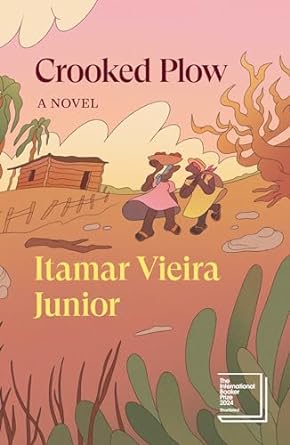
Shortlisted for the International Booker Prize, Johnny Lorenz’s translation of Itamar Vieira Junior’s novel Crooked Plow represents a significant achievement in Brazilian literature. The novel splits into three sections: “Edge of a Blade,” “Crooked Plow,” and “River of Blood.” The individual sections are narrated by the sisters, Belonisia and Bibiana, with the last one taking on the vantage point of the spirit Santa Rita the Fisherwoman.
In an interview, Junior noted, “I believe it to be connected to feelings, to memories. And although we live in urban environments, in cities, I think that the countryside, the forests, natural environments, they still evoke memories, which are very emotional to readers.” He’s spot on—the essence of his story revolves around the most basic and universal human experiences: family, food, and work. Then, he makes careful use of religion, a mix between Catholicism and indigenous rituals and spirits, to imbue the world with a mythic aura that transforms the particular into the universal. This is the story at its best. Violence renders their way of living and community on a knife’s edge.
Parents and their children are universal across all cultures and times. The relationships they share embody a universal truth of life; that once life begins, it must be cultivated and cared for lest it fail. Birth is the beginning of this cycle and the characters in Crooked Plow esteem birth. On two occasions, births help to mend family tensions. Belonisia and Bibianna grow estranged after Bibi runs off with her lover to get married and start a new life. Another set of sisters also fight over the love of a man, and they both end up pregnant by him. In both instances, the birth of a child sparks the healing process.
Zeca Chapeu Grande serves many roles: father to Belo and Bibi, village healer, and farmer. His role as the father furthers this theme of life. He teaches his children how to care both for the land and for others. Belo tells us, “My father would turn to me and say, ‘the wind doesn’t blow, the wind is the blowing,’ and this made sense to me. ‘If the air doesn’t move, there’s no wind, and if we don’t keep moving, there’s no life.’” The land keeps them alive and in return they keep the land. Zeca teaches her how to listen to the earth, when to plant and when to weed. These things surpass the mere production of food; they comprise the living of life. They are not the wind blowing but the blowing. Life is not the act of planting, but life is planting.
Zeca’s healing draws power from both the regional rituals and a loose Catholicism. His practices range from herbal mixtures to Jaré, which are community rituals where spirits interact with humans. These rituals both add flesh to the community and heighten the mythic status of this story. During Zeca’s childhood, he runs away from home to seek a better life for his family, and on that journey, he is hunted by the leopard. This terrifies his mother, but when she finds Zeca the leopard is sleeping at his feet. Zeca’s commitment to healing is what protects him from the leopard; life wins out over death.
When Zeca and Salu, the girls’ mother, take a pilgrimage to Bom Jesus at the end of their lives, they return revitalized, and Zeca can now die in peace. He spends his days working the earth until he physically can’t. He makes one request: to stay at home and not to die in a hospital. When he finally does pass, he does so on Easter Sunday.
Belonisia gets married to a strange, out-of-town man named Tobias. Their marriage is both abusive and infertile. We learn that Tobias “shoots blanks.” He offers nothing in terms of life. He lets his lands and house fall into disrepair—they are described as a slum. His failure to help cultivate life helps to highlight the beauty and archetypal position of Zeca and Salu’s house. The abuse that Belo endures under his roof is a part of the curse of things that do not grow and do not encourage any life.
Unfortunately, the final section of the novel loses the plot. Narrated by Santa Rita the Fisherwoman, she speaks from an omniscient perspective that ventures away from the strength of the novel and into a bitter pessimism. Santa Rita makes clear the already understood injustices the plantation workers endure. We are told early on that they must build houses of clay and nothing else, which places a great burden on the farmers. In addition, we learn through the story that they are taxed heavily, and Severo, Bibi’s husband, introduces the idea of social change into the story naturally. The overt politicization shouts over all else, reducing the magic of the story to secondary importance. Zeca always encourages his family to live a life of gratitude insisting that they have everything they need even if they don’t own their own land. His death is peaceful, unlike so many others. His approach is subtle—not the blowing of the wind but the wind blowing—and tragically, I believe the author makes an error with the injunction of Santa Rita here.
In the final pages, Belo is possessed by Santa Rita and the descriptions make her out to be like a leopard. She stalks through the jungle with a mind only for prey. When she finally catches her prey, the plantation overlord, she uses the knife that crippled her sister to kill the overlord. The final line of the novel is: “On this land, it’s the strongest who survive.” Belo has become an animal. Life is reduced to the survival of the fittest.
This is fairly typical in modern literature. The urge to clearly draw the lines, to shout that you are against the “oppressor” runs rampant. The judges of this year’s International Booker Prize noted the political themes in this year’s nominees, and it’s true that most works of fiction include political elements because most include people. Yet Crooked Plow goes astray when Itamar Vieira Junior doubles down on the political message. In fact, he goes away from the very theme of life. In the last section, “River of Blood,” we see exactly that: blood and violence. Life becomes a cheap commodity laid to waste by the violence. Cemeteries disregarded, people shot out back and hunted, and all so that the author can make clear who the “bad guys” are, even though that was clear from the start. It’s a shame.
In a world of fiction that feels the need to proclaim political opinions without nuance or subtlety, we, writers, must strive to be like Zeca Chapeu Grande. The first two parts of the book accomplish this; they are beautiful descriptions of life that stand on their own. They communicate everything by being good, not saying good things. Let us be the same. Don’t be the act of blowing, be the blowing.
Crooked Plow
By Itamar Vieira Junior, translated by Johnny Lorenz
Verso Books, 2023; 288pp


Related Posts