The Lady and the Fountain: A Glittering Retelling of an Arthurian Legend
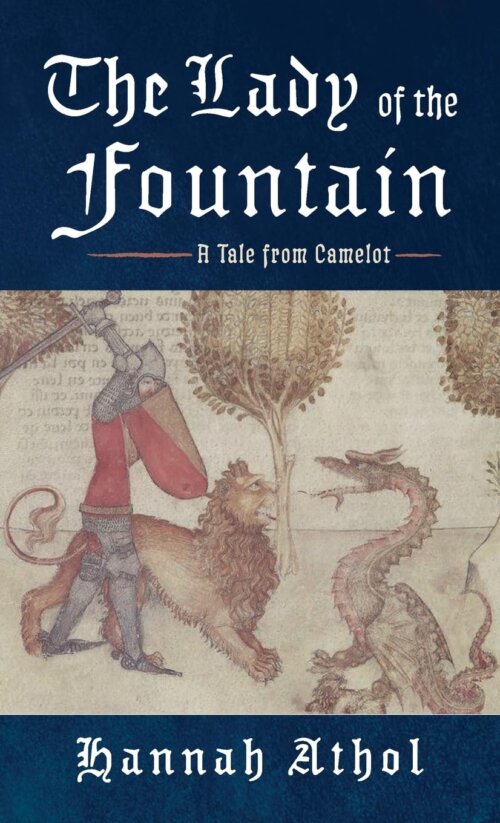
The tail end of last year witnessed the publication of The Lady and the Fountain, the debut book of Hannah Athol, a PhD candidate in biological engineering who also has a soft spot for medieval romances. A very short but swift escapade through the lands under King Arthur’s rule and the watch of his chivalrous knights, The Lady and the Fountain is a retelling of a 12th century French tale of Camelot by Chrétien de Troyes and sits nicely in the same vein of stories as the Welsh Gereint and Enid or the English Sir Gawain and the Green Knight. In fact, Gawain – King Arthur’s nephew – appears in this tale too, unknowingly taking up arms in a tournament against his friend and ally, the “courtly Yvain,” who is also one of Arthur’s knights.
Yvain’s world is much like that of other Arthurian legends, one which perceives honor as the highest good attainable and which boasts a society of people quick to judge and hasty to make vows. The honor sought by knights who seek great daring deeds to perform is tenuous, and their repute is a fickle thing. Besides Gawain and the good king himself, other familiar faces who are glimpsed or mentioned in passing include Guinevere, Lancelot, and “Morgan the Wise.”
As in other Arthurian anecdotes, the eponymous monarch is hardly the protagonist but prefers to take a back seat, seldom forging to the front lines to deal a decision in the matters of the moment. Like other medieval dramas, including the English epic Beowulf, Athol’s characters’ speech is peppered with acknowledgments of God and his glory. Just as the virtuous give a nod to God’s goodness, the hero must face definite evil, as exemplified by the tree-demons who beset the Isle of Damsels. (Animated trees, as opposed to the inanimate kind, seem to be a favorite of English fantasies and medieval sagas.) Biblical language and imagery are occasionally employed, as when Athol describes the sublime transformation of the woods near the Fountain as Edenic. Furthermore, the sacraments as provided by Mass and Confession strengthen Yvain before he and his lion companion set out to battle Harpin the giant. Like all good medieval masterworks, the hero faces and battles ferocious and fantastic creatures. There are damsels to aid and villages to save!
The protagonist, Yvain, upon hearing of a magical fountain deep within the dark recesses of a forest guarded by a black knight upon a black charger, determines to set out and find the font and confront this dark knight. He embarks on this quest and proves the better fighter, mortally wounding the black knight and quickly falling in love with the late warrior’s lover, Laudine. Yvain soon meets Lunete, a maid of Laudine’s royal court, who has pity on the noble knight hiding in the shadows of the city filled with people who would only seek his death had they but known he was their guardian’s killer. To Yvain, Lunete is a shining light in the darkness. For his protection, Lunete lends him a golden ruby ring that grants him invisibility. The charitable woman explains:
A token, a test of your chivalrous merit;
When one pure of heart yet endangered shall wear it
It encloaks one in – ether, shall we say. None will see you.
But beware, lest sin of hate or lies betray you.
The reader’s mind immediately evokes a memory of the One Ring from J.R.R. Tolkien’s now-famous The Lord of the Rings. But we must remember that magical rings have a much older history still, appearing in tales from various ancient cultures like the Norse saga of Siegfried and the Ring of Gyges (which has the ability to make its owner disappear) as related in Plato’s Republic. Athol’s The Lady and the Fountain briefly taps into this long tradition.
Lunete’s act of kindness, which saves Yvain’s life, is repaid by the noble knight later in the epic when a mob seeks to subject Lunete to the same infernal fate as St. Joan of Arc. Meanwhile, Yvain marries Laudine. Their love seems genuine; their happiness, warm and enduring. That is, until Yvain commits to a tournament at Camelot. Laudine makes him promise to stay involved in the games no longer than a year and a day or else he would “forfeit my love and my vow.” Through his own negligence and losing track of time, the unthinkable happens: The time comes, and Laudine, like the noblest knight in the land, stays true to her word. Though the narrator never fails to laud the virtues of Yvain, the protagonist feels he must prove his honor by going on quest after quest.
Along the way, Yvain rescues a lion caught in a death grip with a serpentine dragon, and the beast is forever grateful, forever loyal. (Even this struggle between two animals is reminiscent of Christian imagery, which uses the Lion to symbolize Christ and the serpent to symbolize the devil.) This leads Yvain, who keeps his true identity a secret out of shame for having lost Laudine’s love, to become known as “the Knight with the Lion.”
Whether he regains Laudine’s affection is for the reader to discover. This entire tale of Camelot is elegantly rendered to the modern reader who will find it glittering with rhyme and alliteration as well as rough swordplay and adventure, a delightful addition to the collection of any Arthurian legend fan. While it might only be her debut literary work, Hannah Athol’s mini epic proves to future readers that she has a flair for storytelling.
The Lady of the Fountain
By Hannah Athol
Eugene, OR: Resource Publications, 2025; 46pp


Related Posts