Confronting the Great Awokening
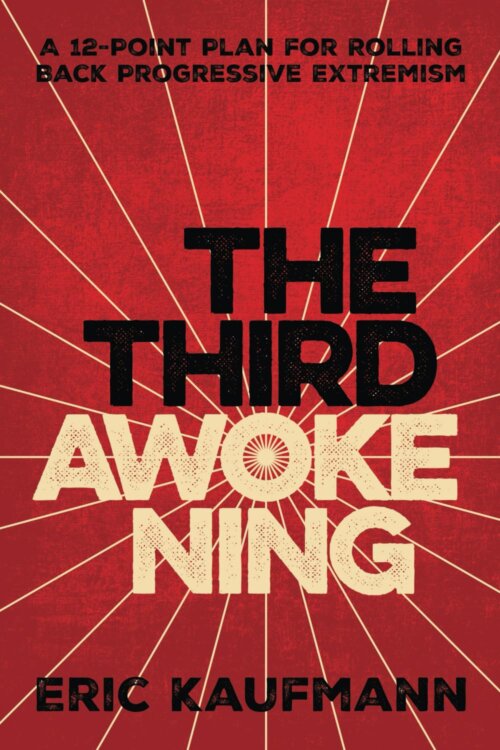
Writing in 2006, French political philosopher Pierre Manent characterized the student uprisings of 1968 as “an explosion of mildness or softness, an explosion of what Tocqueville called democratic mildness.” Specifically, Manent viewed those raucous days in the 1960s as Tocqueville’s intellectual revenge against the displacement of the advance of democratic equality he so aptly analyzed in the 1830s and 40s, by the rise of Marx’s concern with class inequality in the revolutions of 1848. We could say that this French insight is shared by the Canadian academic and professor at the University of Birmingham in the United Kingdom, Eric Kaufmann. In his most recent book, The Third Awokening, Kaufmann sets himself the comprehensive task of describing the origins, dynamics, and potential political responses to what has become known popularly as “wokism,” or what Kaufmann designates “progressive illiberalism” or “cultural socialism.”
Why Manent’s Tocquevillian comments are relevant to Kaufmann’s work is made clear in how Kaufmann conceptualizes the foundations of cultural socialism. While many have argued that contemporary “woke” preoccupations are based in revolutionary cultural Marxism, Kaufmann disagrees, contending that wokism is a form of cultural socialism born out of the drift of liberalism into progressive illiberalism. Clarifying the intellectual and political origins of cultural socialism constitutes the first of three parts of this wide-ranging work. The second part, dominating much of the book, “traces the effects of this ideology on society,” using extensive quantitative analysis to look at the demographics of cultural socialism, its militant use of critical race theory and cancel culture, and the three successive culture wars that have accompanied the advance of the cultural socialist paradigm. Finally, in part three, Kaufmann details his proposal for combatting this ideology with a 12-point plan that focuses on government action to counter woke-infected institutions. By calling for government intervention, Kaufmann harkens back to the very origins of our democratic and liberal regimes in the active engagement of the Hobbesian Leviathan as it deploys its sovereignty to quell the war of all-against-all in the would-be state of nature. In its broad scope, Kaufmann’s book is a political philosophy that aspires to explain why the West, and especially the English-speaking world, has genuflected to cultural socialist ideology.
Whence Cometh Woke: A Farewell to Marx and the Return of Tocqueville
For Kaufmann, the persistence of wokism is a fitting jumping-off point for understanding this latest instantiation of cultural socialism at work. In addressing this topic, Kaufmann targets a number of what he considers mistaken viewpoints. There are those who generally dismiss talk of wokism and its attendant cancelation tactics as false starters. They view “progressive” efforts to combat social exclusion, especially under the “diversity, equity, inclusion” rubric, as means to right historical wrongs enacted against marginalized groups. In their minds, reference to wokism and cancel culture are nothing more than a contemporary backlash by vested interests – usually white, heterosexual males and those “adjacent” to them – to extend colonialist and capitalist structures of oppression.
Then there are those who decry wokism but insist, more based on anecdote than statistical evidence, that the illiberal phenomenon is on the wane. As with its historical predecessor – political correctness – these individuals see wokism as a passing fad that has little staying power.
While the first group views our modern western world and its institutions as shot through with systemic inequalities that must be challenged, the second group believes these self-same institutions are largely immune to the ideological plaintiveness of cultural socialism; if such institutions are influenced by the fad of wokism, it is only a fad and will pass with time and according to the dictates of a free market of ideas. What neither accepts is that contemporary wokism is yet another in a line of liberal-inspired – i.e., not Marxist – efforts to ameliorate the condition of the would-be marginalized. Unlike the second group, Kaufmann does not believe that wokism is a fad fluttering across the surface of western civilization with no substantial impact on our social institutions. And unlike the first group, he does not believe that our institutions are hopelessly weighed down with discriminatory intent. Rather, he considers that it is cultural socialism that has captured our institutions and is entrenching a decades-old ideology in our social fabric. Woke has both a pedigree in cultural socialism and power based in its democratic rhetoric. It is not going away anytime soon, and it is not ready to join Marxist-inspired economics on the scrap heap of history.
Kaufmann contends instead that Marxist revolution was replaced after approximately 1965, at least on the liberal left, with a new dogma of mildness centered around a therapeutic view of democracy emphasizing a liberal obsession with identity built on the sacralization of anti-racism. But this is not entirely a new notion. Rather, it was a central theme in Tocqueville’s writings on democracy, which predated the Marxist social question by a number of decades: the democratic question that so interested Tocqueville both preceded and survives Marx’s social question. For Kaufmann, as for Tocqueville, the issue is a democratic obsession with equality, and in our contemporary situation, an equality based around the need to protect would-be marginalized groups from harms both real and imagined. The result is our current disciplinary and illiberal regime in which speech itself is characterized as a form of violence.
Historically, Kaufmann argues that this obsession with a culture of care inaugurated the first wave of wokism via the anti-racism movement of the mid-1960s, especially in the United States. Going beyond the justified and liberal concerns of the Civil Rights Movement, anti-racism became an ideological force that saw the United States as inherently racist and in need of total revolution. This framework became the template for a proliferation of identity groups each demanding their place in the oppression matrix.
Building on this foundation, the 1980s and early 1990s witnessed the second awokening with the political correctness movement that sought to impose speech codes, primarily on university campuses. As Kaufmann and others have noted, political correctness fizzled out as numerous court challenges found speech codes to be unconstitutional. But these legal victories did nothing to disturb the growing emphasis on identity politics within our institutions of higher learning. In fact, from the 1990s onward, what have become known as “area studies” – highlighting identities of race, gender, and sexual orientation and their intersection – have come to dominate numerous academic disciplines at our universities.
And this brings us to today’s third awokening with its more virulent focus on policing speech, its toxic cancel culture, and most importantly, its migration beyond the academy and into society and our institutions generally. For Kaufmann, this vast social contagion, emerging from left-liberalism rather than cultural Marxism, is more than a passing phenomenon. Rather, it is a significant intellectual and political element embedded within our therapeutic democracy—it is the rhetoric of contemporary democracy. And it is this entrenched aspect that causes Kaufmann to argue that wokism, even if cancelations and DEI policies have peaked, is far from a spent force as it is simply the current manifestation of the underlying cultural socialist ideology.
There are two points worth mentioning here. While Kaufmann denies that wokism is cultural Marxism run rampant, like many, he does point to critical theorist Herbert Marcuse as an important inspiration for left-liberal ideology. Referring to Marcuse’s 1960s writings, specifically his arguments that the liberal doctrine of free speech benefits the oppressors far more than the oppressed, Kaufmann notes how our contemporary cultural socialist ideologues have drawn on certain elements of neo-Marxist critical theory, as well as aspects of Foucauldian post-modernism and neo-feminism, to construct their disciplinary speech regimes. However, he rightly comments that many of the thinkers in these traditions would not support woke goals, even noting that the libertine and emancipatory objectives of such diverse thinkers as Foucault, Habermas and first and second wave feminists, would have little in common with the rigid and puritanical moralism of cultural socialist activists.
The second point I would make concerns what I have called Kaufmann’s Tocquevillian exegesis of democratic egalitarianism. While Kaufmann himself does not discuss Tocqueville’s classic assessment of democracy’s potential drift towards a stifling equality that both restricts human intellect and imposes a regime of therapeutic softness, I do not think Kaufmann would protest at the comparison between his analysis and that of the French aristocrat. Indeed, while the historic situation differs, the very fact that Kaufmann’s assessment of post-1960s democracy so closely reflects Tocqueville’s own analysis, indicates that Kaufmann has identified an abiding danger intrinsic to modern democracy. This is not to say that Kaufmann sees cultural socialism as the only path forward for modern democracy. Indeed, he notes that wokism is far more prevalent in some countries, such as Canada and among many of the Anglo-American democracies, but less a factor in continental Europe, and almost completely non-existent in Asian democracies such as South Korea and Japan.
The Data and Politics of Wokeness
As a trained sociologist, Kaufmann is in his element presenting a series of data sets showing the growth, demographics, politics, and impact of woke cultural socialism. This analysis constitutes the large middle section of the book and includes a number of interesting facts spread across numerous chapters. Kaufmann provides an array of hard statistical data tracking issues from the rise of contemporary wokism and its preferred methods of enforcement through both soft and hard authoritarian measure, to asymmetrical political bias among the woke and the prevalence of cultural socialism and soft democratic despotism among the professional classes, youth, and white females. The great value in these statistics is that they serve to refute those who claim wokism and cultural socialism do not exist. To the contrary, Kaufmann’s exhaustive data provides a detailed picture of those who adhere to cultural socialism’s punitive dogma. In this regard, this large middle section provides an invaluable scientific confirmation of cultural socialism’s methods, demographics, and coherence as an ideological entity.
However, what I found most compelling in Kaufmann’s presentation is his political analysis of the three culture wars that have accompanied cultural socialism’s advance since the 1960s. According to Kaufmann, there have been three distinct but related and overlapping culture wars, each with a specific focus and alignment of forces among left-liberal cultural socialists, classical cultural liberals, conservatives, and the emergent populist forces that arose as a reaction to cultural socialism. The first culture war beginning in the 1960s concerned a liberalization of social mores around premarital sex, divorce, homosexuality, and religious adherence. In this war, liberals generally faced off against conservatives. The second culture war, with its political correctness speech codes centered around national versus globalist divides along with increases in immigration and cultural diffusion. This war again tended to engage liberals against conservatives, though many economic conservatives were ardent supporters of globalism.
This brings us to the third culture war, dominated by wokism and its attendant punitive speech regime, cancel culture, and DEI initiatives. What is interesting here is that the traditional political alignments have changed rather dramatically. Whereas the first two culture wars tended to play out between liberals and conservatives, our contemporary culture war has witnessed a new alignment of classical cultural liberals, with their concerns for free speech, due process, and the rule of law, with conservatives who support traditional values, national identity, and patriotism. This leaves cultural socialists on the far left as the defenders of therapeutic democracy. In addition, a more radical type of conservative has emerged on the right in the form of new populists, often mimicking the cancel culture tactics of the left-liberal cultural socialists.
This realignment suggests two things. First, it departs from the traditional liberal democratic interplay between reformist liberals and social democrats on one side who, to use a vehicular metaphor, apply the gas pedal, and cautious conservatives, who favor the brake when it comes to social and political change. This is significant because the liberal-conservative dynamic of measured progress and alternation between the two political camps has been the model for western democracies since the American and French Revolutions. This has important implications for how we respond to cultural socialism because this ideology appears as a form of strict egalitarian authoritarianism outside the traditional liberal-conservative interplay. The best evidence of this is that the parties of the woke left have largely abandoned working class concerns for cultural socialism, so much so that populists and conservatives are now actively courting a disillusioned working class. In this regard, if Marx is making a return, he is not making it on the left of the political spectrum, and this is bringing even classical socialists and Marxists into the alliance of cultural liberals and conservatives.
The second point goes more to the foundations of our current malaise and serves as an introduction to the third part of Kaufmann’s book. If Kaufmann’s analysis, both of the cultural socialist ideological framework and the political realignments it manifests in our current culture war, is correct, then we cannot respond adequately to this situation with our usual democratic rhetoric. It is not uncommon today to hear left-liberals decry populism with its alleged disinformation and anti-establishment themes as threatening democracy. It is also not uncommon to hear conservatives call for a principled conservatism, based on a Burkean philosophy of tradition, gratitude, and community. However, both positions are heuristically caught in the old liberal-conservative dynamic that has dominated since the rise of the democratic question that so interested Tocqueville. While Tocqueville’s and Kaufmann’s analysis of democratic softness helps to identify the egalitarian extremism of the cultural socialist left, Kaufmann suggests that the way out of this conundrum goes to something more foundational than our democratic mores and institutions.
Back to the Beginning: Hobbes, Locke, and a Normative Political Science
In his final two chapters, Kaufmann offers his prescription for combatting wokism and its underlying cultural socialism. He provides a 12-point plan on how to go about this task, but more interesting than the plan are the thinkers he holds up as models. Assessing the current challenge to liberal democracy in general, Kaufmann notes that we cannot turn to the founders of our modern democratic regimes, explicitly naming James Madison in this context. Here, Kaufmann is worth quoting in full:
The challenge to liberalism is not the one faced by American Framers like James Madison or citizens of authoritarian countries. Instead, it is more similar to the threats identified by Thomas Hobbes and, to some extent, John Locke, who lived during a more anarchic age than Madison. Whereas Madison feared the tyranny of government against its citizens, Hobbes worried about private violence in an age rent by vicious religious war and ideological division. John Locke agreed with Hobbes that governments and citizens enter into a social contract to secure protection for freedoms. Among the natural rights government help to defend are those of life and property, even as Locke also worried about governments’ threats to those rights. As Steven Pinker notes, violence in anarchic contexts like tribal competition or a failed state is orders of magnitude higher than in places with strong governments, even if repressive.
This is a rather revealing passage. Kaufmann argues that we are currently in a state of political dissolution so foundational that it goes well beyond the democratic concerns of framers like Madison to the core of our political and social existence. From his perspective, extreme egalitarian cultural socialism is not simply a threat to our democracy or to the efforts at social equality those democracies have engaged, but to the very existence of our political regimes altogether. As the reference to Hobbes, Locke and Pinker makes clear, Kaufmann views our current situation as one akin to the anarchic state of nature described so forcefully by Hobbes. In effect, the cultural socialist agenda with its emphasis on identity politics represents a tyranny of private interests waging a social war for control of our institutions using toxic speech restrictions and DEI initiatives.
Turning to Hobbes himself, it is not difficult to see the force of Kaufmann’s arguments. As is well known, Hobbes attributed the disorder of his age to certain opinions which, as mere opinions, could not provide the basis for a stable political order. Instead, all they could do was undermine political and social cohesion. Hobbes identified two problematic opinions. The first was that of extreme protestants who sought a return to the purity of early Christianity. The second were the Aristotelians at the universities. By comparison, those who are woke would certainly correspond well with the religious zealots of the seventeenth century. Similarly, our universities, though hardly Aristotelian, are the fountainhead of contemporary cultural socialism. Hobbes solution to this problem was his classical construction of the sovereign Leviathan who would stand as the neutral arbiter over the warring factions of the state of nature, now pacified as members of civil society. This framework, with its interplay between sovereignty and representation, would become the underlying foundation on which the liberal democratic regime would rest.
As with Hobbes, Kaufmann’s solution to our contemporary anarchy is for government, as sovereign, to rise above the woke intermediate institutions of civil society and take in hand its role as representative of individual citizens (whether they are cultural liberals, conservatives or old-time socialists and Marxists) to counter the contagion of cultural socialism that has highjacked those same intermediate institutions. In doing so, Kaufmann notes that this is an inversion of the limited government mantra prized by both conservatives and cultural liberals. For many, it was precisely the intermediate institutions of civil society that were to serve as the check on state power. But in our current situation, it is the institutions, starting with those universities reminiscent of Hobbes’ day, that are now the threats to individual liberty as well as reasonable government action.
The effect of Kaufmann’s analysis is that we have come full circle in our liberal democracies, back to our origins with a return to a Hobbesian state of nature. However, a return is not the same as the origins themselves, and Kaufmann seems to be aware of this. Unlike Hobbes and Locke, Kaufmann references notions of human flourishing. And this, I would suggest, reflects the difference between the Aristotelians of Hobbes’ day and the cultural socialists who dominate our universities. The problem the Aristotelians represented for Hobbes and for Locke was that they promoted a specific notion of human flourishing based on a positive assessment of natural human goods. Underlying this assessment was the notion that humans had a substantive nature that could be known, at least in part. Hobbes, and even more so Locke, explicitly built their political philosophies to eschew any sort of nature, to displace in its entirety the notion of humans as a substance with identifiable ends and to eliminate any suggestion of innate ideas (though David Hume would call out Locke for retaining the right to property as a complex idea). As such, the origins of our modern regimes tend to avoid positive references to human flourishing. But Kaufmann contends that what we need today is a new sense of flourishing that would incorporate the concerns of classical liberals, conservatives, and as I’ve noted above, more traditional socialists and even Marxists. In returning to our modern beginnings, with cultural socialism seeking to undo our past and in the name of a disciplinary and infantilizing therapeutic regime, a new notion of human flourishing – some would even call it a kind of human nature – informed by five hundred years of modern experience, is what is most needed. To the extent that Kaufmann has contributed to this goal, his book would constitute a throughgoing normative political philosophy.
The Third Awokening: A 12-Point Plan for Rolling Back Progressive Extremism
By Eric Kaufmann
Bombardier Books, 2024; 395pp


Related Posts