Things to Hope For
“I fear we are not getting rid of God because we still believe in grammar.” ~ Friedrich Nietzsche
“Postmodernism” is an odd term. Indeed, it is a term that, in the twenty-first century, means both everything and nothing. According to some thinkers, we are no longer in the postmodern period. For these thinkers, postmodernism ended on 9/11 or with the 2008 stock market crash or with the election of Donald Trump. These thinkers are relying on the definition of postmodernism provided by Jean-Francois Lyotard in his 1979 work, The Postmodern Condition: A Report on Knowledge (La condition postmoderne: rapport sur le savoir). According to Lyotard, postmodernism is defined by the death of grand narratives. While premodern societies were structured by reason and religion and Early Modern societies were shaped by a combination of religion, science, and reason, postmoderns (allegedly) have lost all belief in progress, science, religion, and national identity.
The twenty-first century, however, has seen a resurgence of grand narratives. Due to scientists turned public intellectuals such as Richard Dawkins as well as psychologists such as Jordan Peterson, there has been a reassertion of the potency of the grand narratives of biology-specifically evolutionary biology (in the case of Peterson, coupled with Jungian archetypes). Moreover, religion is both (paradoxically and very postmodern-ly) both in decline as well as in ascendence throughout the world. Even nationalism, which, in the West, was blackened by both the first and second World Wars, is on the resurgence. What is different about the twenty-first century reassertion of grand narratives is their “post-ironic” (and thus their post-postmodern) character. Part of postmodernism’s rejection of grand narratives was an ironic posture that mocked everything from religion to the family unit to patriotism (perhaps the most pronounced examples of this ironic post are the television shows The Simpsons and South Park). In the twenty-first century, an often (but not always) fanatical adherence to grand narratives that refuses to listen to any criticism or counter narrative is one of the dominant modes of both thought and communication.
One of the most prevalent post-ironic grand narratives in the twenty-first century is traditionalism. This movement is largely ambiguous, diverse, and contradictory in its character. However, on the surface, traditionalists believe that modernity has had a poisonous effect on the human condition. In this view, liberalism, capitalism, Marxism, feminism, individualism, statism, industrialism, and egalitarianism are all attacks on human nature and the right ordering of human society. Some traditionalists are Gnostics, occultists, and/or pagans; most (but not all) traditionalists are men and women of the right, and some traditionalists are Christians. Traditionalists generally view human culture as being in a state of decline since at least the Reformation. In this view, one form of human culture that has especially declined is poetry (and language in general). In the Anglo-phone world, after the advent of High Modernist poets and novelists such as T.S. Eliot, Ezra Pound, James Joyce, and W.H. Auden, language has deteriorated into a flattened and infantile form of communicating that is produced by and, in turn, produces flattened and infantile people.
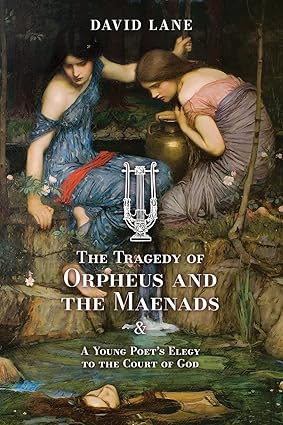
In response, Traditionalists have waged a war on modern art and culture both on the internet and “in real life” with social media accounts, homeschool initiatives, printing presses, and conferences. One Catholic traditionalist who has waged a war against the modern degradation of language is poet David Lane. The author of two previous works of verse, The Tragedy of King Lewis Sixteenth (2012) and Dido: The Tragedy of a Woman (2016), Mr. Lane has published two new works in one volume: The Tragedy of Orpheus and the Maenads and “Young Poet’s Elegy to the Court of God.” What is most curious about Lane’s work is not so much how he utilizes classical myth as well as Christian devotion in a serious manner (something that is verboten among some contemporary poets), but that he writes in such an elegant and elevated manner, a manner reminiscent of John Dryden and other poets of the “Long Eighteenth Century.”
The myth of Orpheus is one of the most potent and ancient in the Western tradition. It deals with some of the deepest elements of being human: love and marriage, the afterlife, the power of poetry, and the tremendous potency of human emotion. In the myth, Orpheus and his wife Eurydice are married. However, Eurydice is bitten by a snake (in some versions of the myth, it is on her wedding day). Orpheus goes to the underworld to retrieve her, playing music for the gods of the underworld. The gods let her return on condition that she does not look back. She, of course, looks back and falls into the underworld. Orpheus returns to the earth to mourn the loss of his wife, foreswearing the company of women. In some versions of the story, the women of Thrace, his home, are so upset with Orpheus’s rejection of them, that they tear Orpheus to pieces and toss his dismembered body into a river; a prophecy develops that Orpheus’s body will be reconstructed, and he will return.
David Lane’s version of the story focuses on Orpheus’s melancholy as well as his encounter with Dionysius, the god of wine (and savage and brutal violence) as well as his notorious Maenads—images of frenzied women who serve the god Dionysius. Dionysius’s temptation of wine cannot placate Orpheus, however. The Tragedy of Orpheus and the Maenads thus presents the limits of the classical world. Wine, women, and song cannot satisfy the human heart. This satisfaction comes in the second work in the volume, “A Young Poet’s Elegy to the Court of God.” This second poem is a moving mediation on the sinful soul’s need for God’s grace and the satisfaction that comes from feeding on Christ, the Bread of Life. The two works thus fit in a harmonious whole and show that true traditionalism is ultimately grounded in the true God.
Traditionalism—including Christian traditionalism—has come under some criticism in recent years from both the left and the right. The left—who fear the influence of power brokers such as Stephen Bannon and Alexander Dugin (both of whom identify as [albeit very different] traditionalists)—have crafted a number of works warning of traditionalism’s rise. Some on the right, using the language of postmodern irony, have attacked traditionalism as an outmoded and ultimately Romantic-nostalgic way of being. Even within Christianity, some conservatives have questioned (at least some forms of) Traditionalism’s association with the occult. Ultimately, however, these are bigger questions than can be answered herein.
Nonetheless, traditionalists are correct to note that the myths of modernity (enshrined in pop culture) have lost their power while ancient myths retain their (sometimes all too dangerous) potency. Moreover, contemporary language (whether produced by Artificial Intelligence or humans) has reached an abysmal state and needs reinvigoration from earlier modes of speech. In his Orpheus and the Maenads & “A Young Poet’s Elegy to the Court of God,” David Lane accomplishes this task admirably, keeping the small flame of civilization alive.
The Tragedy of Orpheus and the Maenads & A Young Poet’s Elegy to the Court of God
By David Lane
Waterloo, ON: Arouca Press, 2023; 105pp


Related Posts