Time With Erich Fromm: A Cautionary Tale
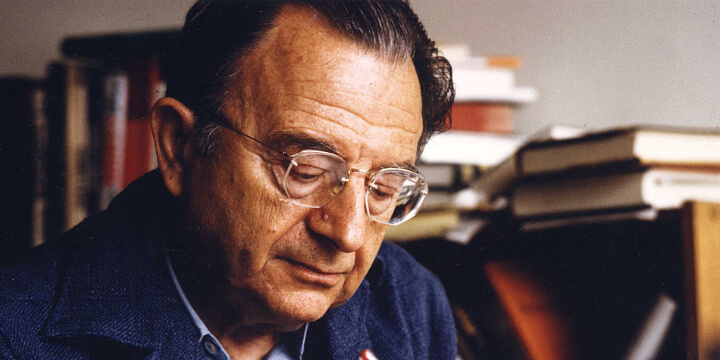
After a more or less successful news hiatus of several weeks (following advice I often give my psychotherapy clients in order to titrate toxic exposure), I had the occasion to revisit the work of Erich Fromm, perhaps best known, especially to coming-of-age Baby Boomers, for his book, The Art of Loving, published in 1956, and released in numerous editions since. That book, an attempt to present psychoanalytic foundations for understanding “contemporary” notions about love, argued that love is an art, requiring knowledge, effort, discipline, and practice: corrective notions to a generation already showing signs of the consequences of the worship of romantic love, suffused as the notion is with quickly evaporating false premises and aspirational but unrealistic expectations.
The occasion was revisiting some of the early classics of psychological literature on which I had cut my teeth as an undergraduate psychology student in the early 1970s. Fingering through shelves of dog-eared volumes, the names were familiar: Freud (of course), Jung, Rogers, Adler, Horney, and many others. I felt afresh the excitement these masters brought me as a curious but naïve young student, eager to soak up the psychological wisdom of the ages, and reflected on how the foundations of their work informed and shaped my own development as a clinician over several decades.
I happened upon a title, certainly remembered for its cleverness but unique in its premise; and in light of the current political landscape, one I had to struggle through my memory to re-apprehend: Escape From Freedom, by psychoanalyst Erich Fromm, originally published in the United States in 1937. (Curiously, the title of the release in the UK was The Fear of Freedom; perhaps more apt to the premise.) Lesser known amongst lay readers than The Art of Loving, it offers, despite its psychological density, a cautionary tale for our time and all time.
Erich Fromm (1900-1980) was a German Jewish psychoanalyst who emigrated to the United States in 1934 following the Nazi regime’s election to power. Along with other psychoanalysts, he founded several psychoanalytic research institutions at Columbia University and elsewhere. In the “Neo-Freudian” tradition, he parted ways with Freud primarily due to his increasing convictions regarding the interplay of the roots of individual personality formation with the social structures in which they evolve. His background in law and sociology prior to psychoanalytic training ultimately led to the development of the field of “political psychology,” or, as implemented in a clinical setting, what came to be known as “social psychoanalysis.” He was eventually disfavored by traditional psychoanalysts who criticized his model that insisted on incorporating the understanding of social and economic factors into the intrapsychic conflicts expressed by the individual.
Fromm’s basic premises about human nature was informed from as varied sources as Talmudic interpretations of the fall of Adam and Eve to the work of social research as it was conducted in the early 20th century. For brevity and an admitted simplicity, his model derives from a theory of human development originating in a conflict of drives: the desire to be free to create a meaningful and fulfilling sense of self in relation to other human beings, primarily from a point of economic security, while at the same time being existentially fearful of the consequences of that freedom. Humans’ inability to control their own economic destiny results in disillusionment, a sense of powerlessness, and longing for psychological rescue. One sees how his model differs fundamentally from Freud’s view that all neuroses resulted from intrapsychic conflicts alone, thus partially explaining Fromm’s departure and his attempts to explain the roots of authoritarian/fascist identification.
Fromm’s comment on the inherent conflict described above might best be summarized here: “There is only one possible, productive solution for the relationship of individualized man with the world: his active solidarity with all men and his spontaneous activity, love and work, which unite him again with the world, not by primary ties but as a free and independent individual. However, if the economic, social and political conditions do not offer a basis for the realization of individuality in the sense just mentioned, while at the same time people have lost those ties which gave them security, this lag makes freedom an unbearable burden. It then becomes identical with doubt, with a kind of life which lacks meaning and direction. Powerful tendencies arise to escape from this kind of freedom into submission or some kind of relationship to man and the world which promises relief from uncertainty, even if it deprives the individual of his freedom.”
The ”relief from uncertainty” Fromm describes is to be found in identification with a leader who promises “freedom” from such uncertainty. The identification with such leaders, who are often elevated to “messianic” status, and the fantasied relief they promise, explains the psychological underpinnings of the supposed “populism” broad-based media often struggle to explain. (A recent work by noted psychoanalyst, Dr. Roger Frie, Edge of Catastrophe: Erich Fromm, Fascism and the Holocaust, [Oxford University Press, 2024], traces the formation of Fromm’s theories across the span of his lifetime, derived from unpublished correspondence of Fromm’s family members during the time of the holocaust and provides some critical insight into the evolution of his thought.)
In a 1937 essay, “On the Feeling of Powerlessness,” Fromm says, “In authoritarian states, the incapacity to have any influence is elevated to a conscious principle.” Put more bluntly, Karen Horney, another Neo-Freudian and contemporary of Fromm, in the 1939 article, “Can You Take A Stand,” states, “Fascist ideology promises to fulfill all their needs. The individual in a fascist state is not supposed to stand up for his own wishes, rights, judgments. Decisions and judgments are made for him and he has merely to follow. He can forget about his own weakness by adoring the leader. His ego is bolstered up by being submerged in the greater unity of race and nation.”
The individual’s need to come to terms with concepts about freedom and personal responsibility in the face of social forces is no less relevant today than it was in overtly fascist Nazi Germany or other authoritarian regimes. Today, these themes are increasingly emerging in psychotherapy as expressed by clients who struggle with the question of, “What do I do?” when faced with the perceived advance of authoritarian imperatives and policies. Such questions are superimposed on the therapeutic dialogue related to more immediate concerns such as anxiety and depression. Immersed as we are in the contingencies and necessities of everyday life, one can easily succumb to pessimism bordering on nihilism. Likewise, therapists struggle with how to support and guide clients in their pursuit of wholeness in an arguably and increasingly unrecognized social/psychological landscape. For clients, these struggles often involve a growing sense of alienation from and even suspicion of others stemming from a sense that historically accepted social structures, such as “the rule of law,” seem to be crumbling. For therapists, the struggle is to learn how to appropriately address such concerns within the psychotherapy context in ways that would have been unimagined a mere decade ago.
In typical psychoanalytic style, while Fromm’s writings suggest that there is clearly no formulaic answer to these questions, Fromm is to be credited with the prophetic voice that warns against the surrender of the pursuit of true freedom, however constrained by economic and related social hardship. Fromm was not “religious” in the sense of offering any traditional theology to provide a landscape from which to navigate such questions, much less the Judeo-Christian concept of God from whom all earthly authority derives. How does an individual respond to the psychological dissonance experienced by those whose life in free democracies has been the water they swim in and now find the waters receding and gasping for breath? Might one be forced to reconsider fundamental notions about the meaning of a “free” society and how might such considerations rewire one’s psychological journey? This is an emerging aspect of contemporary psychotherapy for which we can be grateful to Fromm for his prescience and guidance.
One statement I’m sure I would have youthfully ignored in my reading of Escape From Freedom during the relatively early post-World War II years was this: “There is no greater mistake and no graver danger than not to see that in our own society (referring to the United States) we are faced with the same phenomenon for the fertile soil for the rise of Fascism anywhere.” Fromm warned us that this mistake will be great, indeed.


Related Posts