Walking the Camino Portugues to Santiago: On Development and Developers
As we are running out of time for many things, we chanced this April to walk the Camino Portugues with Agnes. We had limited success, for various reasons, but gained experiences that helpfully confirmed and complemented our previous pilgrimage experiences, the basis of our 2018 book Walking into the Void. We deemed them worthy enough to share here. Hope the kind reader would agree.
Portugal is a country we never visited before, though heard a lot about it, mostly good things, and these turned out to be mostly correct. Not all sociologists agree with the point of Gadamer about so-called prejudices being ‘prior judgments’ based on previous experiences, but I do agree with the relevance of the point, and it certainly applied to Portugal. In Portugal, people are still quite friendly and nice, probably because the natural human kindness has been preserved there through the isolation of the country, food and drink is cheap and of good quality – except, of course the larger cities – which immediately takes us into the very heart of things, the way the nature-culture-modernity trio works out through the experiences of a long-distance walking pilgrim.
Walking pilgrimage is fundamentally about walking in nature. Walking in modern cities makes no sense; it is not a pleasant experience. Portuguese cities are not exceptions to this rule, but the Camino Portugues, from Porto, where we started, has a solution: there is a Coastal Way, where one can walk out of Porto alongside the river Douro, then the seaside, so it is actually quite pleasant. This was made even more pleasant by constructing near the beaches wooden plank walkways, thus saving the trouble of the difficult choice between walking on sand – which after a certain distance becomes very cumbersome; or walking on asphalt roads – which is always unpleasant.
Thus we walked out of Porto in a quite pleasant manner, also – being April – in a quite pleasant weather, until we reached Matosinhos, where we stayed for the first night. In our 2011 Camino di Santiago we did regularly 25-30 kms per day, but now we settled with the more modest 15-20 kms. And in Matosinhos we were immediately confronted, quite violently, with the nature-culture-modernity nexus, that became our guiding experience already in our previous walking pilgrimages. Matosinhos is the North-Western coastal part of the Porto metropolitan area, so the presence of nature is guaranteed. In fact, in abundance, as the size of the beach at Matosinhos is astonishing: while I had ample experiences in Italian and French beaches, they cannot be compared to the size and quality of Matosinhos. They indeed recall the beaches of Brazil, like Copacabana, though I was never there, only know about them through football.
There are also signs of culture in Matosinhos, but for this we must leave the beach and go to Rua de Brito Capelo, which we found by accident, as our lodging was there – the pilgrim hostel of Matosinhos was some three miles inside, reaching which we were advised to take the metro, which we declined.
And here I should indicate that the following analysis will be purely phenomenological, based on my lived experiences. One could research the history of Matosinhos, but that would fall way outside the scope, and purposes, of this essay. Here I only try to convey my experiences about the striking contrast between nature, culture, and modernity in contemporary Matosinhos, and what it could possibly teach us about the character of our world.
Let me start by saying that Rua de Brito Capelo, where now a tram runs – which, in contrast to the beach tram of Porto, is a modern vehicle – is still a strikingly beautiful street. It is quite wide, much wider than the neighboring streets, with the tram running in its center, and having two wide pedestrian sidewalks – cars are not allowed to enter. This means that one can calmly walk up and down the street, without disturbance, trams only intruding once in every 7-8 or so minutes. The street is of North-West – South-East orientation, so on an April afternoon it both offers ample sunlight and places in shadow. It also strikingly recalls classical Westerns – I cannot quite explain, even for myself, why.
The main feature of the street, however, are its houses. They are – or rather were, and this should be stressed, being at the center of this story – exceedingly beautiful. They are rather small houses, not large villas, mostly of two floors, with the walls covered by beautiful and varied maiolicas – a main feature of Portuguese building decoration. So they were evidently the residences of a quite numerous middle class – well-to-do but not exceedingly rich. But only were, as most of them show signs of significant decay – many being close to collapse, some having actually done so.
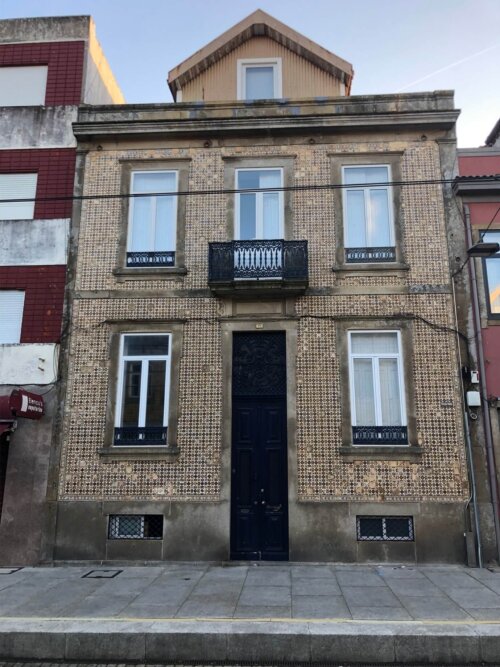
Of the houses, many are still lived, but quite a few are evidently completely abandoned. These, often, are among the nicest ones. The cover image offers a good illustration. The house is still intact, the maiolica coverings mostly have not yet fallen, though some have been, while others are evidently fading away, in need of repair. But this will not come soon: the door is not only closed, without any sign of a ring or a letter box, so clearly abandoned to its fate, but its wood shows very serious signs of decay.
The house is by no means alone. Almost facing it is the house in the following picture, just as nice, even bigger, with a balcony, though without a mansard, similarly abandoned to its fate. The door was clearly not opened in long years.
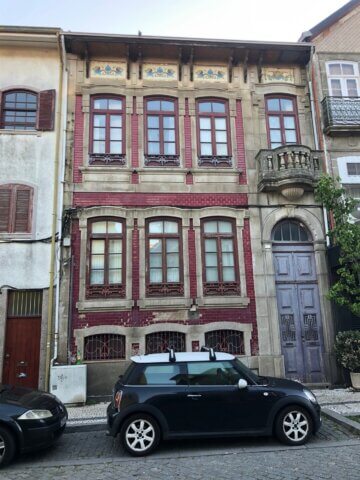
These two houses remained residences until they were abandoned; in other houses, the ground-floor was converted into a shop, mostly likely in order to maintain the house alive and in good condition. But such strategies only yielded a moderate success. Many of these ventures cater for contemporary technology-oriented business: computers, mobile phones, internet parlors. But such shops, while might work for a few years, are also among the firsts which go bankrupt quickly. Indeed, many of these shops were already closed, while in other cases only the covered, or even broken window is visible, so the character of the business that was there is invisible.
There were evident signs that some people, some locals, still try to keep of the area. The hotel where we stayed (Pensao Central), was still in a very good condition, though mostly empty, and the house just next to it has already collapsed, offering a striking contrast which I did not want to reproduce in a photo. There was a similarly very nice old-style trattoria a hundred meters away – not a restaurant by modern standards, rather a combination of a bar, a food-store, and an eating place: quite nice, cozy and homely. The two persons serving the clients – not too many, but quite some – were well into their 70s; once they will be gone, the place almost certainly will also be closed, and the street will be much the poorer.
There was a shoe-shop in the street, in the process of closing down, where we could buy at very reasonable prices good-quality women’s shoes. Walking further we noticed that there was another shoe-shop that was already closed down. The closing down of a shoe-shop in an otherwise declining though once beautiful street is a serious matter. The closing down of two shoe-shops there is an utter disaster.
The street only showed a culture in decay, contained only indirect indications on modernity. But the buildings around Matosinhos beach demonstrated modernity in its full brutalism.
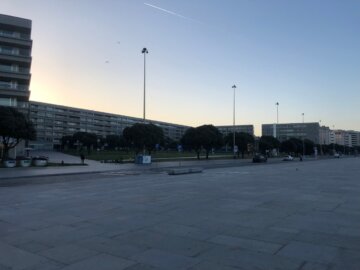
The picture hopefully conveys the strikingness of the scenery, though for a full appreciation one would need to present a video – or rather, of course, be there. Just next to the beaches of sand, running for kilometers and having a depth of a hundred meter or so, on the other side of the road, there are enormous multi-floor concrete buildings, showing the exact same pattern, one after the other, as if they were built from Lego. They are ugly beyond any reckoning, with not even the minimal care being taken of introducing at least some pleasant variation. And it goes on, and on, and on, continuing with the next locality, and the next beaches.
Let me resume the point, and then try to offer in interpretation.
The nature-culture-modernity contrast in Matosinhos is extremely palpable. I do not exaggerate here, only resume the bare ‘facts’, the given. There is a natural setting which, in its kind, is as beautiful and nice as it could get. There is a cultural setting that was also quite remarkable. It was not Venice or Florence ever, but nothing else is, or was, or can be. And this is then now used, and abused, and destroyed, by a modern industrial-technological ‘development’ that is revolting beyond any belief.
What sense does all this make?
Well, evidently, it makes no sense at all, having no real meaning, as most things inside modernity. But, still, one needs to explain what is going on.
Let me try to present, as clearly as possible, what I would like to do here. It is not to offer an explanation for the concrete situation in Matosinhos. This is why I even avoided gaining any further information. The aim is to get away, as much as possible, from trivializing contemporary explanations, no matter how much they could be right in certain angles, and try to understand, at the broadest possible level and relevance, how and why such a turn of events could have become possible.
A first such explanation could be related to democracy. Well, it might have been the case that a social ‘elite’ lived in such nice houses a century or two ago, going to the empty beach whenever they wanted, but the toiling masses lived in substandard houses and had no access to the beach. Thanks to democracy, and democratization, all this has changed by now, and the decay of some old houses is the price to pay for the progress of democracy.
Now, apart from being historically incorrect (people did not live forever in history in rickety houses, this was rather a consequence of the industrial revolution, urbanization, and similar contingent processes of modernization), such an explanation does not hold water also because it was by no means written in the book of fate that the “masses” wanted to own such concrete bunker houses at the edge of the sea. My point is not an attack the principles of democracy, and the defense of democracy is not identical to the defense of such ugly buildings.
A similar argument can be made more generally in the name of development, but it leads to a similar conclusion. ‘Development’ anyway is a bogus ideology, that can be used to justify anything – and was used for everything by many governments in the past, totalitarian or liberal – but nothing implies that ‘development’ necessarily would entail the decay of the old and beautiful town, and that the new should be ugly. One might evoke the problem of costs, but this is again a minor technical issue: everything has its ‘costs’; the question concerns the decision whether it is worthwhile or not. And so why does something become worthwhile, and for whom?
It is not possible to hide behind a generalizing ideology. The situation now confronting onlookers in Matosinhos is not the outcome of inevitable and irresistible historical processes: democratization, modernization, progress, development. But the word ‘development’ offers some hints towards the answer, except that we need to alter it from the presumably inevitable and beneficial process captured by the term to its less appealing sibling word, ‘developer’.
In order to arrive here, we need to pose the Mannheimian question of the sociology of knowledge: Cui bono? Such a question seems to imply a cynical perspective, but this is true only if we consider the question as central for any human society. But this is not the case: the relevance of the question is not general; it only applies to the modern world, or to similar kind of globalizing cases. People in most places and most times lived in a world of mutual concern and benevolence, and did not act solely guided by their own presumed interests, and especially were not guided by the aim of making money. Such people, people only concerned with gaining money, were rather universally despised. This is why merchants in most societies were foreigners, who traded participation, recognition and respect for money.
In the modern world, the situation is different. Here and now, it is assumed that everybody all the time only wants to make money: cosi fan tutte. But this is not true; it only applies to some people; but exactly these ‘some people’ are behind the kind of ‘developments’ that lead to the Matosinhos situation.
But how and why?
To understand this, we only need to consider the central underlying process, which is the building of new houses. This process, in our days, is done by ‘developers’. But who is a developer, and what does that person do?
A developer is somebody who buys land for the sole purpose of there building houses for others. Thus, makes money out of land – and quite a lot of money, as in general the price of the land plus the price of building material and workforce costs much less than the price of the houses completed and sold. Which is just a triviality, every enterprise works this way, it might be said.
However, it isn’t so, and for many reasons, which we now have to review carefully.
The first point concerns buying land, which supposedly is like buying an office, some machinery, or a piece of clothing. But, again, it isn’t, because there is a big difference between a piece of land and most other things, in that land is sacred. Land is where, on which, we live. Land is the surface of the Earth. Land is given, and is limited, even fixed. Nobody can ‘produce’ land. Land is simply the property of mankind – in the sense that it is a gift of God that we must all care for and preserve.
This was well understood in the Middle Ages, for example, where all the land belonged to the king – not in the sense that he could do whatever he pleased with it, but that he was its guardian, and he received this guardianship directly from God. But the sacredness of the land was accepted in every human community in the past. The Roman Law had a very complicated legal process by which a piece of land, under exceptional circumstances, could change ownership.
The modern world is unique in its desacralizing land, and this is indeed one of the central, though much overlooked aspect of modern ‘secularization’. It is part of economic theory, heart of the modern trickster logic, according to which everything can be classified as a ‘resource’: Land, Labour, or Capital. Capital, meaning liquid money, machinery, technology, offices, building, are of course not sacred, and can be traded – though even here long-term commitment and participation are central, as John Maynard Keynes, the greatest economist of modern times, strongly hostile both to the ideas of Marx and any form of socialism, knew it so well: this was his central idea, and not fiscal policy or the role of the state, as it is argued by those who failed to understand him – or only understood him too well. But land, meaning a piece of the surface of the Earth, is sacred; just as we human beings are also sacred, in the sense of being ‘images of God’, gifted with intelligence and searching for meaning. And whatever is sacred cannot be simply instrumentalized.
The evil that comes out of such a desacralization becomes easily visible by considering what developers do, and how this inevitably leads to Matosinhos-like situations. Matosinhos was not a Paradise, say, before the 20th century – like nothing else, Paradise having been lost, in my interpretation, with settlement – which, not surprisingly, is a development much connected to the appropriation of land and housing! But it was, evidently, a rather nice place to live, and for quite a number of people.
The problem is that when developers emerge, materializing out of the blue, as if ghosts, old houses become liabilities. They are expensive to buy. So, from the perspective of developers, the decay of neighborhoods with nice old houses is a must.
Empty land, or land with buildings of little value, are much more lucrative to buy. And, in order to make much money out of such land, it is imperative to build houses as high and big as possible, with as little expense as possible, including quality building materials and plans. The houses near Matosinhos beach correspond as perfectly to such exigencies as possible. The interest of developers, thus, is destruction, ugliness, uniformity, standardization. Due to this, they are indeed, as a group, necessarily act on the basis of a trickster logic, prime enemy of mankind.
Some might say that I am not fair to developers; that I demonize them. And this actually is true: I don’t like them; I do not think that a decent human being can be a developer, making money in this way. I even don’t like people who like to ‘make money’. I have no problems with private property and family enterprises. People can have different kinds of ambitions. They can found their own enterprises, which become the driving purpose of their heart. All this is human, and fine: living well through your own work, the creation of your hand and brain, and leaving to your children a farm, a factory, a firm that works well and allows them to continue to work and live well. But ‘making money’ is not human, as money is impersonal, has no qualities, and no limits. ‘Making money’ is technically an alchemic expression, equivalent to the alchemists’ aim of transforming metals into gold, indicating the strong alchemic inspiration behind the rise of modernity, argued by Frances Yates and Agnes Horvath, and demonstrated best by the enormous amount of alchemic writings of the young Newton – which Keynes was systematically collecting, leading him to write “Newton the Man”. Making money is hubris impersonated and incorporated – literally evil becoming flesh. Wanting to make money is obscene. It is perverse. It is by no means accidental that a society, and world, oriented towards making money becomes perverted, in all kinds of ways.
Thus, I suggest a simple solution. Land should be made sacred again. It could and should be alienated only under very particular conditions. Such conditions could be legislated and democratically accepted. Which would not be difficult, as people would realize that this helps them to live a better life. And have much better and nicer houses!
It would only require a different kind of thinking, which proper, culturally trained social, political and economic thinkers, not ideologues of money-making or of extreme liberalism, should be able to work out.


Related Posts