Why Moralize upon It? Democratic Education through American Literature and Film
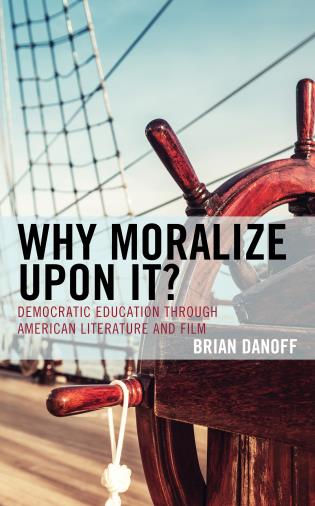
Why Moralize upon It? Democratic Education through American Literature and Film. Brian Danoff, Lexington Books, 2020.
Brian Danoff continues the effort of illuminating our understanding of politics through art and literature. In Why Moralize upon It?—a reference Melville’s ‘Benito Cereno’—Danoff tackles questions of democratic leadership and citizenry. He explores how people can be conditioned to citizenship through art, how the ideal leader in a democracy ought to behave, and the complexity of freedom in a democratic society.
The book contains four chapters with an introduction and conclusion. The introduction situates the value of literature within our current political dynamic of extreme partisanship and self-righteous pontification. The divisive thoughtlessness manufactured for profit by social media platforms can be mitigated by reading a literature Danoff argues. Literature engages through nuance and immersion such that the reader becomes empathetic and humble. “[P]artisans today are often filled with self-righteousness; novels teach humility and generosity toward others insofar as they remind us that all of us—even the most noble—are inevitably flawed.” However, the thought of getting the average Facebook user to put down their device for long enough to have a three-sentence conversation before your own notifications start pinging seems ambitious. The argument is directionally correct and serves as a reasonable justification for moving forward with the book’s examination of literature and politics, but it’s a maneuver that seems more hopeful than practical. But that does not detract from the useful insights this book contains.
Chapter 1 uses both Melville’s ‘Benito Cereno’ and the film Captain Philips to elucidate and extend our author’s thesis in the introduction that literature and art have the ability to transform our thinking by subtly engaging our feelings. Both pieces show us, according to Danoff, that issues of equality, blame and right are more complex than they are generally treated by non-fictional accounts. He gets to this point by integrating the non-fiction source material for both ‘Benito Cereno’ and Captain Philips. Both works are based upon a real-life captain’s account of events at sea. Danoff shows how the moral complexity of the action only comes to the surface through fiction which then forces the reader or viewer to grapple with discerning right from wrong as they grow empathetic to the supposed protagonists. This treatment supports the author’s claim that “novels, at their best, help their readers explore the complexities and the nuances involved in moral and political questions.” Although, Danoff undersells the wisdom and intention of fiction writers when he writes, “while nonfiction works often try to advance a specific argument, novels just as often raise questions.” If the director of Captain Philips or the author of ‘Benito Cereno’ were not trying to make a point about the moral complexity of the situation it seems they wouldn’t have bothered making a work of art that surfaced these questions. It seems more reasonable to think that a fiction creator has just as strong of a point of view and sense of morality as a non-fiction writer. Do we not think Dostoevsky wanted to convince his readers of something? Although, this does not undermine Danoff’s crucial point that fiction can “enable the reader to consider a multiplicity of possible answers” in a way that non-fiction cannot. This also positions literature as being more democratic than non-fiction.
Chapters 2 and 3 work together to explore democratic leadership and are where this author is at his strongest. Danoff finds in Ellison’s Invisible Man a tripartite theory of democratic leadership in which democratic leaders support the efficacy of individuals and their ability to effect positive change through official channels, democratic leaders seek to advance goals they have in common with the people they represent, and they advance equality which is the fundamental value that undergirds democracy according to Danoff. Danoff traces the Invisible Man’s journey to show us that freedom in a democracy is not about being left alone but about fulfilling one’s telos and that leaders who do try to persuade or deceive the population undermine all three dimensions of democratic leadership. Chapter 2 shows us that Ellison’s work can be more impactful on shaping the reader’s understanding of freedom and democratic leadership than a didactic argument. Ellison guides and nurtures whereas a treatise tells us what to think. Regardless of where the reader stands on Danoff’s theory of democratic leadership and principles of democracy, his central point that novels are more engaging and illuminating stands up to scrutiny.
Chapter 3 looks at the same questions through the lens of a failed democratic leader in Warren’s All the King’s Men. Willie Stark was a successful leader in that he kept rising through the ranks and provided needed material benefits to his constituents. But he was a failed leader in that he does not empower his people to be responsible citizens nor does he connect his initiatives to the undergirding principles of democracy. Danoff is right to show that Willie confuses freedom with sovereignty which then limits his ability to implement lasting change and to strengthen the democratic fabric of his state. Instead, Willie’s power will die when he’s no longer able to cut deals or when the unintended consequences of his actions overwhelm the positive attributes of his intended consequences. By not fostering democracy, and only maneuvering to entrench himself deeper into power, Willie is a tragic failure. To Danoff’s larger point, All the King’s Men is a far more moving condemnation of self-serving leaders than a biography of a real-life leader. By fictionalizing this account, the reader is free to learn the lessons rather than reading through a partisan lens. It would have been interesting to see Danoff’s view of a Pericles or a Cyrus in relation to the two texts taken up in chapters 2 and 3. This would have also allowed the author to explore the idea of whether a semi-fictional biography whose subject is a great temporal distance from the reader can have the same disarming impact as a fictional account.
The book’s final chapter takes up Greene’s The Quiet American to examine questions related to politics and violence, the power of novels to educate democratic citizens, and how fiction can help us explore the difficulties of political judgment. This chapter does a masterful job integrating each of the works from the previous three chapters as well as the thought of Max Weber and Hannah Arendt. The seamless integration of multiple genres and texts makes this a chapter that was both thought provoking and enjoyable to read. The chapter, within the context of violence and politics, raises a fundamental tension in democratic theory of rather a democracy is defined by institutions or by values. For instance, if violent means are used to promote democratic practices, is that a violation of democracy? Grappling with this question within a novel can help readers come to an understanding of first principles which can then be applied to contemporary arguments about war, assassinations, forceful regime change and voter rights.
Danoff’s contribution to the Lexington Books Politics, Literature and Film Series provides immediate and lasting value to the reader. It illuminates how novels can help us decouple important questions from their contemporary context that translates into productive discussions about controversial topics. I agree with Danoff about the power of novels to make us better citizens and better leaders. The open question remains as to how the power of novels can be injected into the mainstream before we’ve lost all civility, sense of duty or community.


Related Posts