
You Are Gods: A Defense of the Sitcom
While the concept of “comfort media” has not been in vogue for very long, the idea is relatively intuitive—at least in a modern context. Given the advent of streaming services, free podcasts, and YouTube, there is significantly more entertainment available to the average person than ever before in human history. Along with this rise in commercial media has come a shift in the purpose of books, television, and movies. From the perspective of the producers, the point of media is primarily to make money. On the other hand, from the audience’s point of view, media is often meant not to challenge the viewers, but to distract them—to provide an escape from the drudgery of everyday life.
Out of the many available options, one of the most common escapist genres is the sitcom. The sitcom, short for situational comedy, is defined by Merriam-Webster as “a television series that involves a continuing cast of characters in a succession of comedic circumstances.” Generally, sitcoms tend to depict ordinary people living daily life in a commonplace setting: office workers working at a corporate company in The Office, Midwestern family life in Happy Days, or a group of friends living in a NYC apartment complex in Friends. In a sitcom, the stakes are never very high. The world is (almost) never in danger. We begin each episode with the same lovable cast of characters, we encounter a humorous and relatively insignificant problem, and by the end of the episode, everything has gone back to normal.
From a certain perspective, the sitcom might seem pointless and empty—fluffy comfort media that does not grapple with universal truths or themes in any real way. In some sense, this is a fair critique. After all, the sitcom was invented for its entertainment value and little else. Some might say that if one is searching for deep, meaningful stories that will enrich one’s life and worldview, one must look farther afield than the sitcom.
However, in spite of this critique, I would contend that there is actually something deeply meaningful and redemptive about the format of a sitcom. Although this argument applies to most sitcoms that follow a traditional format, my primary example will be a contemporary sitcom that ran between 2009 and 2014: Dan Harmon’s Community.
A Second Chance at an Honest Life
When I started watching Dan Harmon’s Community, I did not know what to expect. As someone who cannot manage to turn my brain off, even while watching so-called “comfort media,” I have never been content with pointless entertainment. Perhaps this is why I was skeptical throughout most of Community’s 26-minute pilot, even in spite of the smart writing, tight dialogue, and the memorable characters.
At first, the plot and characters seemed flashy but meaningless. At the show’s outset, stereotypically silver-tongued lawyer Jeff Winger has been disbarred—not because he’s a bad lawyer, but because he’s a little too good at his real profession: lying. It turns out that he faked his undergraduate degree, and in order to keep practicing law, Jeff needs to go back and get a real degree. His solution? Enroll in the substantially-less-than-prestigious Greendale Community College.
The pilot depicts Jeff Winger savagely insulting the colorful cast of characters around him, casually maligning a young man with Asperger’s, and shamelessly hitting on a pretty classmate (while showing little to no real interest in her as a human being). He even trades his expensive Lexus to his professor in exchange for all the test answers he needs to cheat his way through the first semester. What a jerk, I thought to myself as the pilot progressed. Do I really want to spend six seasons with this guy?
Truthfully, the show had almost lost me until the pilot’s last few minutes. Near the end of the episode, Jeff emerges from his professor’s office, triumphantly brandishing the packet of test answers from his professor. But then he opens the packet to find nothing but blank pages. Enraged, he storms back into his professor’s office. For the first time, someone has cheated him the way he routinely cheats others.
“Jeffrey,” his professor cries out, shrinking away from an angrily advancing Jeff Winger. “Before you say anything, you might want to think about the gift you’ve been given.” But when Jeff is not pacified, the professor continues: “You see, the tools you acquired to survive out there will not help you here at Greendale. What you have, my friend, is a second chance at an honest life.”
A second chance at an honest life. And with that line, I was sold. I had no desire to watch a show about a jerk being a jerk and continuing to be a jerk now and ever and unto ages of ages, amen. Indeed, that is the primary pitfall of the sitcom at its worst. SpongeBob SquarePants will never change. Bart Simpson will always be Bart Simpson. You can only watch the same character fall prey to the same flaws so many times before the show loses its energy. We want to watch someone grow.
But at the end of Community’s pilot episode, Dan Harmon makes a promise to his viewers: a promise that Jeff Winger will not remain the same; that if we stick with him, he will grow painfully, slowly, into the kind of person who deserves the second chance he has been given.
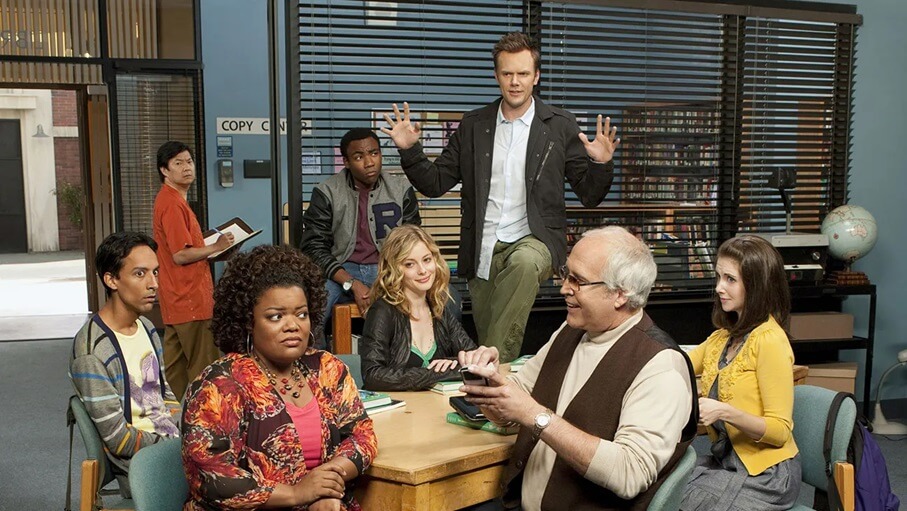
As Jeff emerges, defeated, out into the Greendale campus in the pilot’s final scene, we spot the ragtag group of students who circle through the background of the pilot in sharp relief behind him: the socially awkward Abed, former high school football star Troy, youthful and naïve Annie, divorced single mother Shirley, lonely senior citizen Pierce, and misfit activist Britta. And before the story even really begins, we understand where it will go and how it will end: with the slow triumph of love and friendship—of community—over Jeff’s selfishness and dishonesty.
What you have, my friend, is a second chance at an honest life.
The Story Circle and the Power of Change
But really, I shouldn’t have been surprised. Besides writing Community and the wacky animated sci-fi sitcom Rick and Morty, Dan Harmon is known for creating a storytelling device known as the story circle. While I call it a “storytelling device,” it’s really more of a way to break down the plot of any story. Overall, Harmon’s story circle is an adaptation of Joseph Campbell’s Hero’s Journey, but with some key changes. For example, while the Hero’s Journey has eleven beats, the story circle only has eight. Additionally, the Hero’s Journey model only applies to certain kinds of stories, while Harmon’s circle is effectively universal.
Harmon’s story circle is divided into eight different quadrants, each of which represents a story beat or plot point. At the top, the first quadrant—or story beat—depicts a protagonist in the status quo. At the next beat, the protagonist wants something or encounters some kind of problem. Next, they enter an unfamiliar or uncomfortable situation. In the fourth quadrant, they adapt to that situation. Over the next two story beats, the protagonist gets what they want, but in order to achieve that triumph, they have to make some kind of sacrifice. Finally, they return to their original situation, but having changed. The protagonist is somehow different than they were before.
Although the story circle applies to any story, Harmon created it specifically as a model for writing a sitcom episode—and that is where Community, and the sitcom, comes back into the picture. In each episode, our protagonist Jeff starts in the status quo: his odd student life at Greendale Community College. A crisis emerges, and Jeff has to overcome some overwhelming (and hilarious) obstacle. The situation gets worse and worse until finally, we arrive at the Turn.
The Turn is another point at which Harmon’s story circle distinguishes itself from traditional plot pyramids. In Harmon’s circle, the Turn requires a sacrifice. In other words, you don’t get your happy ending without paying for it. True comedies must be bought.
So three-quarters of the way through the episode, Jeff makes a sacrifice. Probably it’s a small one. Maybe he swallows his pride in order to participate in his much older friend’s overly elaborate Spanish presentation. Maybe he fights tooth and nail to win priority registration for next semester’s classes, only to give it (reluctantly) to a friend who really needs it. Maybe he sets aside his self-consciousness at the prospect of wearing gym shorts to play pool. No matter how ridiculous the situation, Jeff manages to buy a happy ending at the price of a tiny piece of his self-absorption.
And slowly, incrementally, Jeff changes.
Getting Better
This process of change is much of what endears Jeff to us as a protagonist. Why? Because that is how we change, too. Of course we love our big, bombastic stories where someone makes a dramatic sacrifice and redeems himself in that one heroic action. Audiences appreciate a narrative that’s larger-than-life.
But I would hazard the hypothesis that perhaps we like those kinds of stories because we want our lives to work like that. More often than not, we want to make one big, selfless decision and bam! We are all better now! We were lost, but now we are found; we were blind, but now we see.
That would be nice, but it is rarely how our daily lives work out. We have flaws, and we grapple with them, and every day, we make small sacrifices. We listen patiently to our friends, even though we have heard this particular story a hundred times before. We do the dishes without complaining, even though our spouse was supposed to do them. We scrape the snow off the car windshield, even knowing that we won’t be thanked.
Every morning, you wake up in the status quo of your life. Every day, you face a crisis—probably multiple crises—where you have a problem, and you need to make a choice. And every day, the ending of the story falls to you. Is this a comedy or a tragedy? Will you purchase a happy ending with your sacrifice?
Because if you do, then you return to the status quo having changed. Having changed—that is the essential part. The change is small. You probably don’t feel any different. It’s natural to feel that way, because the status quo always remains the same. The circumstances of a sitcom do not change. But you have changed; you change continually from day to day. Every time you arrive at the Turn and pay the price for a happy ending, you triumph and return just a little better than you were before.
At the outset of Community, Jeff Winger is a liar. At the outset of our lives, so are we. Psalm 58 says that “the wicked are estranged from the womb; they go astray from birth, speaking lies.” We are born into deceit. It comes naturally to us, just as it comes naturally to our favorite former lawyer. Even so, Christ’s passion and resurrection offer us both hope and forgiveness from sin. Our sins are removed as far from us as the east is from the west. When Christ is lifted from the earth, He draws all people to Himself.
Even so, Christ’s saving work on the cross is not the end of the story, but the beginning. Christ invites us into a life of truth. He calls His people to take up their crosses and follow Him. Our participation in Christ’s story means having faith, and that means suffering, and that means changing. “Whoever desires to love life and see good days, let him keep his tongue from evil and his lips from speaking deceit,” St. Peter tells us. “Let him turn away from evil and do good; let him seek peace and pursue it.” That process is slow and difficult. It means suffering. It means sacrifice.
But it also means getting better.
The early Church Fathers also wrote about this process of “getting better.” They viewed the Christian life as a process of growing, changing, becoming more and more like Christ. Western denominations, Catholics and Protestants alike, call this process sanctification. The eastern church calls it theosis. And while Christian denominations may disagree about how we ought to think about this process of getting better, no one disagrees that it must happen. No one disagrees that we want it.
St. Athanasius put it this way in his groundbreaking theological work On the Incarnation, probably written about 318 AD: “For the Son of God became man so that we might become God.” But how is that possible? “You are gods,” the Psalms tell us, “and all of you are children of the Most High.” What should we think about this shocking Biblical claim? Answering that very question, Anglican theologian C.S. Lewis has this to say:
The command ‘Be ye perfect’ is not idealistic gas. Nor is it a command to do the impossible. He is going to make us into creatures that can obey that command. He said (in the Bible) that we were ‘gods’ and He is going to make good His words. If we let Him—for we can prevent Him, if we choose—He will make the feeblest and filthiest of us into a god or goddess, dazzling, radiant, immortal creatures, pulsating all through with such energy and joy and wisdom and love as we cannot now imagine, a bright stainless mirror which reflects back to Him perfectly (though, of course, on a smaller scale) His own boundless power and delight and goodness. The process will be long and in parts very painful; but that is what we are in for. Nothing less. He meant what he said.
In other words, the central claim of Christianity is not merely that man is sinful and then forgiven. Through that forgiveness, man learns to sacrifice as Christ did. By this process, he changes. He becomes more and more like his God. He gets better.
Changing By Suffering
There is an idea, repeated over and over again in the western tradition, that suffering is a necessary part of redemption. Thematically, we find it first in our Savior’s suffering on the cross for the sake of redeeming the whole world—and from there, it spreads to saturate and fill in the cracks of the world’s art and literature.
For an example of this devotion to the concept of purgatorial suffering, we could turn to classical literary giants like Dante or Fyodor Dostoevsky—or alternatively, we could turn to the brilliant and moving Pixar movie Cars.
In Cars, the shiny, modern, and narcissistic race car Lightning McQueen finds himself trapped in a hillbilly, middle-of-nowhere town along Route 66 called Radiator Springs. (Sound familiar?) In order to escape Radiator Springs and return to his self-absorbed high life, McQueen must carry out a sentence placed upon him by the town judge: fixing the broken road through town. At first, he hates Radiator Springs. He hates rusty cars, blinking traffic lights, and country manners. He wants nothing more than to leave.
Lightning McQueen believes that Radiator Springs is hell, but as it turns out, it is really a kind of purgatory. The rusty cars that he despises slowly become his friends. He grows to love the scenic view of the countryside. His suffering changes him, and when he finally returns to his normal life, he is not the egotistical car he was before. Go your way, Lightning McQueen, for your suffering has made you well.
In the midst of McQueen’s suffering, he finds love. And in this way, the plot of Cars has inadvertently provided us with the last piece to our puzzle: that redemption requires suffering, but that suffering requires love.
Love (and Community) in the Ruins
Jeff Winger doesn’t want to go back to college—especially not community college. He’s a practicing lawyer in the real adult world with money, power, parties, and expensive alcoholic beverages. To Jeff, Greendale is a kind of hell—just as Radiator Springs was to Lightning McQueen.
But in this hell, he makes friends in the form of a study group. These friends form an unlikely bond as they face the trials of community college together. And as Jeff reluctantly begins to grow attached to this lovable group of eccentrics, he discovers a painful truth: that in order to love them, he must become something other than what he is. So he compromises. He makes small sacrifices. With a groan and an eye roll, he dies a little bit to himself every day for the sake of someone else.
In the Season 3 finale, Jeff faces a particularly difficult crisis. He volunteers to defend his friend Shirley in an unofficial kangaroo court ruled over by the dean of the college (don’t worry, it’s fine), only to discover that the opposing counsel is the boss of his old law firm. Jeff’s former colleague lays down an ultimatum: If he wants his old job back after graduating, he can’t defend his friend.
Shirley tells Jeff to give up the case. She’s willing to sacrifice what she wants (the deed to her cafeteria sandwich shop, in case you’re curious) so that Jeff can return to his old job as a cheat and a liar. Moved by Shirley’s sacrifice, Jeff makes an unforgettable closing argument for the defense:
Guys like me, we’ll tell you there’s no right or wrong. There’s no real truths. And as long as we all believe that, guys like me can never lose. Because the truth is… I’m lying when I say there is no truth. The pathetically, stupidly, inconveniently obvious truth is…helping only ourselves is bad and helping each other is good. Now, I just wanted to get out of here, pass biology, and be a lawyer again, instead of helping Shirley. That was bad…. But now…Shirley’s gone good. Shirley’s helping me. It’s that easy. You just stop thinking about what’s good for you, and start thinking about what’s good for someone else. And you can change the whole game with one move.
But Jeff is wrong. It wasn’t one move. It was never one move. It was a series of small moves, ridiculous moves, mildly inconvenient moves over three years of hilarious antics that got us here. Jeff changed because he bought hundreds of happy endings with hundreds of tiny sacrifices.
And as we see Jeff’s progress, it occurs to us that perhaps he always had the spark of a human soul worth saving. After all, he could have just given up after he got caught. He could have moved on to the next con job. But he didn’t. There is something in Jeff Winger that wants to be a real lawyer, that wants to live an honest life. That spark of virtue is what submits to the purgatorial fires of community college, albeit with a rotten attitude. That spark of virtue is what responds to the gift he has been given: a second chance at an honest life.
And that, I think, is part of what makes Community such a good comfort show. We, too, have been given a second chance at an honest life. We, too, endure suffering—suffering that is sometimes, and perhaps often, laughable in its banality—as we stumble toward where we want to go. And like Jeff Winger, we want to know that the day-to-day suffering we experience—the small crises we face and sacrifices we make—all mean something. We want to get better, and we want to know that it’s possible.
This, I would contend, is also the redemptive value of the sitcom as a whole. True, there are many bad sitcoms—but the best sitcoms merely apply this same format to a different setting, with similar results. All over the modern television screen, ordinary people face ordinary struggles and make ordinary sacrifices. All throughout the world of sitcoms, we watch characters develop and grow in the same way that we do: slowly but surely. This process moves us. It gives us hope.
After all, if Jeff Winger can get better, why can’t we?


Related Posts