A Journey into the Heart of Humanity
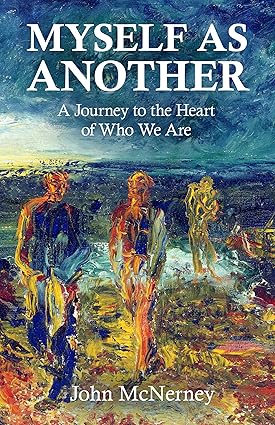
John McNerney’s Myself as Another unfolds rather like a triptych—a three-paneled artwork where in each frame is painted the distinct but unifying aspects of being human in terms of the trinomial: “self-other-Other.” Examples, he depicts, include Etty Hillesum’s search for her true self, Edith Stein’s living out of empathy for the “other,” and Simone Weil’s love of the presence of God discoverable even within the monotony of daily work. Just as a triptych reveals a broader narrative across each of its panels, McNerney’s exploration focuses on a philosophy of the human person in action.
Each section—or exploration—reveals the reality and drama of persons who are often trapped during times of great personal hardship and are struggling with “no ladder to get out” of the pit they find themselves in. They feel like “caged squirrel[s] endlessly running in circles,” and mostly not knowing what kind of mad house they inhabit. The central focus of these beautiful philosophical meditations is on the “acting person.” In these chapters, we come across people who give witness to a response to the question: what must I do to be happy? Herein, it is disclosed the “in-between” nature of our life as human beings. Our affirmation or negation of who the “other” is can be realized only in an encounter with them as “Thou.” Facing up to the reality of the “other” as a “you, as Hannah Arendt suggests, provokes within us a radical rethinking of “what we are doing.” In McNerney’s scintillating chapter on Gabriel Marcel, we discover how Marcel strikingly articulates this by posing the all-important question: “what are you living on?”
McNerney is not concerned with a mere theoretical speculation per se but with the enigma of the human person understood as “relation.” The book essentially reveals how personal encounters take precedence over what we may say. How we live is what counts! Resonating throughout McNerney’s exploration is his testament that “Humans are ‘relaters.'” In the chapter “David Walsh – The Priority of the Person,” we discover the original inspiration for McNerney’s particular reflections. The author sets out how Walsh suggests that the term person is not, in fact, a philosophical or theological dogma merely to be grappled with. It is rather an invitation to go “beyond” self. Person means “relation,” and this is the background on which the entire book is triptychally painted.
In the chapter “Edith Stein- Stairway to the ‘Other,’” we see clearly emerging the consequences of McNerney’s personalistic understanding. Stein says, “I am not by myself and by myself I am nothing…and so from moment to moment I must be endowed” with being. If not I “stagnate or vegetate.” Even before the horrors of Auschwitz, Stein encountered personal discrimination in academic circles because of her Jewish background and because she was a woman. In the face of this, Stein said that she did not “consider life on the whole to carry so much weight that it would matter what position” she occupied.
In his reflections on Søren Kierkegaard, McNerney points to the hidden key “whereby we can reach toward the eternal.” The neighbor is the “narrow pass or door giving us access to the transcendent.” At times we may search for an “Archimedean point” or a “fulcrum” by which we can explain all but if it is to be found at all, and that is indeed doubtful, its location “must lie outside the world, outside the limitations of time and space.” This lies within the realm of the “Other.” The author of Myself as Another is rather like how Dante’s guide Virgil in that his book is really a type of spiritual-philosophical vade mecum assisting us on a journey to the heart of who we are. Mc Nerney’s work is a fine contribution to our sense of the breadth, length, height, and depth, of knowing Myself as Another (Ephesians 3:18-19).
Myself as Another
By John McNerney
Hyde Park, NY: New City Press, 2024; 196pp


Related Posts