A New Dark Age?
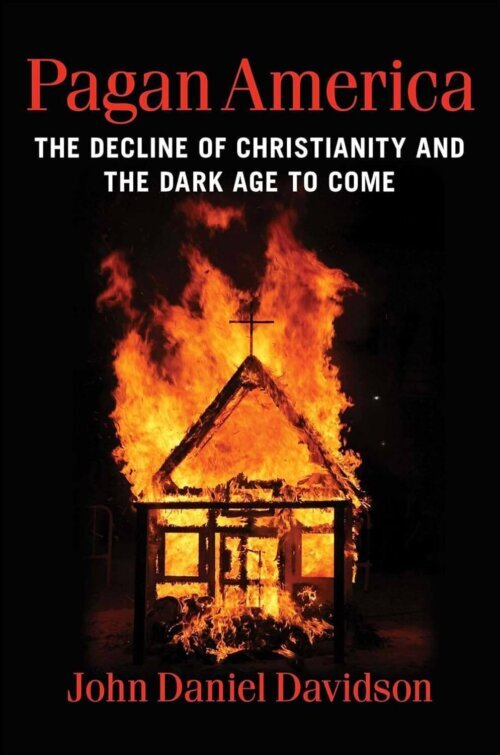
John Daniel Davidson’s Pagan America: The Decline of Christianity and the Dark Age to Come is an important book dealing with issues that impact the lives not only of American citizens, to whom it is specifically addressed, but of everyone living in what is now called the “West” and used to be called Christendom.
Its main thesis is that American society was founded not only on the ideals of “life, liberty and the pursuit of happiness”, but also on a set of Christian moral virtues indispensable to its survival. Without a social consensus based on traditional Christian morality, says Davidson, free citizens in a republic soon become slaves in a pagan empire. A society that abandons the Christian faith gradually reverts to a new “pagan dark age” that denies the possibility of any objective moral truth. In such a world, might alone determines what is right and the weak are tyrannized by the powerful, as attested nowadays by the legitimization of abortion, the rise of transgenderism, the spread of euthanasia, the sexualization of children and the disruption of the family structure.
To clarify what the rise of neo-paganism entails, Davidson draws on the writings of anthropologists and historians who have studied the pagan customs of the Vikings of Scandinavia, the Aztecs of Central America and some now extinct tribes of West Africa. Although separated by time and geography, these populations shared a bloody form of paganism involving the sacrifice of children as a means of appeasing their gods and maintaining social order. Davidson also focuses on the life and customs of the Roman Empire before its conversion to Christianity, describing it as a civilization based on military might, slavery, and sex trafficking. Drawing from the historian Tom Holland’s 2019 book Dominion, he explains that all these barbarous customs were suppressed over several centuries because of a revolution that was itself “irredeemably Christian”. So much so that even the modern ideals of equality and freedom invoked by anti-Christian movements such as the French Revolution and Communism did not originate in the old paganism, but rather from the tenets of the Christian faith.
The transition from Christianity to paganism, says Davidson, has consisted essentially in a shift from an understanding of religion as a set of truths discoverable by, or compatible with, human reason to one where religious truth is purely subjective and alien to reason. This led to the notion of religion as a strictly private matter – a notion that denies religion’s place in the public and professional square. More specifically, it means that there can be no public recognition of two basic tenets of Christianity, i.e., that there is an objective moral law and that we must obey it. The alternative is the pop psychology version of Christianity, i.e., the old Pharisees’ self-righteousness (recast in modern parlance as “accepting yourself as you are”), which has become dominant because it is much easier than God’s program of sanctifying ourselves through self-giving. The switch to this new alternative involves nothing less than the demise of the foundations of American social life and the rise of a neopagan ethos that will ultimately lead to the persecution of those refusing to abide by it.
To describe how this switch took place, Davidson highlights its quantitative dimensions, and then its more concrete manifestations (abortion, euthanasia, transgenderism, and pedophilia). He notes that the proportion of “nones” (people claiming to be atheists, agnostics or “nothing in particular”) in the general population rose from 5% in 1972 to about 20% in 2012, and to 30% in 2022, thus outnumbering the share of Americans (25%) attending a church service weekly. Also notable is the decline in the quality of religious belief. For example, a 2016 Barna survey found that 54% of American Christians admitted to not feeling compelled to share their religious beliefs with others, thus ignoring the duty of evangelization. According to another 2022 survey, a staggering 73% of evangelicals said they believed Jesus was “created by God”, thus denying his divinity. More generally, surveys clearly show that on marriage, sexuality, abortion and even the nature of God, Protestant denominations have relinquished orthodox Christian doctrine in favor of liberal social ethics and politics. Catholics are not much better: according to a 2019 Pew Research poll, nearly seven out of ten of them believe that the bread and wine used in communion are merely symbols rather than the true substance of the body and blood of Christ.
This regression of Christianity, far from resulting in a surge of atheism and agnosticism, has led to the emergence of various forms of paganism, the most prominent being climate change activism. For those who may have doubt about this, the author notes that the University of Helsinki recently conferred an honorary doctorate in theology to climate activist Greta Thunberg. He also points to other social phenomena such as the mass protests and riots that swept in the wake of George Floyd’s death in 2020, which had all the hallmarks of religious belief, including communal acts of penance, such as public kneeling, confessions of collective guilt, donations to Black Lives Matter and calls to “defund the police”. Manifestations of neopaganism can also be observed in fashion, academia, or the media, the best examples perhaps being the performances of popular singers like Sam Smith, Lil Nas X, Katie Perry, and Lady Gaga, all of whom take pride in publicizing their flirting with the occult.
Of even greater concern are the various forms of witchcraft spreading on social media, most of them designed to appeal to young people. In case some might find this of little concern, the author deals at some length with The Satanic Temple, an organization defined on its own website as a “new religious movement founded […] to fight a perceived intrusion of Christian values…”. It claims some 700,000 members, with congregations in 24 states and 6 countries.
Davidson also shows how the legitimization of abortion and euthanasia are rooted in the notion of an unconstrained individual autonomy fostered by the new paganism. Noting that more than 63 million unborn children have been killed by abortion since 1973, he points to a quite significant but little-known fact: we owe it to no less than the Marquis de Sade to have made the first affirmative case for abortion. In an essay titled La Philosophie dans le boudoir and published in 1795, the Marquis, a French nobleman and revolutionary politician, sets out most of the arguments that have been used over the past 50 years to legitimize abortion. Sade also believed that it ought to be equally acceptable to kill a child inside the womb as outside it.
In his analysis of transgenderism, Davidson highlights the fact that it flows naturally from the entire LGBTQ ideology. Indeed, transgenderism can be seen as a natural consequence of the legal enshrinement of gay marriage, which is why progressive activists have found it irresistible. If marriage, which is the most basic and primordial form of human relations and a major foundation of society, can be redefined, there is no reason why we cannot redefine what it means to be a man or woman. But there is more to it than that: the greatest danger with transgenderism, argues Davidson, is that it is being used to foster a sense that human nature is malleable, like a modeling compound, as well as to redefine the idea of consent in the hope of turning it into something else. We are never told into what exactly it may be turned, but the point is that consent may one day no longer be seen as an act of free will. Indeed, some proponents of the new paganism go so far as to deny the very existence of free will.
In this regard, Davidson shows how our mainstream media no longer have any qualms about publishing articles “that move pedophilia outside of the category of mental illness”. Making clear that he is not conflating transgenderism and pedophilia, Davidson notes that they cannot be viewed as entirely separate in terms of their moral impact. Indeed, if current efforts at normalizing gender-affirming care for children are allowed to continue, it will become much more difficult to prevent the social normalization of pedophilia. If there is no agreed rationale for preventing the castration and sterilization of minors allegedly consenting to such procedures, on what moral grounds can pedophilia be declared unacceptable?
Davidson also shows how the new paganism is being promoted by political elites who feel increasingly freed from the constraints of the old constitutional system. This is evidenced, inter alia, by measures of all kinds such as the 2022 Respect for Marriage Act based on a definition of marriage without any precedent in law or tradition, the 2015 Supreme Court’s Obergefell decision legalizing same-sex marriage, or the infamous “Twitter Files” scandal which exposed how U.S. intelligence agencies used the social media Twitter (since renamed “X”) to carry out what would otherwise have been illegal government censorship. This latter scandal is just the beginning of something much bigger since governments will soon be able to use Artificial Intelligence technologies to pursue their agenda.
Pagan America is a well-researched, well-structured and well-written book that makes a convincing case that once the Christian faith is abandoned, Christian morality quickly erodes, the result being both an uncontainable expansion of arbitrary power and the erosion of traditional liberal principles such as respect for basic human freedoms, the independence of the judiciary, free elections, etc. In short, there can be no Christian morality without a sustaining Christian ontology, no Christian virtue without a Christian Creed, no social peace without a common faith.
The idea that the loss of our Christian heritage, far from fostering a sense of freedom, will usher in a pagan culture characterized by brutality and violence may seem far-fetched. Yet, we have good reasons for believing it because, as Davidson reminds us, it has happened before. It happened during the French Revolution whose instigators undertook to abolish the Catholic Church and replace it with an atheistic cult of Reason. Five years into the Revolution, the reign of ‘reason’ had claimed more than 30,000 lives and led to the establishment of what came to be known as the Reign of Terror. Thus, the rejection of Christianity initiated by the philosophes of the so-called French Enlightenment (Rousseau, Diderot, Rousseau, d’Holbach) resulted in an almost immediate national bloodbath, followed by 12 years of Napoleonic wars, and then by the long-protracted debilitation of French political institutions (since 1789, France has had 14 constitutions, including 5 republics).
In his concluding chapter, Davidson describes the posture Christians should adopt in the face of the current pagan onslaught. In doing so, he first addresses the Benedict Option proposed by Rod Dreher in a book bearing that title – a title itself taken from Alasdair MacIntyre’s book After Virtue. Davidson notes that this option amounts to no more than the way true Christians should be living their faith, which means that, although recommendable, it can no longer guarantee the passing on of the faith to future generations. What is missing from the option is a clear acknowledgement of the need “to defend the faith”. As an alternative to the Benedict Option, he proposes an option inspired by the life of Saint Boniface, an 8th century English Benedictine monk who famously felled the Oak of Jupiter, a tree German pagans thought sacred, and used the timber from the tree to build a chapel, thus paving the way for the conversion of vast numbers of German pagans living on the margins of the Frankish Empire. The Boniface Option might thus be seen as more militant than the Benedict Option in that it involves not simply creating one’s own little community, but also getting rid of pagan practices and rebuilding the Church.
Davidson may have exaggerated the differences between the Benedict Option and his own Boniface Option. (The back cover of his book includes a praiseful blurb by Dreher). What is clear, however, is that his book offers a thorough assessment of a mindset that prevails not only in America but in most Western countries. More importantly, it accords fully with the 1969 prophetic words of then German theologian Joseph Ratzinger (later Pope Benedict XVI) which Davidson cites: “It seems certain to me that the Church is facing very hard times. The real crisis has scarcely begun. We will have to count on terrific upheavals. But I am equally certain about what will remain at the end: not the Church of the political cult, which is dead already, but the Church of faith.” (My italics).
Today’s Christians are thus called upon to hold beliefs and live lives that are increasingly at odds with mainstream society. Like the Christians of the first centuries, they appeal always to free choice, not to any kind of fear, or greed or earthly gain. Because of that, they face substantial rejection and opposition. That should not come entirely as a surprise. Jesus himself forewarned us when he said: “In the world you will have trouble, but take courage, I have conquered the world” (John 16:33). Only three men in history have dared to say they had overcome the world. Alexander the Great was the first to do so after his armies had conquered the whole civilized world, but his empire did not survive his early death. Buddha said he had overcome the world after he had taught a philosophy that dismisses all that exists as illusions, including individual souls and bodies. Jesus was the third man who said that he had overcome the world, and he was the only one who spoke truly.
We live in a world where, ultimately, we must choose between the spirit of the age and the will of God. There is no way around this: we cannot choose not to choose. If we choose God, we will get sufferings and joy in this world, and God and bliss in the next. All in all, a safe bet, as Pascal would say!
Pagan America – The Decline of Christianity and the Dark Age to Come
By John Daniel Davidson
Washington D.C., Regnery, 2024; 344pp


Related Posts