A Poetic Pond of Brilliance
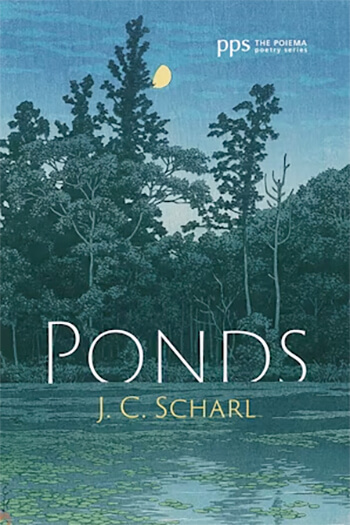
J.C. Scharl debuted her verse drama, Sonnez les Matines, in 2003. Now she has her first poetry collection published, Ponds, and it is a great collection with which to debut. Interspersed with lyrics of ancient and mythic figures like Abraham of Ur, Elijah the Prophet, and Penelope of Ithaca, we also find poems for Scharl’s mother, her children, and her garden. The subject of each poem is brought sharply, and sometimes surprisingly, to light, and Scharl knows just how to weave them into a fuller view of history.
Each poem captures a moment like a photograph; however, they don’t hold that moment static but instead unfold them to show that every story holds echoes of the ones that came before it, and teases those that come after. These poems hold conversation not only with storytellers of the past, but with other poems in the collection. These 49 poems are carefully selected and gathered to create a whole that is bigger than the sum of its parts.
To give you an idea of what’s on offer, walk with me through “The Newlywed.”
The poem opens with something of a challenge. Persephone is here to set the record straight. “The myths are wrong—it wasn’t Hades’ fault. / No one gave me those seeds to eat. I found them / myself one afternoon;” Even the enjambment, which sets “myself” into a forceful beginning of the third line emphasizes Persephone’s desire to take sole responsibility for her actions. It also serves to emphasize the loneliness and separation that her taking and eating of the fruit would ultimately bring. This is compounded with “I took” being repeated four times in three stanzas. While Scharl has Persephone proudly taking control of her own story, there is still the sense of loss and lament that pervades the original myth. The goddess took control of her story and knows that she ran it to a bad end.
This is singular, but Scharl takes it further. In Scharl’s hands, Hades warned Persephone away from the fruit, but she refused to listen. I’ll give a slightly longer excerpt here:
“But three I ate. That’s when he knew he’d won,
according to the myths, and crowed in triumph
and all that dead land laughed. That’s not what happened
at all. The truth is, he tried to warn me off.
He as good as said it was a trap, and
told me that land’s fruit is bitter. I laughed
at him. I think I even offered him a piece.”
Here, I found myself transported out of the land of Hades and into the shadow of another, even more ancient garden: Eden. Many Rabbinic traditions hold that Eve is forced from the garden and trapped by death by eating a pomegranate from the Tree of the Knowledge of Good and Evil. A pomegranate is the forbidden fruit that Persephone takes, and it is the means by which she is bound to the land of death for a portion of the year. As Adam stands impotently by while Eve takes her bite, so Hades stands powerless here as Persephone takes hers and offers him a piece. As Eve’s choice drove our original parents from their Garden and started the cycle of life and death, so Persephone’s keeps her from fully returning to the land of the living and starts the cycle of the seasons – and what are they if not a picture of life and death?
I hear Eve’s lament for this sundering in Persephone’s final line in this poem: “Never would all I loved be whole again.”
This brokenness so pervades our history and mythic stories that it would be easy to leave them there, to let them have the final word, but Scharl takes us past that painful truth into something deeper, far truer, and even hopeful. In another poem, she finds an answer to Persephone’s problem while watching her garden with her firstborn son.
“Post Partum” begins with spring, the season most closely associated with Persephone. Scharl points out the early growth of flowers to her infant son. She does with startlingly sharp language:
“In spring the wet ground gashes
itself open round the stalks—if it could bleed,
it would, there where new growth marks places of parting.”
In fact, every line throughout the poem ends with “gashes,” “bleed,” “parting,” “split,” “leave” language that her Persephone would certainly recognize. These are hard, sharp words, and their repetition drives deeply into the reader how difficult the process of growth and birth is. But Scharl tucks in, almost unnoticed, another word which repeats at the end of one line in each stanza — “Up.”
“All things now are split
like that for me, for I have been the Red Sea parting
and I have been a pale pathway through it. The gashes
in the rock at Meribah are me, for I leave
scars upon myself, and the water drawn up
from the rock is also me.”
This little, single syllable word seems quiet, but asks the reader to draw their gaze from the bleeding earth, past the parting clouds and on to a Creator who has not been unaffected, but has entered into it, making it possible for the sundering to bring about life.
“Being gashes
itself open on itself; the great parting
does not end. They say even God had to bleed
for it. Like you and me, the world’s forever split
apart by being what it is, my son. Always, the leaves
pile up around the trees. Spotted tree trunks bleed
sap in spring. To live is to split open. Without gashes
there are no leaves. All places mark our place of parting.”
There is a similarity in how the two poems end, but where one leaves off at the breaking, the second leads through the break into something more hopeful.
I have spent nearly a thousand words digging into only two poems from this collection, but I’ve scarcely scratched their surfaces, and there are 47 others that I haven’t even touched. As this is a review and not a thesis, I’m afraid I’ll leave that to you. Just know that these remaining 47 are just as meticulously crafted and full of meaning. This is a book that invites re-reading several times over to discover everything Scharl has to offer here, which is exactly the thing a volume of poetry should do.
Ponds
By Jane Clark Scharl
Eugene, OR: Cascade Books, 2024; 86pp


Related Posts