Is the Grade System “Off the Mark”?
The infamous anecdote regarding French television executive Patrick Le Lay comes to me via the philosopher Bernard Stiegler. According to Stiegler, Le Lay had stated publicly that his primary job was to create an audience for commercials, and that this was the purpose of television shows. His job, in other words, was to “sell available brain time” to advertisers, particularly the “brain time” of children, who would ideally be formed into lifelong consumers of the media and of whatever products it was the media’s function to advertise. Le Lay, as Stiegler presents him, was effectively “saying the quiet part out loud,” as the saying goes.
This was in the 90s. It bears updating in the age of often ad-free streaming, but I think it remains a useful reminder that, in the prescient words of novelist John Williams, “we live in a peculiarly silly age.” Williams was talking specifically about the reduction of the four-year college, in which fledgling adults leisurely and idyllically elected classes in whatever fields inspired them before leaving to embark on their careers in “the real world”—the reduction of this to a mere appendage of that so-called real world, the world of enforced frivolity and ruthless competition—what Stiegler would perhaps call “the unworld.”
Early on in Off the Mark, Schneider and Hutt cite a criticism of the credit system in high schools and colleges around the turn of the twentieth-century. The system was intended to implement a recognizable standard across institutions in order to measure what had been learned. The merit of this credit system was that it eschewed a presumptuous attempt really to measure the immeasurable and instead offered merely time spent inside the classroom as the common denominator that would facilitate some sense, at least, of what a student’s academic career consisted in—and thus facilitate transfers and justify admittance to higher levels. Critics claimed it “reduced learning to mere ‘seat time.’”
This criticism is probably still relevant today. The writers don’t dwell on it; I am offering it here as a way in to their discourse since it points to the potential absurdity of grading systems in education and indeed, to the extent that these systems unduly and inevitably come to influence the conduct of both teachers and students alike (teaching to the test; craving merely high marks, regardless of whether these reflect substantial learning)—the potential absurdity of formal education itself.
A century later, after the advent of seat time as a measurement of the quality of formal education, brain time was introduced as a device in the informal transformation of citizens into mere consumers. I think in the digital age it is important to keep in mind both of these absurdities—of formal education geared narrowly toward grades and of informal training in consumerist behavior—when pursuing philosophical questions regarding what and who education is for. The pervasive, all-encompassing absurdity of our silly age perhaps is what Stiegler had in mind in speaking of “systemic stupidity.”
Schneider and Hutt write that “the crucial point is that our system is set up in such a manner that learning may be incidental to most of what happens as young people progress through the education system.” The worry, that is, is whether devices for measuring learning, though probably in some sense necessary and even valuable, as the authors insist, might actually prevent or distort learning. What is “learning”?
The authors characterize authentic learning as “exploratory, curiosity-driven, and nonlinear.” They are careful and balanced, however, in admitting that grades serve a vital purpose and need not be eliminated altogether in order to preserve and accommodate true learning. There are perhaps alternative methods of grading that aim at the “inculcation of students’ desire to learn for learning’s sake, rather than in pursuit of grades.”
Among these are narrative substitutes or complements to letter grades, adding nuance(s) to the false clarity implicit in the latter. Letter grades are inevitably misleading for several reasons—simply because teachers have different styles of implementing them. Why should a bright but underperforming student not receive a low mark in order to inspire greater effort in the future, if the aim is indeed to promote learning? But why should such a mark follow the student throughout their career, affecting their prospects both inside and outside the classroom?
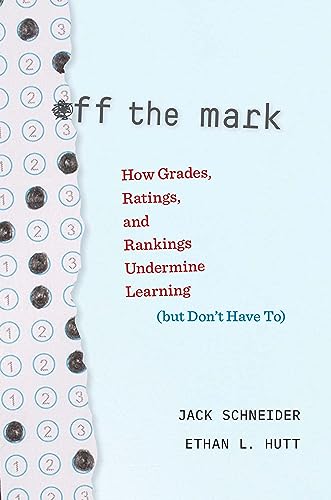
In tracking and interrogating the theory and history of “grades, ratings, and rankings,” the writers helpfully explain that there is nothing natural or inevitable about assessment, much less of our current assessment practices. This book persuasively carries forward that general project. We all sense a current crisis in education, but Off the Mark brings a very unique look into that problem and how conventional means of learning are actually undermining the pursuit of learning and wisdom.
Off the Mark: How Grades, Ratings, and Rankings Undermine Learning (but Don’t Have To)
By Jack Schneider and Ethan L. Hutt
Cambridge: Harvard University Press, 2023; 296pp


Related Posts