Animal Spirits and Birth Rates
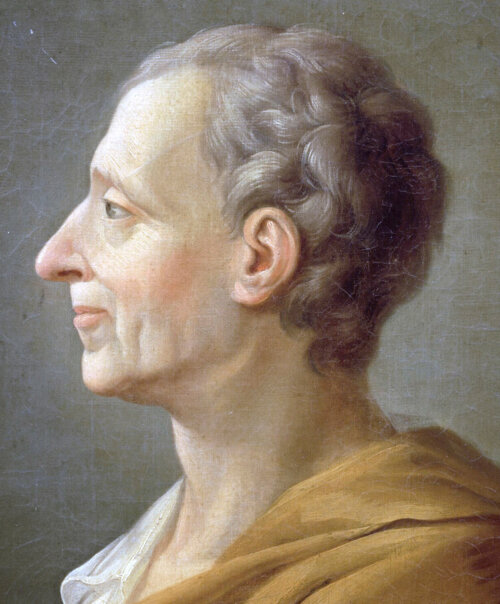
No philosopher thought more deeply about population decline than Montesquieu, the French thinker from the early to mid 1700s. Montesquieu is known mostly for his Spirit of the Laws (1748), a book defending modern commerce and the separation of powers. His insights into population comport with his embrace of modernity, though they also point to its limits.
A few years after Montesquieu wrote, Scotsman David Hume wrote “Of the Populousness of Ancient Nations,” a combination of fact-finding and analysis. Following hints and rabbit trails in ancient authors, Hume showed that ancient nations were more sparsely populated than modern ones. Hume traced the population growth underway during his lifetime to the release of animal spirits accompanying advances in modern freedoms.
“In the flourishing age of the world,” Hume writes, “it may be expected, that the human species should possess greater vigour both of mind and body, more prosperous health, higher spirits, longer life, and a stronger inclination and power of generation.” Removing impediments to the “desire and power of generation,” will lead, Hume writes, to an increase in population. Modern political communities that abolish slavery are governed by the rule of law, protect commercial relations and private property, and encourage more consensual and relatively egalitarian sexual relations.
Hume’s attention to population increases in modernity tells part of the story. Europe’s population grew steadily with the growth of industry and commerce, from about 116 million in 1700, 195 million in 1800, about 400 million in 1900, and about 725 million in 2000.
Though Montesquieu thought ancient times were more generative, one of his explanations for recent population increase comports exactly with Hume’s. Agricultural societies, he thought, buckle under excess population. Ancient agricultural societies practiced infanticide, sent out colonies, or promoted the vile practice of sodomy to keep their potentially growing populations steady. Industrial and commercial nations would, according to Montesquieu, produce, employ, and feed a growing population.
Because Montesquieu misread the data, he departed from Hume’s simple story of upward trajectory in an illuminating way. Notable was Montesquieu’s belief that Christianity undermines birth rates. Christianity encourages spirituality and otherworldliness, not this-worldly family life. It honors chastity and continence in marriage, he writes, which can lead to less sex. The Church honors celibate priesthood and nunneries at the expense of marriage. Christian allegiances replaced family life. Bishops replaced fathers. With fewer marriages, fidelity was less practiced, “just as when there are more robbers, there are more robberies.” Pious devotion distracts from mammon.
Montesquieu’s critique of Christianity cannot simply be dismissed as anti-theological ire. The time when the prestige of the Christian faith was ascendant hardly fostered population growth. Life expectancy was low. According to estimates, Europe was roughly the same size at the fall of the Roman Empire as it was at the time of the Reformation, though there were times of growth in between. His blunt condemnation of Christianity requires qualification, however. Montesquieu mistakes the reign of Gnostic heresies for the reign of Christian dogma. Regular church attendees today have among the highest birth rates in America.
Montesquieu begins the book on population by describing his preferred sexual constitution—including public encouragement for continence and patriarchy. It hardly contradicts Christian teaching. As against illicit unions and prostitution, “public continence is joined naturally to the propagation of the species.” He practically equates family life with fatherly authority. Fathers consider the family line to be “a sort of property” in that it shows how each person’s life is part of a long chain of ancestors extending backward and forward in time. Family names inspire fathers “with the idea of a thing that seemingly should not perish.” Concern for the family legacy leads fathers to use “their prudence” in helping to select spouses for their children and to oversee the education of their children.
A solid sexual constitution, however, is not enough. After completing his description of a healthy sexual constitution, Montesquieu writes a short crucial chapter entitled “What Induces One to Marry.” His answer is manifestly political, bridging the private and the public. Marriage comes about wherever “there is a place for two persons to live comfortably.” What people mean by living comfortably is a complex psychological matter. Some difficulties are productive. “Nascent peoples,” Montesquieu writes, “multiply and increase greatly.” Life is hard for newly formed peoples, but the release of energy and the hopes to achieve great projects make living in celibacy “a great discomfort” while having many children “is not a discomfort.” Tough, hopeful times like the founding of modern nation-states bring more kids. The threshold for discomfort flips among nations already formed. When political worlds grow old and easy times arrive, children are too much of a burden.
Rome, one of Montesquieu’s favorite topics, was audacious and thirsted for glory as a new polis. It first conquered its neighbors, then Italy, and then the Mediterranean. Its old laws induced citizens to marry and enforced public continence through censors, but burdens were born lightly in a world of struggle and honor-seeking.
Rome’s success brought corruption. “Few citizens remained, and most of them were not married” after the republic’s empire was established. Civil wars raged. Montesquieu relates a speech by Caesar Augustus. Childrearing compromised comforts and pleasures in a political world that grew old.
The city does not consist in houses, porticoes, public squares; it is men who make the city. You will not see men emerge from the earth to take care of your business, as in legend. It is not to live alone that you remain celibate: each one of you has companions at his table and in his bed, and you each seek only peace for your profligacy.
Augustus was serious about restoring morality. He exiled his only daughter Julia for committing adultery.
Augustus appealed to interest by imposing penalties for remaining unmarried or childless while rewarding those who marry and have children. Husbands could not bequeath much inheritance to wives unless the couple had children. Honor was more important, too. Among the penalties: women without children or husbands could not wear precious stones. Rewards: Young men with wives and children could be eligible for offices at an earlier age. Spouses got better seats at the theater. The most fecund married senators spoke first and got their choice of provinces. He promoted marriage. When wives died, widowers had two years to remarry. Fathers had to give dowries. Men over a certain age could not remarry women past childbearing age.
Montesquieu blames the rise of Christianity for stunting Augustus’s policies. All indications are, however, that Augustus’s policies failed to move the needle. They fell into desuetude before Christianity’s triumph. Nor does Montesquieu even suggest variations of Augustus’s laws for his own time, when, he believes, “laws are needed to favor the propagation of the human species.”
Something was rotten in France when Montesquieu was writing. France’s general spirit was informed by “an almost incurable ill,” as depopulation was “of long standing because of an internal vice and bad government.” Gone were thriving localities where many could participate in self-government. Political power was centralized. Oligarchs owned whole regions. Working men had little: “in their isolation” they lacked “courage and industry.” None of the energy characteristics of commercial societies or nascent people was present. Louis XIV tried to do something about it, giving pensions to parents with ten children and even larger ones for those who had twelve. Such rewarding of “prodigies,” Montesquieu worried, would not change the general spirit of the age.
As a desperate measure, Montesquieu suggested that France engage in land redistribution, just as Rome had rewarded returning soldiers with estates in Italy and the provinces. “This distribution should be made until the last man gets a share.” It would, he hoped, create a new hopeful political settlement, destroying feudalism and democratizing political and economic power.
Montesquieu’s doomerism was off target. The French population doubled between 1700 and 1800, mostly without land redistribution. The commercial revolution, instead, brought France something akin to land redistribution. Instead of taking from the oligarchs, the poor profited in commercial exchange, and many acquired different kinds of property. Cities started to grow. Populations exploded throughout Europe at this time. The commercial republic created, as Hume had predicted, a “nascent people,” happily bearing burdens and making sacrifices that spoiled people of luxury would never think of making.
Cultural contradictions beset the commercial republic, too, and Hume did not see that. Animal spirits become tamed. Strict sexual constitutions loosen when they are not needed in hard times. Oligarchs stifle commerce in certain respects. People are more afraid of losing what they have than of gaining a world.
Montesquieu is wrong to think Christianity is simply inimical to family life and propagation. Yet, as Montesquieu teaches, a rebirth of faith alone will not foster propagation. Making the political world new again helps people to bear the burdens of family lightly and happily. Attachment to a thing that will seemingly not perish—a nation or an enduring family—is needed to make sense of the struggles of family life. No Augustan tinkering can override these realities. Having children is an act of hope in the future. People will not suffer the struggles of family life unless they believe in the future.


Related Posts