Are We a Nation of Victims?
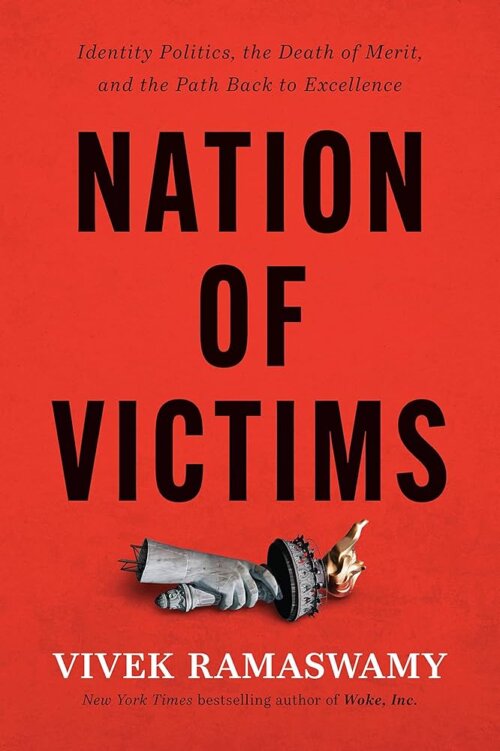
Nation of Victims: Identity Politics, the Death of Merit, and the Path Back to Excellence is a book by Vivek Ramaswamy, founder of Roivant Sciences and author of the New York Times bestseller Woke, Inc. According to Vivek our beloved United States are in a state of deep crisis. Like Sleeping Beauty, our nation is experiencing a sleeping curse from which we cannot wake, with the only difference that while young precious Briar Rose had a trick up her sleeve (that being the prince who would break the spell when the time was right). In contrast, we (the people of America) have no such option. Vivek believes that the major cause or rather reason for how we came to such a state is the propagation of the concept of victimhood, which serves as one of the pillars of our modern political/ideological narrative. Through his work, he not only tries to explore the origin of one of the core foundations of the American Pandemonium but also offers alternative ideals that we can use to build a better political narrative than the one that we have at the current moment.
The book itself consists of an introduction, nine chapters, and a conclusion. In the Introduction, we are presented with a brief overview of American history and, at the same time, introduced to the main theme of the narrative that is going to be present throughout the rest of the book, which is America’s obsession with victimhood and the numerous contradictions that as a result of it are consuming the nation from the inside akin to the same way parasitic vermin feast on a rotting corpse. The first three chapters following it focus on one of the core pillars on which the American political narrative stood (and continues to stand, although barely), along with how its transformation caused us to enter a civil war that is still ongoing today. Chapters four, five, and six continue where the first three left off while at the same time covering subjects of their own, which are the issues of race, the inner conflict plaguing modern American conservatism, and analysis of how our focus on being an empire made us forget what it means to be a nation. The last few chapters (seven, eight, and nine) finish off the narrative established by the chapters preceding it by focusing on the issue of overall decline that occurred as a result of our desire to make victimhood the core of our society along with the potential solutions and alternatives that we can use to fix it. Following this, we have the Conclusion, which serves both as a recap of everything that was discussed prior and establishes that despite all the issues and struggles that the victimhood narrative brought us, there is still hope. However, the only way to make that hope a possibility is to leave the past behind and focus on rebirth instead.
My favorite moment from the introduction was a clever parallel that was made between the modern American victimhood narrative and the magical thinking that was present in human tribes during the early days of human cultural development. In my view, it serves as a good mirror reflection of what current American ideology looks like and what we as a people have become due to the message that our almighty political Atlases have been promoting the past few years. One of the beliefs that was quite popular in certain tribes was the ritual consumption of a body part of another living being (whether human or animal) to gain possession of traits present in the being consumed. However, according to Vivek, in modern progressive America, we have developed our own version of it. Instead of literally consuming someone or something to gain certain traits or abilities, our version of this belief involves faith in the fact that after we give ourselves a certain name (such as a label of a social or political group), we will immediately become the thing or idea after which we have named ourselves or whose name we took. As a result of this belief, we ended up with numerous groups/tribes that war with each other due to not sharing the same name and, because of that, viewing each other as enemies. This, in the eyes of Vivek, is a crucial problem, one that, if left unchecked, can lead our country to its ultimate downfall. As we go on further through the book, he will reveal to us examples of some of the major tribal divisions that were caused by this belief, but at the same time, he will try to present alternatives that might help us in removing this harmful belief from our national mindset.
Chapters one, two, and three serve as a kind of opening to the issues that will be discussed further in the book. In them, Vivek talks about the archetype of the underdog and how, through social/political evolution, this concept went through a change that caused it to transform itself from a guiding principle of our nation to a sword placed in its back by our own hands. Additionally, he analyzes the Civil War and its role as a foundation for the modern victimhood narrative. This plays a key role down the road as it gives us an understanding of the origin of certain parts of the victimhood narrative, such as the issue of race and the radical conservative boom (referring to the increased popularity of groups that are extremely dedicated to the cause and are not above using violence to prove their point) that will be talked about in the later chapters.
The idea or, rather, the concept of the underdog had always been a kind of ambrosia that helped to keep the American spirit alive and thriving. However, in modern times, it has been replaced by a concept that, while seeming similar, under careful inspection reveals itself as something different and more harmful than what it is trying to imitate. The name of this concept, or rather character type, is that of a Victim. Traditional underdog stories were usually about how, despite all odds, a person (no matter his background, race, class, or gender) could achieve his/her personal goal and become successful. Today, this is not the case at all, for instead of a classic struggler (like Guts from the popular manga Berserk) against overwhelming and unbeatable odds, our current hero is instead a victim. At first glance, it might seem that both types of narratives are similar, but nothing can be further from the truth. Unlike classical underdog tales in which a character is faced with a challenge and must go through numerous hardships before at last reaching his destination, victimhood tales are about reaping benefits while others are struggling for you. In other words, an underdog is somebody who works hard and is focused on overcoming obstacles that stand in his way, while a victim is somebody who wants to avoid the hard part of the journey to success (that being the obstacles) and get the reward anyway simply for the fact that he was inconvenienced in some shape or form. As Vivek himself rightfully points out, both story structures “are like the light and dark sides of the Force: they have something in common, but the dark side is the easier path to power, even if it leaves you worse off in the end.” (page 47). Sadly, as difficult as it might be for some of us to admit, these words are unfortunately quite true. For many modern Americans (especially those of a younger generation), the main goal of life is centered not on working hard to bring prosperity both to themselves and their nation but on pursuing personal pleasures while simultaneously expecting someone or something to provide such pleasures to them. Despite this unpleasant truth, according to Vivek, there is still hope and a chance to return the underdog to its rightful place as one of the central narrative symbols of our nation.
In chapters four, five, and six, the main subject centers around two prominent examples of modern victimhood narratives and the exploration of how imperialism diverted America from its rightful course. Here the reader is presented with an analysis of how two prominent victimhood narratives originated and how they operate in current times. One such narrative (the radicalization of conservatives) has a very personal connection to Vivek himself, for it represents an unfortunate corruption or, rather, diversion from the values of life that he considers to be important not just for America but for people in general. In his view, the desire to promote the “Left Movement” as the enemy while at the same time using similar tactics in order to convince the people that they are on their side is not doing the right thing and achieves the opposite effect by transforming Conservatism into a crooked mirror reflection of their political/ideological opposition. Also, in chapter six, Vivek covers the subject of American imperialism and analyzes the validity of the popular conservative talking point that our nation is the new Rome that is on the brink of its demise. This is a crucial part of the book for the observations and conclusions made here lead us into the next part of the book, which describes the issues caused by America’s desire to be an empire and the consequences that might come because of that fixation.
One of the points made by Vivek that I strongly agree with is that in modern America, Conservatism as a movement/concept has taken a wrong turn. If, in the past, the goal was to preserve traditional values while at the same time promoting the idea that as an individual, “you’re responsible for your own life…” (page 230), now this does not seem to be the case. In current times, the main goal/sacred duty of a conservative is to battle the enemy and take back the power that was unjustly stolen. I do agree that in the past few years, the fact that our government has been occupied by radical Left ideology cannot be denied. Yet coming down to their level while at the same time using an exact copy of the narrative that they are forcing upon us to combat them does not seem to be the reasonable answer to the main issue. In fact, I would say that such an approach is making things even worse, for what it ends up doing is make us fight a war between two radically extreme forces while the one and only foundation on which both sides stand (that, of course, being the people and numerous workers of our nation) are being thrown under the bus. However, what is even more troubling is that if we fail to see the dangers and potential consequences of this artificial conflict, what we might get is the tragic ending of George Orwell’s Animal Farm, where it truly became impossible to tell apart man from pig and pig from man. As Vivek himself says, the victory of the Left in modern times comes not from the superiority of their arguments but from “getting the other side to adopt its own values and methods without even realizing it, even as they continue to battle one another.” (page 202)
Of all the chapters in the book that we have discussed so far, seven, eight, and nine happen to be the most interesting and thought-provoking. A major reason for this is that they cover the consequences of the main issue discussed throughout the entirety of the book (victimhood) and the potential solutions that we can implement to rebuild ourselves from a power-preserving empire into a nation again. In chapter seven, we, along with Vivek, explore the connection between victimhood and American imperialism, which was discussed in the previous chapter. Chapter eight introduces us to the concept of forgiveness, while chapter nine calls us to forget to look for victims and bring back the strive for duty in our actions and goals. In the view of Vivek, only by coming to and understanding the other side (forgiveness) and empowering ourselves through the purpose of duty (not just to ourselves but for the greater good as well) can we start the process of rebirth through which we can remember the roots of our past as a nation while at the same time developing into something new.
Another point that I found myself agreeing with while reading the book was the author’s emphasis on the concept of duty and the need for its revival. In chapter nine, Vivek correctly observes the fact that to the current young American generation, especially those from privileged and wealthy families, the principle of “with great power comes great responsibility” (words of wisdom that any American and Spiderman fan knows by heart) means little to nothing at all and that their main goal seems to be in not doing anything worthwhile with it, but instead giving themselves away to mindless pleasure. This is an unpleasant sign that spells the potential doom and decay of our country. The reason this issue should be a concern is because a nation cannot survive or rather stand on individuals alone. Historically, humans have always been collective beings, and our main priority has always been the benefit of the group instead of that of the individual. If a nation or any other social group prioritized the individual comforts and needs of every single member of the group instead of collective survival, the result would be collapse and self-annihilation for an organization that is built on selfishness alone cannot survive without a unifying principle that keeps everyone together. According to Vivek, such a dreadful scenario for our nation could be avoided through the implementation of the principle of duty, which will not only provide a proper unifying principle for citizens to strive for (instead of self-pleasing victimhood) but also will aid the rebuilding of a foundation on which a new and new improved American nation can stand.
My favorite and the most interesting part of the book from a philosophical perspective is the Conclusion. In it, the book’s author not only recaps the points discussed in previous chapters but presents an inspiring message that many of us need in our current troubling times. According to Vivek, the major crime that resulted from America’s dependence on the victimhood narrative that has been troubling us for the past several decades was the loss of our national identity, which has been replaced with chaos. Instead of being united by a single purpose that kept us together and provided everyone with proper inspiration so that a person of every race, culture, gender, or background could pursue happiness in his own way, we are now instead nothing more than a group of ravaging savages akin to the Yahoos from Gulliver’s Travels that are looking for the proper magic word to use for smiting their opponents. In his view, rebirth is what our nation truly needs right now, but to achieve it, the most demanding thing must be done. Instead of keeping the mindless war between abstract words of power devoid of any true meaning, what America should do is go through a practice like the one that was done by ancient Hindu sages of the past and Dante in the beginning of the Inferno. The practice of entering the dark and unknown woods and, throughout our journey, casting away bit by bit all illusions that bind us to the past and instead reaching an understanding that it is time to become something completely different. Only by removing all illusions and accepting ourselves as we truly are while at the same time seeing in others the same struggle can we start to become once again what we used to be so long ago and that is: a “Nation.”
Nation of Victims: Identity Politics, the Death of Merit, and the Path Back to Excellence is an intriguing and quite informative political analytical narrative that explores a crucial issue of modern American society. In current times, Victimhood and the narratives that have sprung from it have caused a lot of commotion and division both in politics and American life in general, with many people being entirely lost in its menacing tides as a result. For those who are trying to gain an understanding of this chaos and how to avoid it, along with analyzing potential solutions that can be used to prevent further downfall (or, in the worst-case scenario, total annihilation), this book might quite well provide you with the information that you so desperately seek. If you are a person who is deeply invested in political discourse and at the same time is interested in gaining an understanding of one of the major foundations of our country’s current political narrative, then Vivek’s Nation of Victims is the right kind of book for you.
Nation of Victims: Identity Politics, the Death of Merit, and the Path Back to Excellence
By Vivek Ramaswamy
New York: Center Street, 2022; 288pp


Related Posts