“Do it Again”: Monet, Chesterton, and the Holiness of Repetition
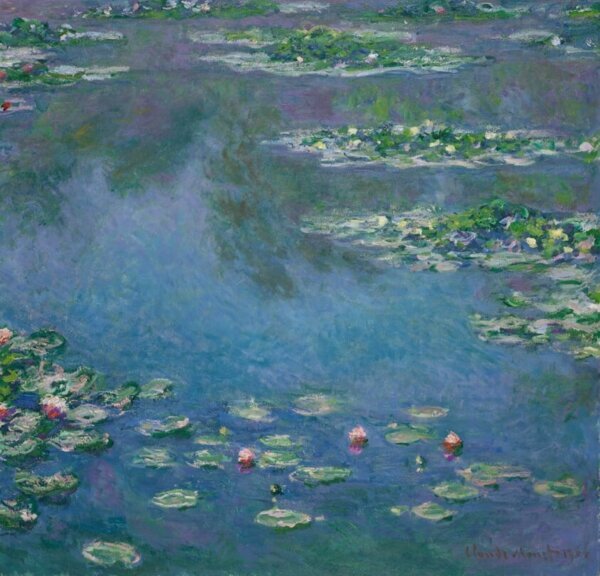
When one thinks of artistic impressionism, Claude Monet is probably one of the first names that springs to mind. This is for good reason—Monet and impressionism are so synonymous that the term itself actually comes from the title of one of Monet’s paintings: Impression, Sunrise. But if you really want to understand why Monet is probably the most famous impressionist of all time, all you need to do is take one good look at a Monet painting.
When Monet paints a landscape—a field, a sunrise, a pond of water lilies—he does not attempt to capture every minute detail, as the realist painters did before him. Instead, Monet paints the experience of the landscape. When gazing at one of Monet’s paintings, one is forced to reckon with the fact that although it looks nothing like a photograph, it nevertheless transports the viewer into that place and time. The viewer feels as though he is sitting next to Monet, feeling the breeze on his own face and listening to the twittering birds with his own ears. It simply does not matter that this sky is purple or that tree is blue. Even in their most fantastical moments, Monet’s paintings capture the real world more richly and fully than any photograph.
But Monet is famous for more than vivid colors and soft brush strokes. Indeed, the artist is perhaps even better known for his habit of returning to the same subjects over and over again. For example, over the course of about eighteen months between 1890 and 1891, Monet sat in a field near his house in Giverny and painted a couple of haystacks. He did this thirty times—the same haystacks each time, but at different times of day, different seasons, different weather conditions. This resulted in a particularly famous series of paintings known predictably as the Haystack paintings.
Recently, I had the pleasure of wandering through a collection of works by Monet at the Art Institute in Chicago. The collection included several of his Haystack paintings. As I walked through the exhibit, I was particularly struck by the profound realization, perhaps only possible when viewing an artist’s work up close, that Monet really did stand in a field and paint these same haystacks thirty separate times. Gazing at Monet’s work, I found myself wondering whether I could have done the same. At what point would I have lost patience? After the tenth painting? The fifth? If I’m being perfectly honest with myself, I fear that I might have grown bored of those haystacks after even the second or the third painting. Or, more likely, I would have painted the haystacks once, packed up my easel and paints, and moved on to something new, something different. The haystacks might be worth my time, but only once.
For Monet, however, this was not a one-time phenomenon. Monet did not develop a strange obsession with haystacks and then move on. Instead, Monet found several other subjects to which he devoted an absurd amount of time and attention. He painted the Rouen Cathedral over thirty times. He painted Waterloo Bridge forty-one times. He painted the water lily pond in his flower garden two hundred and fifty times.
What exactly could compel an artist to produce three hundred and fifty-one paintings on a grand total of four subjects? I am no artist, but it seems to me that Monet must have seen something in the haystacks, the bridge, the cathedral, and the water lilies—something that cannot be explained away by his whims, his genius, or even his personal artistic style. If we look closely enough, perhaps we too can try to catch a glimpse of what Monet saw.
Chesterton and the Theology of Repetition
Modern society is suffering from a boredom epidemic. With the rise of social media, streaming on demand, and fast-paced technology, our attention spans are declining. We do not like to watch videos any longer than a minute or two, and even that might be pushing it. We certainly do not like to repeat anything—and why should we? There is an endless well of new content to work through. I see something amusing, I laugh at it, I keep scrolling, and I will never see it again. We could scroll until we die and never reach the bottom. In this eternally fast-paced world, what benefit could repetition possibly serve?
In his groundbreaking theological work Orthodoxy, G.K. Chesterton challenges the assumption that variety means life and repetition means death. “It is supposed,” he writes, “that if a thing goes on repeating itself it is probably dead; a piece of clockwork.” But Chesterton argues that the opposite is true: that people change their routines because of their weakness, not because of their strength. For example, a hiker rests on the side of the path because he is tired; if he contained boundless life and energy, he would not slow his pace until he reached the top of the mountain. Building on this principle, Chesterton writes:
The thing I mean can be seen, for instance, in children, when they find some game or joke that they specially enjoy…. They always say, “Do it again”; and the grown-up person does it again until he is nearly dead. For grown-up people are not strong enough to exult in monotony. But perhaps God is strong enough to exult in monotony. It is possible that God says every morning, “Do it again” to the sun; and every evening, “Do it again” to the moon. It may not be automatic necessity that makes all daisies alike; it may be that God makes every daisy separately, but has never got tired of making them.
But if God himself delights in making each daisy separately, then there must be something so profoundly beautiful and holy in the daisy that if you could see it, really see it, you would fall to your knees in fear and awe. Of course, this is not to say that there is some kind of mystical wall preventing you from seeing the daisy as it really is. In other words, if you do not react with sublime reverence every time you see a daisy, the most likely solution seems to be not that there is something wrong with the universe, but that there is something wrong with you. “For we have sinned and grown old,” as Chesterton writes, “and our Father is younger than we.” Put simply, we are too weak to see the holiness in a single daisy. If we were stronger than we are, we could sit in front of that daisy for hours, days, weeks, years, and never grow tired of it.
Perhaps the same is true of a water lily pond.
Attention and Prayer
If Chesterton is to be believed, then the whole of reality—both the world of nature and the world of man—is fundamentally worthy of repetition. In other words, just as God commands the sun to rise every morning because he rejoices in the repetition, Monet also sits in his garden and rejoices in painting his water lilies for the two hundredth time. If we were to follow his example, then we too would stop every day to examine the water lilies. We would exercise our will and attention until we were strong enough to find value in repetition.
Of course, seeing the world through the eyes of Monet is not merely a matter of repetition. Monet did not bestow two hundred and fifty passing glances upon the water lilies. Rather, in order to paint a subject, an artist must focus his attention on it. The painter must spend hours looking and looking again, mulling over the shapes and lines, adjusting and re-adjusting until the likeness is just right. Repetition is not enough. It must be combined with the power of attention.
The French philosopher and mystic, Simone Weil, has something to say about the power of attention. In her famous essay, “Attention and Will,” she makes the simple but profound argument that “we have to try to cure our faults by attention and not by will.” According to Weil, even the most valiant effort to attain inner purity by clenching one’s fists and trying harder will ultimately fail. This is because virtue has almost nothing to do with will. Indeed, she argues that “if we turn our minds toward the good, it is impossible that little by little the whole soul will not be attracted thereto in spite of itself.” From this perspective, the solution to evil is not willpower, but attention—attention directed toward the things that are worth contemplating. According to Weil, the soul will naturally grow in goodness and virtue, if only it focuses its attention on the right subjects.
But she takes this argument even further. She argues that “attention, taken to its highest degree, is the same thing as prayer.” While this claim may sound surprising at first, it actually makes a good deal of sense. When a person prays, he does so with the knowledge that his omniscient God already knows exactly what he needs. Prayer, then, is not the practice of passing information along to God, or of telling him anything he does not already know. Instead, it is the act of focusing one’s attention upon God. This is why Weil makes the extraordinary claim that “absolutely unmixed attention is prayer.” They are one and the same thing.
But if prayer consists of perfectly focused attention, then prayer must actually be quite difficult. When was the last time any of us perfectly focused our attention on anything? Even as I write this essay, I find myself constantly distracted by checking my email, refilling my coffee, or thinking about what to cook for dinner. If we cannot learn to give anything our unmixed attention, then how in the world can we learn to pray?
Incidentally, Weil argues that this dilemma is one reason why education is so important. As a Latin teacher, I frequently find myself fielding questions from students who want to know why they need to study Latin. Typically, I supply a rehearsed list of reasons: Latin is foundational to western civilization; many of the most important texts in the western canon are written in Latin; learning a secondary language is good for your brain development; Latin students perform better on the ACT and SAT; and so on and so forth. But perhaps I ought to give my students Weil’s response: that the primary purpose of studying Latin—and indeed, any other subject—is to cultivate the skill of focusing one’s attention on something meaningful. In other words, when you study Latin grammar, practice the multiplication tables, or memorize a poem, what you are really doing is learning how to pray. At the risk of sounding like too much of a mystic, I venture to add that perhaps the act of study is already secretly a form of prayer.
The Holiness of the Ordinary
If repetition is strength and attention is prayer, then maybe we can begin to understand why Monet painted how and what he did. To be clear, Claude Monet was probably an atheist (or agnostic at the very least). He certainly would not have thought of his painting as prayer. But even so, we can learn from his example. Monet could have painted the water lilies once or twice and moved on to a different type of plant. He could have traveled the world, painting a new and exciting landscape every single day, and produced hundreds of works that depicted a vast variety of subjects. Instead, he chose to paint the same water lily pond two hundred and fifty times. The water lilies captured his wonder, his attention, for nothing less than thirty years.
By painting the same subjects over and over again, Monet echoes the voice of God. He tells the water lilies, “Do it again,” and they obey him. In doing so, Monet reminds us that every ordinary thing you look at—whether bridge, haystack, or pond—is so precious and sacred that it is worth painting a hundred times. It would be worth painting thousands more times, if you were a better person than you are now, if you had enough life and strength and attention.
Perhaps there is still time. Perhaps you can start practicing now. Perhaps you should close the computer, set down your phone, and go outside for an hour or two. Sit under a tree and gaze up at the branches. Contemplate a flower. Lie in a field and watch the clouds. Tell the world to “do it again,” and maybe it will listen. If you focus your attention carefully enough—if you look hard and long enough—maybe, just maybe, you too will begin to catch a glimpse of what Monet saw.


Related Posts