Ethics, Not Metaphysics: A Review of Buddha, Socrates and Us
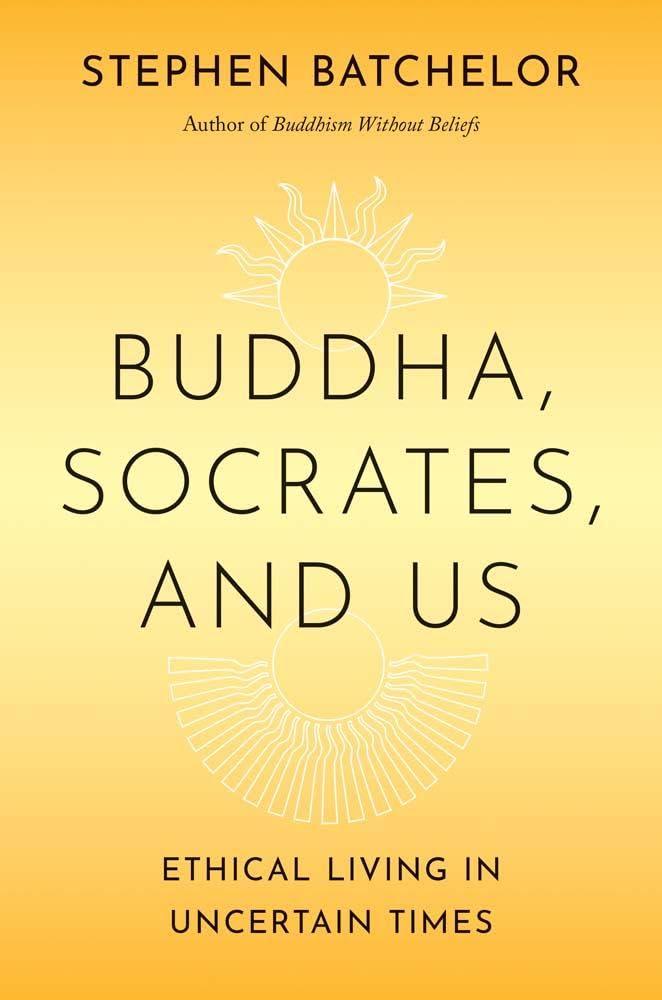
In The Origin and the Goal of History, Karl Jaspers calls the period from 800 BC to 200 BC “the axial age.” This period consisted of much turbulence and violence that nonetheless led to a flourishing of various groundbreaking thinkers across the world, from Confucius to Thucydides. Taking cues from Jaspers, Stephen Batchelor, a scholar of Buddhism, takes on the challenge of analyzing the comparative ethics of Gotama Buddha and Socrates, two contemporaneous historical figures from the “axial age,” in his new book Buddha, Socrates, And Us. As its subtitle, Ethical Living in Uncertain Times, suggests, it is more of an interventionist work than a purely theoretical book, but it still contains many interesting theoretical reflections, not only on Buddha and Socrates but also on the history of both Western and Eastern thought in general.
From the outset, Batchelor claims that he will examine “how the Greek and Buddhist philosophy might address the existential concerns facing us today.” He identifies these existential threats to be, not exclusively, climate change and the rise of a technological society. However, his reading of both Buddhist and Greek philosophic texts does not directly address the threats he enumerates in the beginning of the book. His work is ultimately less of an interpretation of those texts and more of a secular guidebook of ethics for our current times.
Drawing upon his personal experiences with different schools of Buddhism, Batchelor provides a history of Buddhism and how different schools have different concerns. According to Batchelor, almost all schools of Buddhism have a focus on ascetism, eschewing the secular world. This leads him to become somewhat disillusioned with the concept of Buddhism as “truth-based metaphysics,” turning instead to a more “task-based ethics.” Socrates, who, as Cicero rightly stated, brings philosophy down to earth from the heavens, becomes a great interlocutor for Batchelor in his quest to consider a kind of Buddhism that has more concern for earthly things.
Buddha, Socrates, And Us can be more accurately titled Buddhists, Greeks, And Us, since Batchelor engages with various traditions of Buddhism that stray even from the strict discourses of Gotama, as well as the thoughts of several contemporaries of Socrates such as Euripides and Thucydides. Curiously, he points to Hannah Arendt as an “ideal conversation partner” to understand Buddhist ethics with respect to today’s world because her insights on the condition of human beings do not take any cues from the Eastern tradition, unlike her mentor, Heidegger. This, in turn, makes her insights less beholden to the weight of tradition, which often can turn dogmatic.
Batchelor’s attempt to find a fusionist ethic in Socratic Buddhism, or Buddhist Socratism, faces two hurdles: a disservice to Socrates on the one hand, and on the other, a demand that Buddhism be something it is not. Regarding Batchelor’s interpretation of Socrates, there are two main issues that render it dubious at best. First, Batchelor argues that Socrates had no concern for the knowledge of natural science and metaphysics after his so-called ‘second sailing’ described in Plato’s Phaedo. Socrates’s move away from metaphysics is what allows him to become an ethical individual, embodying moral virtues by spending all day questioning his fellow Athenians regarding their moral values. Batchelor quotes from Xenophon’s Memorabilia that Socrates not only questions the moral values of his fellow Athenians but also teaches them how to be ethical. According to Batchelor, Socrates settles for an ethos of uncertainty when he moves away from his quest for metaphysical truths.
But does this same Socrates not claim in the Memorabilia that one of the greatest activities he enjoys is discussing metaphysical matters with his friends? In many of Plato’s works, from Phaedrus to Phaedo, Socrates discusses several metaphysical doctrines like the Myth of Er and the Tripartite Soul. Since Socrates did not write anything himself, it would not be fair to separate Socratic thoughts from Platonic or Xenophontic thoughts in the dialogues of Plato and Xenophon. In other words, there is no Socrates that we know of that is separate from the portrayals of him by Plato and Xenophon, in which he always talks about metaphysical doctrines. We also cannot ignore Aristophanes’ portrayal of Socrates as a natural scientist in his Clouds, although Batchelor interprets this portrayal as a mere parody.
Batchelor also claims that Socrates wants others to use their daimon (or, as Batchelor interprets it, their “conscience”) as their moral compass. Nowhere in the writings of Plato and Xenophon does Socrates urge others to use their so-called conscience. Socrates knows that his daimon is a special gift, but he does not assume that others have one as well.
I am not merely disputing Batchelor’s interpretation of Socrates for academic reasons. Socrates’ interest in metaphysics is important for his notion of ethics, or how to live a good life. He does not merely want to question the definitions of virtue; he wants to understand those definitions after rigorous examination. Batchelor’s commitment to a nondogmatic notion of ethics prevents him from understanding who Socrates was.
Batchelor wants Buddhism to engage actively, not dispassionately, with the problems of the world. As a seasoned scholar of Buddhism who has studied various schools, from Tibetan Lamas to Korean Zen priests, Batchelor knows that Buddhists, regardless of the school they are from, ultimately consider the detachment from the world and the cessation of suffering as the ultimate goal of Buddhist practice. How, then, can he think it possible to secularize Buddhism to better serve the needs of our world? Batchelor rightly points out that a major doctrine of Buddhism is to accept the world as it is, yet he wants Buddhism to do more than what it claims to do.
In the chapter “Whose Socrates, Whose Buddha?”, Batchelor laments the fact that, because Buddha’s teachings were only orally transmitted during his lifetime and his discourses were only compiled by his monastic disciples (not lay disciples), we may be stuck with a version of Buddhism that is more oriented towards a monastic life. This ignores the fact that Gotama Buddha himself entered a monastic order, so it makes sense that most of his discourses feature conversations with his monastic disciples. The discourses that are compiled by his monastic disciples also contain conversations Buddha had with lay people, which can guide us towards living a Buddhist life as lay people. Batchelor acknowledges their existence, but for him, these teachings are not enough for his project on secular Buddhism.
Buddha, Socrates, And Us is an interesting compendium of philosophic and theological practices that considers ethical matters as the best path towards living a good life. However, it does not achieve its goal of showing how Greek and Buddhist thought can help us with contemporary crises, since it does not attempt to understand either the Greeks or the Buddhists.
Buddha, Socrates, And Us
By Stephen Batchelor
New Haven: Yale University Press, 2025; 352pp


Related Posts