Evangelicals in the Public Square After the Scopes Trial
Fundamentalism is something of a dirty word; equally a badge of pride and a mark of shame, but most definitely a banner that has led many controversial crusades across the past century. “Those darn fundamentalists,” their critics say. “They’re ignorant country bumpkins holding back progress and science with their Bible-thumping ways!” And certainly, this line of argumentation hasn’t gone away. The resurgence of evangelicalism during the latter half of the twentieth century, followed by the rise of “Christian Nationalism” more recently, has led to much scrutiny and criticism against modern-day American Protestants of the fundamentalist persuasion.
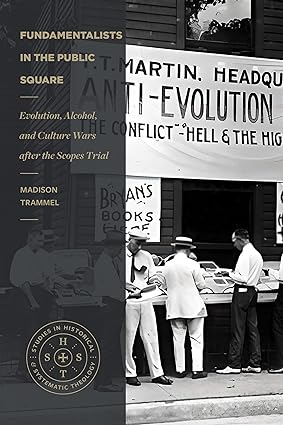
It is into this cultural war that author and publisher Madison Trammel has descended, writing in his new book, Fundamentalists in the Public Square, about a small but curious distinction in the history of Christian fundamentalism, its history as a political force within the United States, and arguing that the fundamentalists may not have received quite the defeats than the history books often accuse them of suffering.
In July 1925, the small town of Dayton, Tennessee, played host to one of the largest and most contrived media circuses of its decade when a ACLU-backed science teacher defied the state’s new laws against teaching Darwinism in schools, which led the national media to descend upon the small town to watch the spectacularly scandalous court trial play out.
The fundamentalists technically won when a Democrat politician, celebrity lawyer, and Christian fundamentalist named William Jennings Bryan successfully led the prosecution. The affair was posthumously declared a public relations disaster for the ascendant Christian fundamentalist movement, which was enjoying its success after passing Prohibition into the Constitution in 1917.
As Trammel argues, the Scopes Trial is often recorded by historians as a massive defeat for Christian fundamentalism, which allegedly forced the movement underground until the later ascendancy of Neo-Evangelicals like Billy Graham. However, his research into the newspapers at the time shows just the opposite—that the movement was thriving and energized after 1925, it remained culturally active and powerful well after the abolition of Prohibition in 1933, and it even helped elect President Herbert Hoover in 1928.
The myth about fundamentalism’s defeat at the Scopes Trial tends to be equally propagated by Christianity’s critics and proponents. While notable religion critics like H.L. Mencken blasted fundamentalist Christians for embarrassing the country in his eyes, conservative historians tentatively agreed and believed that the movement had retreated from social activism in the public square in shame. As Trammel notes, this is the view propagated by leading historians like Ernest Sandeen. Sandeen acknowledged, in his 1970 book called The Roots of Fundamentalism, that fundamentalist historiography going back to the 1930s was too heavily biased against it.
If the fundamentalists were in retreat, it is not evident in their actions. Their two most pressing social concerns were Prohibition and Darwinism; they continued to fight on those issues. Coinciding with the outbreak of the fundamentalist-modernist controversy across Protestant denominations, fundamentalists came to regard the importance of establishing Biblical morality in law and saw much political success, with multiple states passing anti-evolution legislation. The movement would hold strong under the leadership of religious leaders and politicians like John Roach Stratton and Bryan until their untimely passings left the movement nominally headless in the mid-1930s.
Christian fundamentalism’s public reputation certainly isn’t hard to figure out, with its critics being famous and loud figures like Mencken. The movement has been accused of anti-intellectualism and obscurantism; it was also conflated with the narrow-mindedness of the Ku Klux Klan. They were further accused of being rural, fearful, ignorant, uneducated, bigoted, intolerant, menacing, and dangerous. Mencken described them as “Homo boobiens,” calling them “half-educated” fools who do not comprehend anything of substance and held back the country.
The newspaper coverage that Trammel surveys in the US’s four largest states shows a far more balanced depiction of the events of the Scopes Trial. The Christians involved felt empowered by the nominal victory and recommitted themselves to continued anti-alcohol and anti-evolution efforts. They saw no reason to retreat from the public square and saw the defense of these issues as the “defense of religion” itself.
“The writings of nationally known columnists like Mencken appeared in relatively few publications, and blistering critiques of Fundamentalists such as those he wrote were the exception rather than the norm,” writes Trammel. “The coverage of fundamentalists was fairly evenly split between positive, negative, and neutral articles. Though expert opinions pointed against anti-evolutionists… newspapers would also occasionally publish articles friendly to fundamentalists.” He continues, “In the immediate aftermath of the trial, newspaper articles tended to focus on what was next for the anti-evolution cause and the trial participants, No evidence of a fundamentalist retreat can be detected in these pieces.”
The role of Christian fundamentalism in public life continues to raise concerns. They were, themselves, the inheritors of the Great Awakening’s proponents who helped enshrine religious freedom as an American virtue in the eighteenth-century, and they were now demanding to set new rules for the public square.
As Trammel notes, they were also “incoherently” pushing against their own dispensationalist theology, which believed that social renewal and activism were essentially pointless before the final return of Christ. “Dispensational ecclesiology offered the church no role in world transformation and included no conception of the church and society mutually benefiting each other.” The Baptists, Methodists, Presbyterians, and Pentecostals leading this movement were effectively moving in defiance against their stated assumptions about the world. And yet, they felt compelled to live out the social gospel as they saw it.
Trammel’s research thus stands as a narrow but fascinating correction to one of the popular myths of the twentieth century; one that is likely to come into focus once again amid the 2024 election and the upcoming 100th anniversary of the Scopes Trial. The fact that fundamentalist Christians were able to push back against the forces of the modernist elite and their theological priors for two decades shows how powerful their lobby proved to be and continues to be among evangelical Christians in America.
Fundamentalists in the Public Square: Evolution, Alcohol, and Culture Wars after the Scopes Trial
By Madison Trammel
Bellingham, WA: Lexham Academic, 2023; 200pp


Related Posts