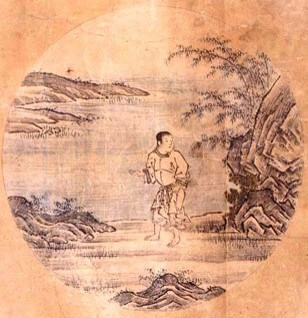
Finding the Ox
Bewußtsein ist eigentlich nur ein Verbindungsnetz zwischen Mensch und Mensch – nur als solches hat es sich entwickeln müssen: der einsiedlerische und raubtierhafte Mensch hätte seiner nicht bedurft. (Nietzsche, Gaia Scienza, § 354)
What is the sound of one hand clapping? (Zen Buddhist koan)
SEARCHING FOR THE OX[1]
Coming out of the marbled whiteness of the entrance, you are at once embraced by the darkness in the interior of the building, where you now journey downwards. You descend a slick, wide, steep staircase, always in danger of slipping and falling. As is customary, your search begins with a katabasis, a journey to the underworld and the questioning of the spirits of the dead. Through the double doors of the Museo dei Gessi of the Sapienza, you are guided to the left, gestured on by the deafmute guardian, where they wait for you.
First, five reliefs of animals: a faceless hero encounters a lion, a snake, a horse and an Amazonian woman. Of them and of their vanquisher, only few forms remain, rounded by time, breakpoints smooth now, chiselled out of the plates, barely discernible, and yet: the paws of the lion, the coiled body of the snake, the horse’s rump, the female torso, we anticipate them. Then further eight, facing each other, four and four, duelling heroes with monsters, overcoming their opponent. On the opposite wall, high up under a row of windows, the long marble of a great battle, the turmoil of many warriors, tumbling, staggering, attacking, mutilating together, white and immobilized in the linoleum silence of this empty library of statues.
What we see here is a collection of plaster casts of famous antique sculptures. The corporeality of the dead is evidenced in different ways: The sculptures are embodiments of legendary heroes, often larger than life, that perish in the storms of time like the bodies of mortal men, and yet, fragments of represented bodies endure and come upon us. They are assembled here as copies in plaster, but this time the mutilations of time are presented-with, at hand, a catalogue of what remains for us. But the lack of hands, of arms, noses, legs, entire faces, sometimes heads, does not seem like an abstraction, but rather like a highlighting of the singular. The Heracles who fights here (the plaster copy of a marble representation maimed by ravages of time) appears unique among all the other depictions of Heracles, an individual.
I am alone with the plasters. They are not like the plasters of Pompei – taken from the mold of spaces where once bodies lay dying. They are not casts of the actual dead, but they are those heroes and ideas which once inhabited the world so plentiful as angels in a poem by Charles Simic: the sky at dusk used to be thick with them.[2]
I note that what I face here are encounters: of heroes who themselves encounter in their deeds different figures, often hybrids between human and animal, sirens, centaurs; that as I encounter them, these gessi encounter me, that in this archive of forms they encounter each other, as though we could step over the threshold of time into a common present. This present is imagined here, in the sense that it is only copies, likenesses, which are collected, for us – to study their poses, compare their features, understand similarities.
We know that each mortal body on earth is lost. From its conception, it is already part of the process of decay. It does not persist. (Even the bodies of the dead imagined in heaven do not possess the same corporeality as on earth; they are not subject to processes, have no more desires and needs, they are unchanging.) The visibility of their journey through time witnessed by injury, mapped in the process of casting, of these sculptures makes one consider the specific difference of our (mortal) bodies: an embodiment of such short duration, that the entire ‘long’ history shrinks into a swift succession of short generations, the intertwining of flesh, a birthing turmoil. And even the becoming of a single body is a singular violent process of change. Of which nothing is left?
The gessi lead chronologically across ideas and epochs, delineated by postures, and styles of garment folds. Such gods, heroes, ideas, are a tangible part of antique society, demons in Karl Jaspers’ sense, because they make the transcendence of an imagined pantheon become immanently visible and present.[3] Here, only the idea of corporeality remains, preserved in the representation of violated physicality. What remains from the encounter with the body-fragments is an idea – that our bodies are unique and mortal.
On the other side, at the end of the chronology, the encounter with another kind. These are the Etruscan dead. Clay representations of a person from whose tomb they were taken. In the 2023 movie ‘La Chimera’ by Alice Rohrwachter, a clairvoyant Englishman can locate these graves and, with this knowledge, assists a gang of tombaroli, grave robbers. But this opening of the gates leads in two directions, reality is accessible from both sides, it seems: The people he now meets on a train are the ghosts whose burial objects have been taken.
Exiting into the blinding warmth of a Roman midday in July, received into the heat of the paved driveway, welcomed by urbanity back into the now, you make your way towards the gate of the Città universitaria, step out into the streets of the eternal city and board a bus headed back to the center intra muros, you will see in every man, woman and child who crosses your path, the faces of the dead – those missing faces, now reimbodied in the living, an eternal, generational reach. You will see the Etruscan youth, the Roman senator, the child whose tomb was guarded by a face-less cat. Even this cat will find you. You will see the Nubians, the Carthaginians, the Greeks. You will see the faces of those from Hispania, from Asia, from Cappedocia, Thracia, Macedonia, Dalmatia. You will see the women returned to their vital splendor, the children, their slaves – the dead ones of all parts who once populated the city.
In fact, you will no longer be able to not see them. This way of seeing the others as the returned dead will remain with you from your visit to the Museo dei Gessi, your trip into Hades. But what is the significance, the meaning of the encounter with the dead? Your search is underway, but can one lose one’s self? The ox has never been lost, so what need is there to go and pursue it?
Tracking the Ox
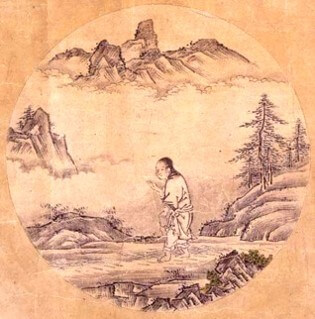
Our puzzle: Consciousness. That humans in every epoch of their long history, as Han Kang said in her Banquet Speech, are seeking to find themselves, that they are losing themselves in violence and recover themselves in love and make meaning, is the clue we are pursuing. [4]
Traditionally, there is the ‘hard-problem’ of consciousness which asks what the causal and/or constitutive relation between the physicality of our embodied existence and the experience of who we are is – the How of our Now. It is distinguished from the ‘easy problems’ where sciences seek to explain how the brain processes specific information to generate behaviour, for example. I once purchased a tote bag in Cambridge which featured a bat and read: What is it like to be a philosopher? – a tongue in cheek reference to the famous example by Thomas Nagel.[5] Nagel discusses how the way a sentient being, a bat for example, is embodied, say by sleeping hanging upside down and using echolocation to hunt, exclusively conditions their experience of qualia, that is, the qualitative aspects of consciousness. We must conclude that we can never know what it is like to be a bat (or a philosopher) unless we are one ourselves.
When I came to Berkeley as a doctoral student from Germany, I had with me the letter of recommendation of my Doktorvater who had once published a paper with the daring title ‘To Hell with Speech Act Theory’. At this time, John Searle, the author of ‘Speech Act Theory’, was likely the most famous philosopher alive. Searle welcomed me into his office. I looked around in amazement. There were boxes and boxes on every shelf filled with little tiles onto which Chinese symbols had been printed. “In Chinese, I am just a computer. I am famous for not speaking Chinese,” Searle would say jovially and recount a conference in China in which he had taken on a great number of opponents who all argued with him about his ability to not understand Chinese. Searle’s fame had been established in no small part because of his brilliant ‘Chinese Room Argument’.[6] The point of the argument is to demonstrate the difference between manipulating symbols and understanding a message. In the thought experiment, Searle is given a slip of paper with Chinese symbols on it, he manufactures an ‘answer’ by manipulating Chinese symbols according to a rule book, picks out the corresponding tiles with Chinese symbols from his boxes and then hands his answer back out through a little slot where his ‘messages’ are received by a pleased scientist. ‘Gosh – it passed the Turing-test!’ the scientist (herself a Chinese native speaker) might exclaim and scratch her head in wondrous glee. Thus, John, inside his ‘Chinese Room’ is no different from a computer which manipulates symbols according to rules. The Turing test considers responses produced by an entity, in this case, a man, or a computer. Should a (conscious) evaluator, the scientist in our example, not be able to tell the responses of man and machine apart, so the assumption, there would be ‘no difference’ between the man and the computer. Giving out ‘answers’ which read to the scientist as sensible purportedly proves that the computer ‘understands’ Chinese. I imagine that John would, just then, throw open the door to his office, in a sort of reverse Wizard of Oz move, and shout: ‘And yet – I have understood nothing! Manipulating symbols algorithmically does not equal understanding!’[7]
Involved in the discovery of the mind today are the disciplines of a philosophy of mind, brain sciences, psychology. Researchers also draw on linguistics, neuroscience and computer sciences. They all have contributed to the formation of a new field at their intersection: cognitive science. It serves as an umbrella for scientists who study the mind. We see a line-up of the academic circus according to the priorities of man: on the outset – his interests, first – his self, then – his species, next – his peculiar form of being in the world: as a being with history, namely that his self and his species interact in such a way that they provide the basis for future man to enter into a world of meaning. Thus, last, but not least – his hopes, first and foremost: personal relevance, immortality.
These hopes have been debunked by the meltdown of all aspects of transcendence which are rendered qua materialist representation as immanent. We see the myopia of a narrowed take which can consider only quasi-contractual, interest-based reasons for action. And worse still, if the value of human existence and experience is thus reduced, vitalist interests – that our man should ‘live’ –, no longer convince everybody. Louder are the nihilist calls for an end of philosophy, an end to man. One might conclude even more pessimistically: Man deprived of transcendence has already ceased to be man. I should hope that by now this word rings shrilly in your ears: Man! Let us turn away. Let us regard ourselves. Not man. But many. But woman. But me. And: you.
The argument I am searching for in this inquiry of consciousness is a maximalist argument; it runs parallel to Searle’s Chinese Room Argument. We are not looking for a minimalist criterion, a threshold which an animal or a machine might cross to be allowed to join the ‘Club of Conscious Entities’, in the form of a Turing test which puts up a minimal requirement and relies on a third personal (already consciousness biased) observer. Instead, we are looking for a maximalist criterion: a maximalist account of consciousness pays tribute not only to its first person perspectival phenomenology and its motivational make-up (the materialist foundations), its evolutionary role in explaining its origins and its function for the survival of life on our planet, but also its metaphysical, existential and soteriological aspects, for the individual and for ourselves as a species.
The first encounter with a ‘religious’ practice, or a set of doctrines, points one in the right direction, but the search has to be undertaken by oneself.
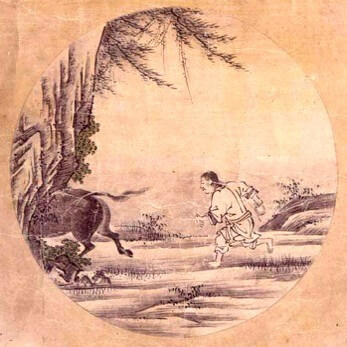
Spotting the Ox
Around 1950 there were two friends sitting in the Tea Orchard in Grantchester. They had walked over from Cambridge, a vigorous walk, then a cup of tea in one of the lawn chairs, to accompany a rigorous philosophical conversation on certainty.[8] One was Georg Henrik von Wright, the other Ludwig Wittgenstein.[9] Imagine you would have walked by, just then, and overheard Ludwig pointing to a tree, saying, intently: “I know that this is a tree!” Georg Henrik would have turned around to you and said kindly: “This man is not crazy. We are merely philosophizing.” You might have been disappointed: Did they have so little faith in your understanding of their undertaking? Were you not yourself often asking these same questions? You should have been flattered: The address to you made you the silent third party, complicit and benefitting – in your chance encounter you witnessed two of the great philosophical minds of the century, their great friendship, and a great insight resulting from both: that philosophical discernment can only be had in conversation. Following the tracks, he finds the ox…
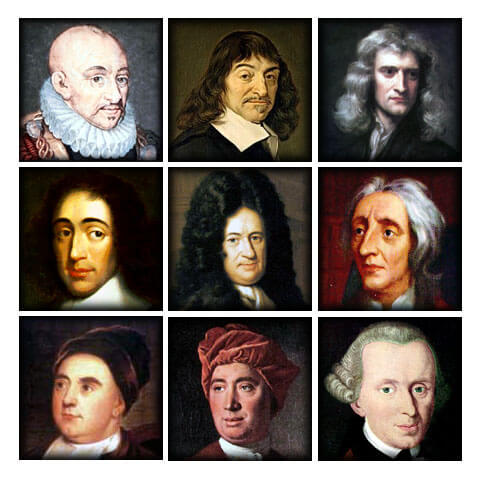
At the time of early modern philosophy, say, one approached certainty by methodically doubting everything until one reached the ‘empty loop of thinking’ (Jean Paul Sartre), inside one’s head (a metaphor). The world of our experience, the world of the others, the world of one’s own body, had by then long been given up in doubt. Dubito ergo cogito ergo sum, is how the Cartesian formulation reads. A sovereign subject confronts an external world of objects and others, it is separated from them through its’ thinking, which is the only certainty to which it can cling. The answer to the question: What is the self? then must be: the cogito. This results in the frequently underwritten assumption that without consciousness, you are nothing. Shizuteru Ueda, in his meditations on the self, diagnoses here a profound misconception of self-hood, that it has to assert: I am I. Descartes’ “powerful answer”, as Ueda sees it, tows a number of strong beliefs about the legitimacy of human dominance over the world through technology.[10] The antagonism of humans versus their world has its root in this basic and false conception of the self. The problem arises because both world as the space of experience which is necessary for human existence, and the possibility of another subject next to my own self, which is equally necessary for my human existence, have to be denied.[11] For Viennese psychoanalyst Viktor Frankl, the specific human phenomena lie beyond the pleasure principle, they constitute the transcendence of self as fundamental anthropological phenomenon.[12]
In order to understand who we can be, we need to understand consciousness; and in order to understand consciousness, we need to understand who we are. This understanding concerns not a generalized ‘we’, the plural majestatis of an author, a veiled ‘I’; nor is it the quest of each one subsumed under the temporary solidarity of readership. This is the ‘we’ of a species, of a family, of comrades in a fight, of participants in a zeitgeist, of persons across time, all of whom need each other to carry on. That we are not merely blindly striving takes us out of ordinary evolutionary time (see: Taming the Ox). That we instead direct our strife and that it acquires meaning for us in this process – this is what we can call consciousness.
Consciousness requires and is constituted by self-conscious groups of participants who relate to individual contributors in the past, present and in an (ideally imagined) future, and they rely on them to share their purpose. It is facilitated by a background of meaning against which the new emerges – in the form of single standpoints, delineated by their environmental interactions, i.e., by dealing with situations as they arise (encounters). These dealings again become part of the background and are accessible to participants via cultural transmission. This ever expanding and adapting background enables the ‘next new’. Let’s call this movement ‘progress as problem-solving’. Understanding it is important and useful for us: it can help us accept our and our loved ones’ mortality; it allows us to see our place in the ordered all (cosmos); it enables us to represent the order of the cosmos in action-guiding ways (make more meaning) and helps us find more effective ways to engage situations: for example by using new tools (AI!) and finding new ways of sustaining our strife (climate change!); in sum: we are enabled to create order as our part of cosmos. Order is the equilibrium which life constantly balances against the icy entropy of loss.
You spot the ox, but it is taunting you from afar, across a river (no crossing in sight), or dashing away from you with all its speed.
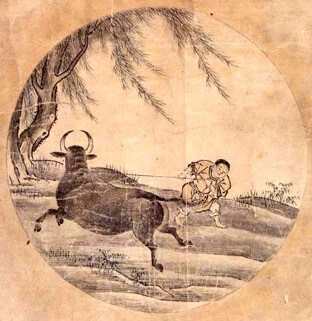
Capturing the Ox
“In my Swedish Bible, it says of the Tree of Knowledge that it was på gott och ont, which in ordinary language means that the knowledge provided by the fruit of the tree could be to the benefit of man or could harm him. (…) The Tree of Knowledge provides not only knowledge of good and evil. It is also for good and evil – and the faulty translation in the Swedish Bible unintentionally expresses a profound truth. The rational aptitude in man has double potential; one potential for the good, i.e. man’s growth towards the ideal; and one potential for evil, i.e. the hubris of man’s self-divination of fancying himself as God.» (Georg Henrik von Wright, The Tree of Knowledge)[13]
Knowledge is equally an instrument for happiness and unhappiness, for good deed and devilry, writes v. Wright in his essay. (v. Wright, ibid.,153) His question: is it good for mankind to seek knowledge? In his answer, he grants that knowledge can be an instrument which satisfies our various needs and wishes. It can also be a way of life, that is, we can strive to understand for the sake of understanding. And in both cases, and however one puts the question of the value of rationality, the answer will remain ambiguous. Knowledge itself is only our instrument. Our own ends will determine its effects and how we are to judge our progress.
How are we to judge the success or failure of our progress? There is an infamous German student who fails so miserably that it is both laughable and terrifying. He can only save the situation by calling his Meister who in turn can call back the spirits which his inept apprentice summoned, and which are wrecking the whole house. Herr, die Noth ist groß!/ Die ich rief, die Geister,/ Werd’ ich nun nicht los! We are not unlike Johann Wolfgang von Goethe’s Sorcerer’s Apprentice.[14] This is why his case can be instructive. An entire branch of philosophy which dedicates itself to criticism of technology deals with it. Georg Henrik von Wright is part of this tradition. Notably, his take on the matter varies from his friend Wittgenstein’s, in that his is a technological pessimism, whereas Wittgenstein’s might be deemed a cultural pessimism.
Hubert Dreyfus, phenomenologist and beloved teacher of philosophy at Berkeley, developed in his oeuvre three lines of interpretation of our being-in-the-world which intertwine with our inquiry; in all three Dreyfus presents a critique of the concept of ‘mastery’:
Together with his brother Stuart, Dreyfus comes up with a classification of the stages of learning, or mastering of a new task (for example: playing piano or driving a car or speaking a language).[15] Leaving amusing details to the side (such as the often observable Dunning-Kruger effect), ‘capturing the ox’ means here realizing that mastery relies on two judges – yourself and an idealized master, as in someone who has already mastered your craft, whom you imagine witnessing your performance. The evaluation of success or failure depends not only on what you think (first person perspective) or on what an external observer might find (such as with the scientist in the Turing test), but it is a mixed internal-external perspective of which it would be hard to say that it was just yours or just the observer’s.
In an early study of one episode of Don Quijote, Dreyfus and his co-author James H. Broderick describe the culminative encounter of the knight with the curds and the lions.[16] It shows Don Quijote as both an idiot believing the curds which end up in his helmet to be his brains melting and a hero – inwardly, in taking on a situation which allows for heroism in his opinion; outwardly, in actually confronting two real, starving lions. Secondly, ‘capturing the ox’ means understanding that beyond instrumental mastery the situations are the background against which your performance shows up as heroic or idiotic. We all have a master, a strict teacher and an unyielding judge: reality.
In his most famous book, ‘All Things Shining’[17], culmination of his legendary lectures on ‘Man, God, Society’, written with his student Sean D. Kelly, Dreyfus reconstructs how we can find meaning in a secular age with the help of the classic works of our literary canon. The study is an elaborate genealogy and critique of monotheism which proposes as an alternative a ‘polytheistic’, that is, multi-realizable embodied and situationally sensitive account of meaning. In this book, ‘capturing the ox’ entails realizing that the meanings we find in situations can be exclusive of one another, that there is not just one, ‘monotheistic’, source of meaning. Meaning can be regained against modern alienation by allowing gods to shine on situations. This implies not perceiving oneself as author of affordance, but seeing affordance as emerging situationally, as though a god would illuminate the scene and make meaning (and the proper course of action) visible. Meaning is situationally distributed and realized in many values (gods) which can quarrel.
Viktor Frankl names another limit of mastery in his ‘Remarks on the Pathology of the Zeitgeist’ when he writes that self-relization cannot be aimed for, directly. It needs to follow from the actions we undertake in fulfilling a purpose or lovingly devoting ourselves to a person. They are the ground against which self-realization comes into focus. So the herder is not yet at the end of his search, the adept has not reached awakening, when ‘we capture the ox’ and the description reads:
You strive to tame the ox with ardent intention.
Taming the Ox
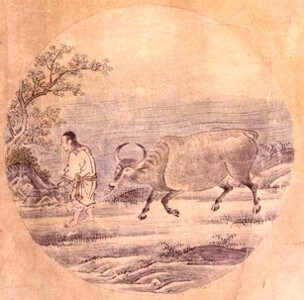
First, we know consciousness by self-observation. Consciousness is in some sense always self-consciousness, a state of wakefulness which always includes a perspective of self-awareness. Friedrich Nietzsche laments it in his ‘Genius of the Species’. The opening quote of this essay is from this piece, § 354 of the Gaia Scienza.[18] Nietzsche receives Schopenhauer, but he reinterprets Schopenhauer’s dictum of the ‘Genius der Gattung’, this idea of an ‘irony of evolution’:
For Schopenhauer, in the connection between man and woman, the so-called ‘Spirit of Love’, overrides egoism and dedicates the individual to the continuation of the species, even against their will and self-interest. The ‘Spirit of Love’ discovers as the main purpose of marriage, according to Schopenhauer, not the fulfilment of the desires of this, but the ends of the next generation which the marriage begets. This, indeed, is the thorn in the side of Nietzsche – that the individual should be reduced to the purposes of a biological condition. This would mean, so Nietzsche, that the individual constantly sacrifices her egoistic purposes for the future of others. Nietzsche’s alternative interpretation of how consciousness develops centres on the preservation and persistence of self-interest. He also reverses the argumentative strategy. We can grasp the problem of our becoming-self-aware, he says, when we start thinking about how we could be rid of it. The entirety of life (thinking, feeling, wanting, remembering, doing) would be possible ‘without seeing itself in the mirror, as it were’. Why have consciousness at all if it is essentially superfluous? Nietzsche asks. Although the human being is no solitary predator and needs others of her kind for survival and getting ahead, Nietzsche develops the idea of a great illusion, a game of trickery the self plays for realization against the forces of evolution and machinations of her kin. Yes, consciousness connects mind with mind, but its origin isn’t benevolence, open communication, or sustaining the future, the motivational base for consciousness instead is competition and its goal domination. If language connects us, it does so only because it is the best tool we have for living-out our individuality, that is, our egoism which is so frequently insulted by the mediocrity and commonality of convention. Instead of a device of the ‘Spirit of Love’ for the continuation of mankind, this most arrogant minute in the history of the universe which sees mankind rise and consciousness evolve, speaks of the stratagema of a species of braggarts, egomaniacs and self-seekers.
Following on such functionalist evolutionary approaches, Searle proposes that consciousness is a biological property of the brain and calls this position ‘Biological Naturalism’ without speculating about its ends or consequences (as Nietzsche and Schopenhauer do). Searle emphasizes that this is no dualism which would posit that there are two different ‘substances’ – matter and mind, and not a materialist monism which claims there is only matter, but a special kind of reductivism which ties consciousness to its biological ‘realization’ in the human animal. Three observations on the situatedness of human consciousness and on how the human condition exceeds these contexts develop a more comprehensive understanding of this ‘realization’:
Hameroff and Penrose promote the idea that the universe is proto-conscious:
This is a premise for their theory of Orchestrated Objective Reduction[19] according to which consciousness arises inside neurons at the quantum level orchestrated by microtubules in a spontaneous collapse; this part of the explanation resorts back to focus on matter only. The ‘proto-consciousness’ premise, that is, the idea that our environment aligns to facilitate the emergence of consciousness, either stipulates a consciousness-readiness in all of physical reality (and is thus a global thesis like panpsychism or pantheism) or it supposes that self-sustaining systems allow for consciousness to emerge. On the species-level it matches up with the ‘egoism’ which Nietzsche attests to the individual: that the world we are born into (without consent) is ‘for us’. Any small child understands the gesture of the adult: for me! The words addressed at her: for me! The love and care: for me! The food: for me! Behavioural scientist Judith Burkart of the Institute of Anthropology at the University of Zurich, aims to understand better the evolutionary origin of the human mind. Her research focuses on the difference of human and nonhuman primates.[20] Although our tool-using capacity shows us as relations of big primates such as Orang Utans, Gorillas or Chimpanzees, our motivational make-up is much closer aligned with that of marmoset monkeys, a small species which have one very important thing in common with us: they are cooperative breeders. This means that they share duties of raising their young in the group; Burkart shows in many studies how this leads to pro-sociality such as the willingness to share food, take on different roles and communicate with others of my group. Importantly, this also give us a picture of how and why language developed. Indeed, not only the emergence of consciousness as Nietzsche explains it as a need of the species, but also the theory of Schopenhauer of a spirit of love which motivationally enables us to care are reflected in this account of cognitive evolution.
Further, the human condition exceeds the embeddedness of consciousness: “The one I met that day I had not taken to be a dog at all.” Shizuteru Ueda, Among the Trees[21]
In a short piece, Ueda describes how he passes a dog on a narrow mountain pass ‘too narrow for more than one man to walk on…’. The encounter leaves him unsettled, so that he turns and finds that the dog has also turned. Their eyes meet. Ueda reports that he often recalls this encounter. Ueda makes use of such moments of everyday experience in which the self-evidence of our approach to the world cracks to help us question our assumptions about ourselves, others and the world.
Rather than understanding myself as an animal (as the Western explanations of consciousness advises), I am now to take ‘the one I met that day’ to not ‘be a dog at all’. This is the decisive turn of my human condition: that I position myself vis-à-vis myself. This stance must be in equal parts discovered, practiced and obtained against the inertia of the everyday self-misunderstanding. The key here is my taking it to be the case which will make it the case that my understanding of myself can shift. What we are considering is some form of self-evaluation for the sake of the ‘virtuousness’ or ‘appropriateness’ of my self-realization. In this take on consciousness, the ‘human as animal’ reduction is rejected; but what follows?
Jeff Sebos in ‘The Moral Circle’ asks us to consider a minimalist argument which we have already seen in the Turing test to admit animals, insects, for example, and potentially other non-biological beings, such as AIs, into the circle of those who are morally relevant.[22] My argument takes a different route. I am proposing a maximalist argument in which personhood is not tied to my ability to step over a threshold to qualify, but in which it marks an ideal, the upper benchmark of achievement. In the realm of morality, this includes a maximal duty to take on responsibility for others, including those who Sebos considers morally relevant. To make it clear: personhood, dignity, self-realization – all of which we might attribute to my ‘self’ beyond experiential phenomenology, do apply to myself as aspirational ideals. Dignity, for example, is mine not because of my belonging to a species or some other club, but because I can strive to live up to the dignity of which humans are capable.
The human condition also transcends evolutionary time:
Biology studies its objects under conditions of cyclical time. Evolutionary theories, in contrast, writes Nikos Psarros in ‘The Ontology of Time’[23], operate with linear models of time, much like physics or chemistry. This evolutionary time is not just entropic (like the time of thermo dynamics), but it is directed, it is in some sense progressive and historical.
He calls the mind’s capacity to grasp particular systematic strucures of the natural world as a necessary and sufficient condition for our existence the basis of all scientific insight; this mental ability is ‘intelligence’ and in turn the precondition for ‘the eschatological nature of evolutionary time’. That human beings have mind allows them to ‘step outside’ of evolutionary time.
Who are we? This was always the first question, the most important one. But it appears to have been replaced by a different question, a question which assumes that our fate is now placed in our own hands: Who do we want to be? The answer becomes a matter of engineering, mechanical, biochemical, computational, conceptual. This essay speaks to the last point – the conceptual frame of what it will mean to be human in the anthropological Anthropocene, a time in which we not only manifestly and irreversibly alter our environment, but also ourselves as a species and do so with intent, that is, consciously. The pressing question is whether consciousness and meaning will remain if we overcome evolutionary time and our evolutionary purpose vanishes.
Riding home on the back of the Ox, playing flute
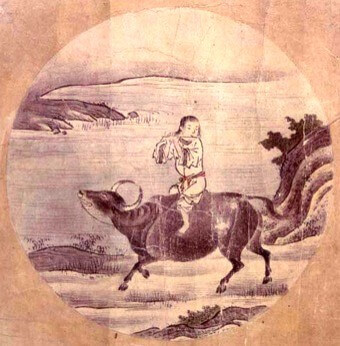
Immanuel Kant championed our natural ability to enlighten ourselves and be mature; he believed that the three questions of philosophy: What can I know? What may I hope for? What ought I to do? together comprise the fourth, most important question: What is the human being? Philosophical anthropology gives us perspectives on how our human condition constitutes how we encounter the environment in which we live, the orders we are integrated in, the systems we are part of. There is a peculiar point in which modern day’s eco-philosophy meets contemporary philosophy of mind with a focus on AI – in the work of philosophical anthropologist Max Scheler. According to Max Scheler, we not only encounter this ‘world’, but we also deny it.[24]
Dave O’ Brian’s work on Scheler and Transhumanism, for example, considers how technology today promises to rid us of human finitude in narratives of human enhancement, post-biological evolution, and the concept of the Technological Singularity.[25] O’ Brian notes that themes of post-biology and post-humanity have long been explored as speculations in science fiction literature, but that they have now become the practical concern of engineers and technologists. The necessary (philosophical) reflection on who we would become and who we want to be has been bypassed. This is where Scheler comes in.
When prompted, the ‘modern cultivated European’, so Scheler, (the person who, we might assume, would nowadays be versed in current theories of consciousness) calls to mind three different explanations for human difference and the special status of humans in the cosmos: the Biblical story of the Creation and the Fall of Man, in which human beings are exalted because they are created in the image of God and are then expelled from paradise because they rebel against God’s prohibition in an act of emancipation and hubris; the idea promoted by Greek philosophers that we, those featherless bipeds, have the special ability to be rational which sets us apart from other birds and creatures; and the findings of modern science which tell us of a continuity of all life with us at the top of the pyramid, superior and dominating because of an accumulation of capabilities, such as consciousness. These three images of man do not cohere into one unified theory of the human being. It is Scheler’s project to work out an anthropology which gives us such a unified theory (and he does so while retaining aspects of all three explanations).
Scheler’s unique conception of the position of the human being in the universe is characterized by the co-dependence of strife and spirit. In a spectacular reversal, he argues that ‘Geist’ or deitas is without any power and relies on the power of life, the life-urge, or: Drang, this undirected ‘towards!’ or ‘away!’, for its implementation. These two aspects of the human condition, urge and spirit, are situated in a continuity with evolution and other life. All living beings are driven by the urge to survive. Scheler attributes an individual ‘soul’ or being-for-itself to each living individual, be it plant, animal or human. Scheler then describes a process of ever further inhibition and control over the life-urge. Animals are able to monitor events and give feed-back to an act centre, they can regulate their responses and negotiate their environment. Yet, they are confined and determined by this environment. It is only man who can deny the world and imagine a different one. We have become ‘world-excentric’. An important aspect of Scheler’s theory is his insistence on the importance of the embodied individual who interlocks with a timeless, supra-individual order which ‘acts through the individual’. This individual human being becomes ‘a person’ as the centre of this activity of spirit.
Deitas works historically through many generations of individuals. It has ‘to put up with’ historical circumstance. Scheler assumes that there is a purpose: the ever further realization of spirit. This entails that deitas is a ‘becoming God’: People will tell me, Scheler writes, that it is impossible for humans to tolerate an unfinished God, a God in the making![26] The human need to feel rescued and supported by an extra-human omnipotence equated with goodness and wisdom is so urgent that in times of immaturity it breaks all ‘dams of sense and reflection’, we give ourselves over to superstitions where we need to identify with deitas. Its’ ‘true being’ is like the being of others. We can partake of it through acts of commitment, a process which Scheler calls ‘Mit-vollzug’ (consummation-with) to highlight the jointness of deitas with the individual as person and of persons with each other.
Frankl concludes that the ‘lack of orientation’ diagnosed as the ‘disease of the times’ is in fact just the lack of a valid view of humanity, an anthropology within which specifically human phenomena, such as the self-realization which follows from acts of commitment, are once again situated.[27]
In a late address to the academy, Helmut Plessner, Scheler’s student and eminent European anthropologist in the post-war years, warns us that if we do not have a clear conception of what is human, we will also lose our grip on what is in-human. Being human is, according to Plessner, not a given, but it is an ideal we strive towards.[28]
Forgetting the Search
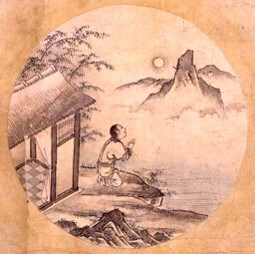
In this essay, we have briefly recounted themes from the quest for consciousness. This text presents them as encounters with the past, with the answers of contemporary philosophy of mind, with doubt and certainty, with success, failure and reality, the gods of meaning, with animals (including ourselves), with the notions of strife and ‘Geist’ and now with a non-Western perspective on the matter: In Shizuteru Ueda’s text ‘Das absolute Nichts im Zen, bei Eckhart und Nietzsche’, the Western notion of nothingness is confronted with its zen counterpart, it is shown to be the last station in the search for the ‘true self’.[29]
This last of the first seven encounters functions as a hinge – it allows us to access a second level of understanding. Our encounters are constructed as two overlaid registers, legible at the same time in two different ways. The ten thematic encounters map onto the stages of the Zen-manual presented by Ueda in his essay, in the form of an image with a poem. In this Zen practitioner’s manual, the search for the true self is metaphorically rendered as the search of a herder for his ox; the first seven stations show the search for ox (aka the self), the finding of its tracks, discovering the ox itself, capturing it, taming it, riding it home and then forgetting the search.
“If you don’t have consciousness, you don’t have anything”, says brain scientist and anaesthesiologist Stuard Hameroff in his Ted-talk ‘The Future of Consciousness’.[30] The search for our self – this state of wakeful awareness of a present which is tied to a perspective that I recognize as centring the different experiential episodes of my lived life, is as important to me as the valuable ox, the raison d’etre of the herdsman’s or herdswoman’s existence. The point of this text is, first and foremost, to facilitate the encounter of a so-called ‘Western’ take on consciousness with the twelfth century Zen-manual as it is presented to us by Shizuteru Ueda.
Station 6, riding the tame ox home full of joy and pride, is a blueprint for ‘the fall’. “Do not be prideful!”, we call out a warning to the flute-playing herder. “Once you believe you have conquered your true self, you have already lost track of it, once again.” The self-conquest in the process of ‘awakening’ ought not to be considered a prized possession or celebrated achievement. This, again, would be a relapse into the misguided self, the one that says: I am I. In Station 7, the subject–object split which plagued and dominated modern Western philosophy since Descartes and culminated in Kant’s philosophy of self-mastery, is (seemingly) overcome. The new self-understanding is the integration of the insights until this point. The herder can forget the ox, because he has internalized the ‘lessons’:
The ox is forgotten; the herdsman stays.
If after the first seven encounters, we carry on, the ‘ox’ will have gotten away, again, and the search will start anew. If, on the other hand, we break out of the cycle through a deepening of our understanding, in Ueda’s reading, we come upon the last three encounters which form a new understanding of ourselves in the world. The Zen-manual and our themes from the quest for consciousness are merging into one picture:
a) the Great Nothingness, a returning to the Ground, that is, the encounter with the self, the death of the self and its resurrection;
b) the flourishing of the entire world as it is, the Other is one with me;
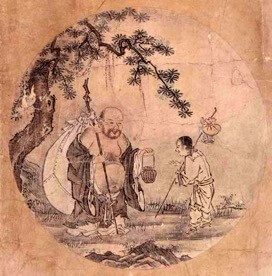
c) the expression of this new unity as an encounter of the enlightened monk with the novice on the market square of the world.
At the heart of Ueda’s explanation of the quest for awakening, lies the analysis that there is a threefold alienation which separates us from our real self, from the others and from the world; we encounter ourselves with false conceptions, we meet others with envy and we greedily exploit the world. The point of the pictures of the herder and the ox is to allow for our false sense of self to fall away and this will result in our relations to ourselves, to others and to the world to realign. Looking back at the seven stations, the breakthrough to our ‘true self’ is ever at hand, in every one of the pictures. Our very existence can and indeed should be transformed. What Ueda requires of us is an existential and epistemological paradigm shift.
What is the sound of one hand clapping? The sound can only be heard if a second hand meets the first. If two traditions are compared.
The Great Death
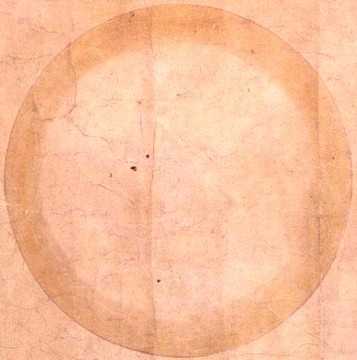
The maxim γνῶθι σεαυτόν – know thyself, on the face of the Greek Appollo temple in Delphi, does not instruct you to give an account of all of your bodily functions, together with a record of all of your thoughts. The search for self-knowledge has to be more than that. So much more, indeed, that it is equivalent to the death of the self.
Station 8 depicts ‘nothingness’, the empty circle out of which the story of the ox and the herder and the natural landscape against which it is set have vanished. The frame remains, but it is no longer the ‘self’ which is thought to be the framing, but ‘the vast heaven’ or ground against which nature and the self-searching self can be depicted. The image does not show that there is nothing, but it intends to free the searcher from substantializing self-absorption.
The Self which deems itself a sufficient cause for itself and world, withdraws into itself, it insists: I am I because I am I! The insistence on mastery and control over situations of our (scientific) world-view, the obsession with authorship shielding us from others in delineating property, and the focus on essential identity as basis for our self-conception come to mind, here. According to Ueda, this ‘I am I’ shows the solipsistic entanglement of the self in its own cognition. It results in a three-fold self-poisoning: blindness vis-à-vis itself, hatred against others, and greed towards the world.
In contrast to this, the Buddhist teachers render the enlightened self as ‘I am I and at the same time not I (Nishitani) or ‘I am I because I am not I’ (Daisetzu Suzuki). All depends on breaking free from the shakles of the ego. Ueda cites in this context also the Western mystic Meister Eckhart who asks us to ‘forget God, leave God’. The self is vis-a-vis itself ‘betriebsblind’ (a dictum by Frankl), that is ‘blind to errors or shortcomings that occur in the area in which one works due to long-term affiliation’(Oxford languages). It needs to be shattered to make way for a new image. To achieve this leap into nothingness, all needs to stay behind: all knowledge and memory, all thoughts of self and Buddha, all worldly desires and every sense of holiness. The description reads: With one blow, the great sky suddenly shatters into pieces, sacred and secular, disappearing without a trace.
Ueda compares this notion with the conceptions of nothingness from the Western canon: The minus absolute nothingness is a ‘continuum of defeat’, we could say, which Ueda analyses in Nietzsche, godfather of modern nihilism. What happens, Ueda asks, if, instead of dissolving substantiality into emptiness in the Buddhist sense substance is retained as a foundation? The result is Nietzsche’s famous ‘God is dead’. Absolute nothingness has replaced God and now is everything. ‘Das Nichts (das ‘Sinnlose’) ewig!’ Nothingness (‘meaninglessness’) eternally! What is nihilism? Nietzsche answers: that the highest values are being devalued. A maelstrom of negative eternity starts rotating. Being, without aim or end, eternally, the experience of the most terrible form of groundlessness, the eternal recurrence of the same. Such nihilism cannot be overcome, if not from the inside, with living through it, like through a life-threatening illness.
My father, a physician, once told me about a peculiar dream he had. He dreamt that in his hospital, a badly injured man could only be saved by cutting his head off and putting it onto a life-support system. This man, reduced to a talking head, would essentially be able to live forever, for in the dream scenario he could be sustained infinitely with a nutrient solution and oxygen. The man himself was pleased with this prospect, but the medical team worried about the financial and ethical consequences – who would pay for this eternal man, who would be there to care for him (after decades or centuries)? This nightmare pictures man’s dream of living forever as impossible to attain under the conditions of human existence and with unforeseeable pragmatic and conceptual consequences.
The eco-philosopher might point out that it is an act of responsibility and charity towards future generations to ‘give back’ one’s bodily material and make room at the table of generations by dying. Only the utterly selfish and hopelessly hubristic would insist on living forever. But there is still the human need to avoid the conclusion that the self is, as it were, irrelevant. There must be value attached to my existing, rather than not existing, the self says. This relates to the perennial question: Why is there something and not nothing?
In the Gaia-hypothesis, Margulis and Lovelock look at chemical macro structures of planets and conclude that the disequilibrium of the earths’ atmosphere is being regulated by life itself, that is, that the earth with all of its inorganic and organic entities is a closely integrated, unified, ‘single’ and self-regulating system, comparable to an organism, which actively ensures that conditions on earth remain favourable for life: “The originality of the Gaia theory relies on the assessment that such homeostatic balance is actively pursued with the goal of keeping the optimal conditions for life, even when terrestrial or external events menace them”, so Lovelock.[31] Proto-consciousness is thought to pertain to such self-regulating systems.
This delivers us to Station 9:
The world flourishes as it is
Die Ros‘ ist ohn‘ warum; sie blühet weil sie blühet
Sie acht nicht ihrer selbst, fragt nicht ob man sie siehet. – Angelus Silesius[32]
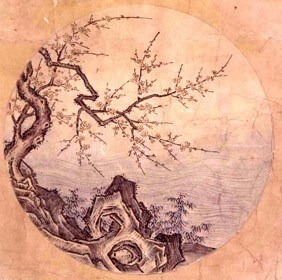
To our next encounter, bring a bouquet of roses – red roses. For we are going to meet Mary, the neuro-scientist who has never seen red. We have made an appointment with Mary, she is an invention of Australian philosopher Frank Cameron Jackson.[33] In the thought experiment, she is a scientist who knows everything about the human visual apparatus, but she lives in a black and white room and has never actually seen red. When she opens the door, we present her with the bouquet. “Is that…?” she asks incredulously. “Yes, yes, it is seeing red,” we say. Mary smiles and then she turns away, crying. The importance of subjective experience for knowledge doesn’t just expose the lacunae of the ‘objectivity’ of our scientific world view, but it reveals, positively, the absolute necessity of a standpoint from which knowledge is gained. Thirdly, it points to the fact that knowledge which is not applied to a particular circumstance and remains thus without standpoint is good for nothing, it is pointless.
The Rose without Thorns:
What Mary didn’t know was told to her by the angel. The Western canon is teeming with negativity, lots of older white men who discuss despair and life as a sickness unto death and who feel thrown and in their thrownness entitled. It is good to encounter a young Semitic woman who accepts a different paradigm for herself. This paradigm embraces natality and responsibility for the salvation of the humankind.
The Rose of the Cherubim Wanderer:
They mystic poet Angelus Silesius records and immortalizes the rose blossoming out of itself. Ueda explains how this is different from the nature we see flourishing in station 9. The Cherubim Wanderer’s rose points to the positive absolute nothingness of a conception of God behind everything. The sentence ‘God is nothing’ points to the fact that God cannot be named or described, that all human categories are nothing in light of God. Thus, behind the fullness of the world stands the not-nameable totality of God. Again, we do not have the letting go of substance and we have thus a conception of nothingness which in some way falls short of the nothingness searched for in the ‘Ox and his herder’. What we see in Station 9 is still the death of the self, but now another aspect of its death is expressed: Nature, like flowers blooming and the river flowing, is the first resurrection body of the selfless self from nothingness, says Ueda.[34]
The Roses of Pireia:
Let us lastly consider a famous poet from antiquity: Ψαφφο. Of her it is said that she was not ninth among men (referring to the list of nine important poets who were canonized), but tenth among the lovely muses. Her poems could be classified as science fiction poetry: She writes about a future changed by the new technique of the writing down of poems. (Written recording of works had started in the late 8th, early 7th century BC with works of Homer; Sappho wrote some 80 years later.) Much of Sappho’s work is about what happens to us, the afterlife, memory, and who we can be in light of a future facilitated by the advanced technology of writing. I think her intense sense of self, the acuity with which she was able to feel her-self, is directly tied to this new understanding. Maybe you, like I, did not know of Mount Piereia in Macedonia. It was a place of worship for the muses. It points to the realm of the Piereian muses, guardians of poetry and sponsors of poets. This is why Sappho can deride the well-to-do middle-class woman who is idle and does not commit herself to the service of the muses, in this manner:
You will lie dead, but there will be no memory of you at all,
Not now, not later: for you did not take the roses,
those from Piereius: but unknown in the houses of Hades (you will wander).[35]
Sappho’s lines on individual consciousness being remembered (or forgotten) by the written word links us to Station 10 in which we see how the ‘true’ self can now relate to other selves:
On the Marketplace of the World
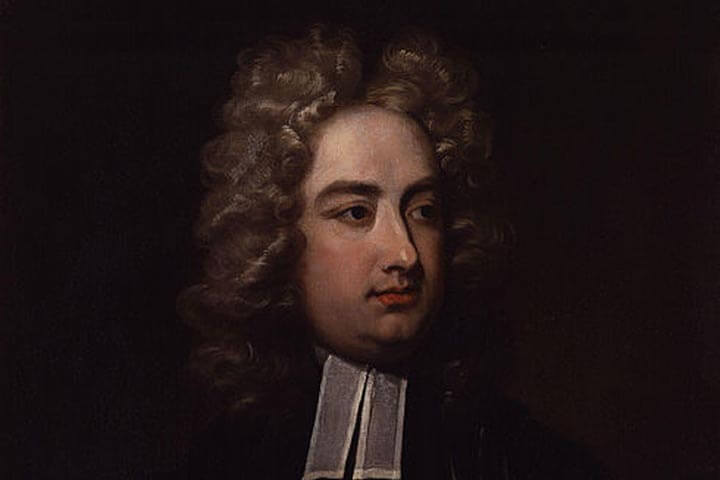
“The first Professor I saw was in a very large Room, with Forty Pupils about him. After Salutation, observing me to look earnestly upon a Frame, which took up the greatest Part of both the Length and Breadth of the Room; he said, perhaps I might wonder to see him employed in a Project for improving speculative Knowledge by practical and mechanical Operations. But the World would soon be sensible of its Usefulness; and he flattered himself, that a more noble exalted Thought never sprang in any other Man’s Head.” (Jonathan Swift, Gulliver’s Travels)[36]
What the professor is manipulating with the help of his students in Laputa, where the fictional narrator Lemuel Gulliver encounters him, is an algorithmical machine. It predates Babbage’s Difference Machine of 1822, his Analytical Engine of 1837 and Note G of Ada Lovelace, the first person to ever write an algorithm for a computer. Lovelace predicted that algorithms could be used not just for solving mathematical equations, but also, for example, for musical composition. Swift pokes fun at the arrogance of the professor, who we must assume lives deeply entrenched in the three-fold alienation: mistaken about himself, envious of others and greedy towards the world. That the machine produces nonsense, is one way of further ridiculing the pompous professor. The big excitement about the advances of what begins with Note G and results in the AI revolutions of our days comes from equating ‘thinking’ with ‘solving tasks given encoded information’. We have seen how John Searle makes fun of this false equivalence in his Chinese Room Argument. James Lovelock’s new foreword from 2016 to his book ‘Gaia’[37], first published in 1979, argues that our life on the planet not only produces waste such as CO2, but also intellectual waste, such as certain concepts or ideas. In this sense, concepts and ideas are as a ‘legacy’ the waste product of a historical moment; we have to deal with all this ‘rubbish’. Nowadays, this ‘rubbish’ is used to train large language models such as ChatGPT to assist us with our writing, thinking, organizing, translating tasks.
The second resurrection, the 10th station, is that of the selfless self into the world of others. The true (selfless) self does not reside in an extra-worldly ‘nirvana’, but it encounters others on the busy road of the world, yet, without leaving absolute nothingness.[38] The marketplace of the world is where next person begins the search for the true self, prompted by the encounter with the selfless self of the another. On the marketplace of the world, we are also able to locate an appreciation of AI as a tool for encountering each other in a new, meaningful way. Rather than seeking profit for ourselves, we are here to encourage questioning. If it is true that the ‘mishaps’ of Grok depend on the (human) inputs it has to deal with, it is ultimately the mistaken goals of these inputters which result in despicable content. If our goal is to help others in their search for their selfless self, our input is guided by this goal.
Our project has a normative dimension because it evaluates our normative take on ourselves. The future of consciousness depends on who we want to be. The future of texts is that they help us formulate appropriate reasons for acting; and when acting, we are acting always on behalf of future selves (which includes our own future self). From the get got, agency cannot be formulated as an instrumental means-end endeavour, but has to be seen with Kant as guided by a categorical imperative: Act in such a way that you treat humanity, whether in your own person or in the person of any other, never merely as a means to an end, but always at the same time as an end.[39] Kant formulates this imperative around 60 years after Swift’s ridiculous professor and some 40 years before the first algorythimical machine was constructed. He gave us the best way to assess our dealing with this new tool. It is the same as for all of our actions: You should consider that you are not acting alone or on your behalf, but on the behalf of those living with you and those coming after you.
Does consciousness still need the term human? I hope you agree with me that it does. What we have seen is that consciousness helps human beings not only survive, but also overcome egoism, shatter misguided conceptions of themselves, and strive towards an ideal; in its most ambitious rendition, it is executing ‘Geist’ in historical persons as act-centres (as Scheler would say). In this, self-realization is supra-individual and transcending time, but it remains processual and relational. The conatus, the driving motivation, of human beings is not only for themselves and not only for sustaining their young, or their species, but it is towards a future goal which itself is unattainable (like immortality) and is defined by an idea of who humans can be. It is up to us to answer this question together.
NOTES:
[1] Images: Tenshō Shūbun, Looking for the Ox from Ten Bulls / 日本語: 十牛図」の「尋牛, 15th century, after lost 12th century original, in the public domain.
[2] Charles Simic: In the Library, in: Sixty Poems, Mariner Books: New York, 2008.
[3] Karl Jaspers, Der Philosophische Glaube, Lectures 1947, Piper: München, 2012.
[4] Han Kang, Banquet Speech, 2024, https://www.nobelprize.org/prizes/literature/2024/han/speech/
[5] Thomas Nagel, What is it like to be a bat?, in: Mortal Questions, CUP: Cambridge, 2012 (1979).
[6] Cf: John Searle, Mind: A Brief Introduction, OUP: Oxford, 2005.
[7] Cf: John Searle, The Rediscovery of the Mind, MIT: Cambridge, MA, 1992.
[8] Ludwig Wittgenstein, On Certainty, edited posthumously by E. Anscombe and G.H. von Wright, Basil Blackwell: Oxford, 1969.
[9] https://www.helsinki.fi/en/projects/von-wright-and-wittgenstein-archives
[10] Shizuteru Ueda, Ueda shizuteru shū, cited by Döll, p. 486, footnote 2; see next footnote.
[11] Steffen Döll, Ueda Shizuteru: The Self That Is Not a Self in a Twofold World, in: The Oxford Handbook of Japanese Philosophy, OUP: Oxford, 2020, (pp. 485-499), p. 488.
[12] Viktor Frankl, Bemerkungen zur Pathologie des Zeitgeistes, in: Wer ein Warum zu leben hat, Beltz: Weinheim, 2017, p. 218.
[13] Georg Henrik von Wright, The Tree of Knowledge, Brill: Leiden, 1993, p. 132
[14] Johan Wolfgang von Goethe, Der Zauberlehrling (1797) in: In:Goethes Werke. Gedichte und Epen I. Band I. C.H. Beck: München, 1998, pp. 276–279.
[15] Hubert and Stuart Dreyfus, A Five-stage Model of the Mental Activities Involved in Directed Skill Acquisition, Storming Media: Washington DC, 1980.
[16] Hubert Dreyfus and James J. Broderick, Curds and Lions in Don Quijote, Modern Language Quarterly (1957) 18 (2): 100–106.
[17] Hubert Dreyfus and Sean D. Kelly, All Things Shining, Free Press: London, 2011.
[18] Friedrich Nietzsche, Gaia Scienza (1887), Kritische Gesamtausgabe Abteilun V, Band 2, de Gruyter: New York, 1982.
[19] Stuart Hameroff and Roger Penrose, “Reply to seven commentaries on “Consciousness in the universe: Review of the ‘Orch OR’ theory””. Physics of Life Reviews. 1(1): 94–100.
[20] Judith Burkart’s lab: https://www.researchgate.net/lab/Judith-M-Burkart-Lab-Judith-M-Burkart
[21] Ueda, in: Oxford Handbook of Japanese Philosphy, 485.
[22] Jeff Sebos, The Moral Circle, WW Norton & Co: New York City, 2025.
[23] Nikos Psarros, The Ontology of Time, in: Burckhardt, Hans et al.(eds.), Time and Tense, Philosophia Verlag: München, 2015, pp. 383-428.
[24] Max Scheler, Die Stellung des Menschen im Kosmos (1928), Hofenberg: Berlin, 2016.
[25] See: Dave O’Brian, What is the Human Being, and What is our Place in the Cosmos?, PhD-thesis submitted in 2022 at Maynooth University.
[26] cf.: Scheler, Die Stellung des Menschen im Kosmos, 88.
[27] Frankl, Pathologie des Zeitgeistes, 217.
[28] Plessner, Mit anderen Augen, Reclam: Stuttgart, 1986.
[29] Shizuteru Ueda, Das absolute Nichts im Zen, bei Eckhart und Nietzsche, in: Ryôsuke Ohashi (ed.), Die Philosophie der Kyoto-Schule, Karl Alber: Baden-Baden, 2014, pp. 440 – 468.
[30] Stuart Hameroff, The Future of Consciousness (Ted Talk): https://www.youtube.com/watch?v=1d5RetvkkuQ
[31] Lovelock, James. The Vanishing Face of Gaia. Basic Books: New York, 2009, p. 179
[32] Angelus Silesius, Der Cherubinische Wandersmann (1657), Reclam: Stuttgart, 1986.
[33] Frank Cameron Jackson, What Mary didn’t know, The Journal of Philosophy, Vol. 83, No. 5 (May, 1986), pp. 291-295.
[34] Ueda, Das absolute Nichts, 443.
[35] Lines from Fragment 55, translated by Sava Wedman, original in: Franco Ferrari (ed.), La porta dei Canti, Cappeli Editore: Bologna, 2000.
[36] Jonathan Swift, Gulliver’s Travels, unabridged, 1726; Penguin Classics: London, p. 135
[37] John Lovelock, Gaia, OUP: Oxford, 2016.
[38] Ueda, 445.
[39] Kant, Groundwork of the Metaphysics of Morals, (1785) 1993: 36.


Related Posts