Grave Confusion
Two years ago, I wrote a book review for VOEGELINVIEW where I shared the wonders of Tomson Highway’s book, Permanent Astonishment. At the time I wrote the review, Canada was reeling as it tried to make sense of the apparent discovery of 215 clandestine burials of Indigenous children in an apple orchard in Kamloops, B.C., where a former Indian Residential School (IRS) had operated. The IRS system operated in Canada for over one hundred years until 1996. The intention of these schools was to help Indigenous people enter mainstream Canadian culture, economically, politically, and socially. And even as I wrote the review of Highway’s book, other grave sites across Canada were being located with ground penetrating radar (GPR), with the Canadian and American media calling these sites “mass graves.” The suggestion from the media reporting was that there were hundreds, and possibly thousands, of Indigenous children who had been murdered and buried in clandestine fashion. These were dark days in Canada, with flags lowered to half-mast for almost half a year and Canadians everywhere reflecting on the gruesome foundations of their nation.
The IRS system has left a dark legacy. Many students were physically and mentally abused, and the schools have been accused of attempting cultural genocide against Indigenous Peoples in Canada. Beyond Tomson Highway’s book, there are all sorts of projects and community work by Indigenous people and Canadians of every cultural background that promote reconciliation and hope. The Kamloops discovery continues to obfuscate conversations and interpretations of the IRS system and Canada’s history generally, because no proper forensic or legal resolution over the 200 possible grave sites has ever been achieved, nor even attempted.
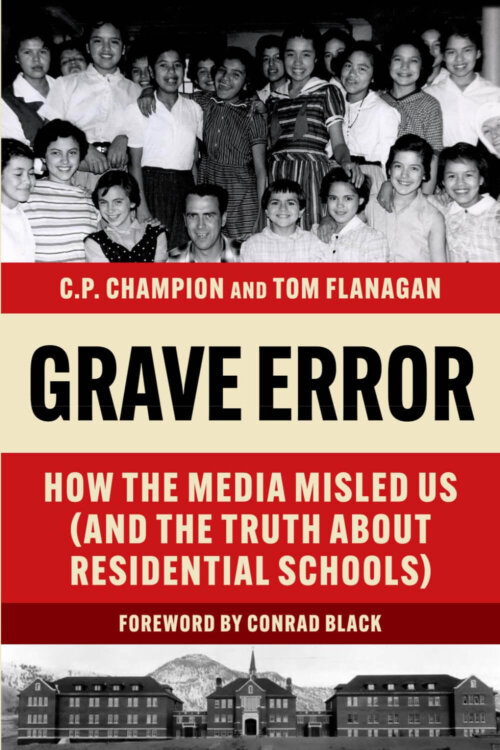
A new book was recently published titled Grave Error, and the book brings to light the confusion currently surrounding grave sites at former IRS’s. According to Amazon, Grave Error was the best-selling non-fiction book in Canada for an extended number of months through 2023-24, yet the book has not been acknowledged by the mainline press in Canada, with the notable exception of the National Post newspaper. This muted response by Canada’s talking heads reveals something of the political disorder currently gripping Canada. While the intention of Grave Error is to appeal for “rationality and truth” in the project to fully appreciate the legacy of IRS’s, the attention the book draws toward Canadian politics and Canada’s national media highlights a deeper problem. The book reveals that Canadian politics are not guided by reasonable thinking and the patience necessary for a statesmanlike approach to national problems nor a potential crisis. The national media, meanwhile, appears as an impotent estate that has been corrupted by popular narratives and ideology, with no desire to seek after the truth, nor to cast reasonable doubt on the messages delivered by politicians.
Grave Error has the tone of a book published in the midst of a national crisis. This alone makes the work interesting for political scientists. But the book also brings some light to a country that has become culturally constipated by its own self-made existential crisis. Can Canadians be proud of their history? Can Canadians be proud of their institutions and their growth through time? Is it necessary for Canada as a nation to deconstruct itself in some type of post-modern suicide attempt, or can she begin to reinvigorate herself through serious and mature statesmanship? This may seem extremely stated, but the disorder in Canadian political life is hinted at when in the introduction the book’s editors, C.P. Champion and Tom Flannagan, remind the readers that the contributors to the book are risking their careers to be published in Grave Error. Furthermore, they suggest that in the Government of Canada there has been “speculation about criminalizing divergence of opinion about historical issues” that would include interpretation of the IRS legacy.
The contributors to Grave Error are fastidious in their research and their reasoning. There is also a careful acknowledgement of the pain and suffering so many students endured in the IRS system. The book is not challenging the fact of Residential Schools, only that words like “murder,” “mass graves,” “forced attendance,” and “genocide” need to be handled with greater scrutiny. That said, writing this review has been soulfully troubling for me, in part because of the suffering Indigenous People of Canada have endured through the past four hundred years, and the loss of language and culture that have accompanied that suffering. Ultimately, the reason I have written this review is that I do believe a book like Grave Error should be exposed to the light. If the uncomfortable assertions of the book are not faced with the same academic rigor with which the book was written, then future generations will have to deal with the subject matter in political and cultural circumstances beyond our control. The work of reconciliation in Canada is not a neat and tidy three-year program with a final end goal in sight, but rather the ongoing mission of a nation as it continues to evolve into the future. In some manner that is admittedly not clear to me, the book Grave Error is part of this ongoing process.
The strength of Tomson Highway’s Permanent Astonishment was his brushing aside of broad, sweeping narratives of the IRS system so that individual experiences could be remembered, including the work of good teachers. The contributors to Grave Error also challenge the dominant narrative about the IRS system. As I have tried to suggest, this will make the book difficult reading for many readers. The idea that mass graves and secret burial sites have been discovered is challenged. Grave Error argues that school and government records do not support the idea that hundreds or thousands of Indigenous children went missing or were murdered at the schools. This argument is ultimately highlighted by referencing Canada’s Truth and Reconciliation Commission that found no credible evidence of any Indigenous child being murdered through the entire history of the IRS system. Grave sites that have been discovered with GPR are shown to be old grave sites whose wooden markers simply rotted away with time, or were intentionally cleaned up. The 215 purported grave sites in Kamloops, BC, since reduced to 200 soil anomalies, have never been investigated, and more than one contributor to the book draws attention to the mystery of why the government and Canada’s national police force (the RCMP) have not sought to investigate what could be one of Canada’s most heinous crime scenes. Could murder charges not be laid, even posthumously? Could serious investigating of the Kamloops site not help bring closure to the legacy of the schools?
The book also challenges the idea that the IRS system contributed to a broader national attempt to commit genocide against Canada’s Indigenous Peoples. Because there are strong feelings involved in the discussion over the term genocide, I will list some of the book’s arguments here. Statistics published in Grave Error shows that Indigenous populations in Canada have grown since the first schools were established, from approximately 125,000 in 1867 to 1.8 million Indigenous People in 2021. In Canada, the use of the term genocide typically refers to the idea that a cultural genocide was carried out in the IRS system against Indigenous culture. Contributors like Pim Wiebel attempt to challenge this assertion, including a quote from a 1937 government record about the importance of Indigenous culture: “An encouraging feature of the educational effort during the year was discovered in the … tendency and willingness of the Indians to recognize the value and distinctiveness of their arts and crafts. Consideration has been given to ways and means whereby the Indian population can be encouraged to conserve still further their ancient values and skills and thus contribute to the cultural life of the nation.” Wiebel also draws attention to the low numbers of students who attended IRS’s, approximately 33% of Indigenous children attended IRS’s, relative to those students who attended day schools or who didn’t attend schools at all. This data counters claims that every child was forced to go to the schools, and subsequently, have their culture taken from them.
Grave Error does attempt to touch on the problem of cultural assimilation and integration. Tomson Highway also draws attention to the issue of cultural assimilation and integration in Permanent Astonishment when he looks at the development of Indigenous language after European contact, as well as intermarriages between Indigenous and European people. While English was the language used in the schools, Wiebel draws from the records to show that sometimes there was a sensitivity toward Indigenous culture. For example, Indigenous students in Cluny, Alberta, wore traditional ceremonial dress and danced to traditional drumming songs for an audience of over 300 people. An IRS choir sang in English and Cree at Expo ‘67, and at one school in BC an Indigenous artist taught traditional art. At a school in Saskatchewan there was a powwow dance troupe. Religious orders like the Oblates were strongly encouraged to learn the native tongue of their students. Pim Wiebel’s study of the records leads them to write that IRS students were never forced to convert to Christianity. Ian Gentles writes that, based on a 2017 survey, Indigenous people who attended Residential Schools were less likely to abuse drugs or alcohol than those community members who did not attend an IRS. Hymie Rubenstein draws attention to records that show how Indigenous communities valued Residential Schools. When Blue Quills IRS was going to be closed in 1970, for example, the community protested its closure. The question that arises with stories such as this is why Indigenous communities valued these schools if those same schools were attempting a genocide?
There are a number of elements to Grave Error that can be criticized. The editors have collected a number of essays written by various scholars and researchers. These essays were originally published in a range of print and digital mediums. Many arguments are repeated by different writers, and this repetitive drone contributes to an argumentative atmosphere within the pages of the book. This atmosphere does not contribute to a culturally sensitive presentation of the subject matter, assuming the editors were hoping their project would contribute to the work of reconciliation.
With all due respect to the editors and to Conrad Black, who is an intelligent commentator on political matters, it would have been helpful in the forward and introduction of the book to involve a number of perspectives and concerns. The issue of understanding IRS grave sites does not belong in only the political or legal realm. There is a spiritual and cultural element to reconciling the present time with a turbulent past. This includes articulating suspicions about past violence that may not be grounded in forensic fact. On the other hand, the disordered political atmosphere in Canada may have contributed to an impossible challenge for the editors when it came to collaborating with a broader swath of academics and concerned community members. People are scared to contradict the popular narrative about IRS’s in Canada.
The work of reconciliation that Indigenous people and church denominations began in the 1980’s has often been meaningful, and soulfully experienced by people across Canada. Not only has the government overlooked this work, so too has the mainstream media and advocates for Indigenous culture. Most recently, Tk’emlups te Secwepemc First Nation (where the Kamloops IRS was located) and the Dioceses of Vancouver and Kamloops entered into a Sacred Covenant, which reaffirms the close relationship between these parties over four hundred years and the work of Reconciliation that will continue into the future. Church newspapers like the Catholic New Times and the Catholic Register were publishing articles and essays about the IRS system in the mid-1990’s when the national media could have cared less about the subject. Now that the mainstream media have picked up the story, they treat IRS’s like a type of discovery they have made, which is not the case. If Grave Error could have drawn attention to some of this reconciling work on the part of the churches over the past three to four decades, it would have enriched the scope of the text.
One of the most heinous forms of violence toward children is sexual abuse, and many IRS students were victims of this violence. It is to be appreciated that the editors of Grave Error wanted to expand the reader’s understanding about the good and bad of Residential Schools. In doing so, they draw upon a great deal of evidence from school and government inspection records and share a range of data that includes attendance records, school infirmary records, and death certificates. They also share a wide swath of evidence from the records that suggests IRS’s were often highly regarded by Indigenous communities, and that students of these schools tended to be more successful in finding further study and employment than children who did not attend. In my own visits with Residential School survivors, however, the evil of sexual abuse in the schools remains a fixture of the IRS experience. This is also recognized by Tomson Highway in Permanent Astonishment. In Grave Error I did not see this experience acknowledged in depth. How many lives were destroyed by this vilest form of child abuse, short of murder? This abuse cannot be minimized.
Finally, one error that occurs repeatedly with contemporary interpreters of Canadian history is that of anachronism. Without seeking to downplay the suffering experienced by IRS survivors, could Grave Error have broadened the reader’s understanding of the context in which the IRS system was developed? For example, the history of British boarding schools in England and abroad, and the strict program of corporal punishment in those schools, is well documented. In a sense, the fictional account of a boarding school for orphans as written by Charlotte Bronte in her novel Jane Eyre is as good a place to begin as any other when it comes to understanding the roots of the IRS system. During the time of IRS’s, there were also the British Home Children, when over 100,000 poor children were taken from their impoverished parents in England and sent overseas to Canada for cheap labor on farms across the Dominion. There were also the Poor Houses in Nova Scotia, where poor children and adults were essentially incarcerated until the end of their lives, farming for much of their own food in conditions rife with abuse. How were children, orphans, the poor, and education systems generally, understood and designed by previous generations of Canadians who did not live with the government budgets and general comforts we live with today?
Ultimately, it is the disorder of the Canadian political landscape that Grave Error draws attention to. Politically, economically and socially, Canada is a nation that is struggling. Entering into this summer of 2024, Canadian productivity is suffering, and the deeply unpopular Prime Minister Trudeau and his governing Liberal-New Democrat coalition are overseeing public dissatisfaction over government healthcare and high taxation. University campuses and city streets have been disrupted by anti-Israel protests, and there is a growing homelessness problem born out of widespread drug addiction, a housing crisis, and what appears to be a mental health pandemic. How the Canadian government and the mainstream media reacted to the 200 soil anomalies discovered in Kamloops in the spring of 2021 seems to be indicative of how all sorts of problems that currently weigh Canada down are handled by the Canadian establishment.
When the news from Kamloops was first released in 2021, the Canadian media began to tell the story in their own words, reporting on secret murders and mass graves. At this critical moment it was up to Prime Minister Trudeau to inject a sense of statesman-like calm into the emotional pandemonium upsetting Canadian society. Instead, the Prime Minister was the first to jump into the proverbial lifeboat, lowering the flags to half-mast for over five months and leading the breast striking of shame and despair, lamenting over the evils of Canadian history. When churches began to be burned down or desecrated—eighty-three churches were harmed in this way, many of them churches used largely by Indigenous people—the Prime Minister still did not bring any sense of authority to the situation in order to bring patience and calm. Instead, the Prime Minister suggested it was understandable why there would be anger directed against the churches, thereby condoning the violence against Christians. The Prime Minister did not lead, he swooned and grew faint. Most amazingly, Michael Melanson writes, the entire Parliament followed Trudeau’s lead, Parliamentarians declaring as one voice in 2022, and without debate, that the IRS’s were a genocide. Jonathan Kay writes that following erroneous reporting by Canadian media and the New York Times of mass graves at the Marieval IRS, the Prime Minister brought a teddy bear to the grave site in order to go through the motions of praying, all for a photo op. Meanwhile, Cadmus Delorme, Chief of Cowessess First Nation where Prime Minister Trudeau’s act of prayer took place, tried to downplay the Prime Minister’s actions by stating publicly, “This is a Roman Catholic grave site. It’s not a Residential School grave site.” The damage done by Trudeau’s photo-op could not be undone. His actions affirmed that there was indeed a mass grave beneath him. Is the Canadian system of governance and security so broken that the Prime Minister’s office was clueless as to where the leader of a G7 nation kneels in his own country to honor the dead, or was Trudeau cynically trying to further his own agenda?
Grave Error cites a wide range of incorrectly reported stories in the national media, and the reader senses that the contributors would like to address each of them individually because the spread of misinformation has multiplied since the Kamloops announcements. Through the nineteen seventies, eighties and nineties, there were national news shows in Canada like The Fifth Estate and W-5, and magazines like MacLean’s, that sought after the truth behind stories without hesitation. Where has that type of journalism disappeared to? Are national media organizations in Canada kept afloat with federal money so they have become loudspeakers instead of sleuths? Has the national media been co-opted by progressive boards and editors so that truth has fallen to ideology, and reason has been lost to a dream? Or has the loss of a sound humanistic education in Canadian Universities created a generation of semi-literate social justice revolutionaries in the media who do not recognize objective truth?
Trudeau once said that Canada was a post-modern nation. His silence over the desecration of historical figures, national accomplishments, and churches makes one wonder if Trudeau sees the IRS’s as an opportunity to continue the deconstruction of the Canadian nation. When Grave Error highlights the anti-Catholic element to the IRS narrative of our day, one wonders if progressives, beginning with Trudeau, are happy to see that story continue to be spun. After all, the social teachings of the Catholic Church will at times resist the progressive agenda. Tom Flanagan and Brian Giesbrecht rightfully suggest the role of the Catholic Church in the IRS system has been overemphasized (approximately half of the IRS’s were run by Catholic Religious Orders), creating a troubling anti-Catholic mood in Canada that extends to resources used in schools. For example, Gord Downie’s graphic novel Secret Path, a widely distributed book in Canada’s schools about the real-life death of Chanie Wenjack in 1966, misrepresents his story. Chanie Wenjack attended a public school in Kenora and boarded at a Presbyterian hostel. Yet in the book, a priest and some nuns are the villains even though Wenjack was not Catholic and probably never met a priest or nun in his life.
Grave Error will trouble the reader for any number of reasons, some of which have been highlighted here. But why can’t a book be troubling? Why can’t the average Canadian deal with a troubling book? In two thousand years of book publishing in the Western world, a decade has not passed when one book or another did not trouble its readers. Some people will call Grave Error a lie, or suggest the book’s contributors are driven by their own ideological agenda. Yet the facts and data cited by the book’s contributors, and the sources of those facts and data, are shared openly, and stand ready to be engaged with academic rigor. The contributors to Grave Error appear to be open minded and willing to have their arguments debunked. In fact, one central premise of the book is that there be a formal investigation of the 200 sites discovered by GPR in Kamloops in 2021. The writers admit to their own ignorance about who or what lies beneath the ground in Kamloops, and suggest that no one actually does know. The question is, does Canada have the political leadership required to honor First Nations People, to support an open spirit of debate among academics who study the many facets of Canadian history, and to seek out the truth of purported IRS grave sites? Without saying so explicitly, the collective voice of Grave Error would suggest that in the current state of politics in Canada, no such leadership will be found.
Grave Error
Edited by C.P. Champion and Tom Flanagan,
True North and Dorchester Books, 2023; 343pp


Related Posts