The Theology of Fantasy
The early Christian theologian Tertullian famously posed the question, “What has Athens to do with Jerusalem?” What, in other words, does pagan philosophy – an effort of human reason to answer the ultimate questions of reality – have to do with a faith founded on divinely revealed answers to those same questions?
Theology, Fantasy, and the Imagination (edited by Andrew D. Thrasher and Austin M. Freeman) raises a similar question: What has fantasy to do with theology? Theology is the study of God – which is to say, the study of Reality Himself. On the other hand, Fantasy is, by definition, make-believe. At first glance, these two fields of study might seem simply irrelevant to one another; at a second, they might seem outright opposed.
Thrasher and Freeman suggest that this dilemma can be solved by the third key term in the title: Imagination. Theology and fantasy are akin in that they are both imaginative projects. Theology concerns itself with a reality that is beyond the direct experience of our senses and thus must necessarily be known by the imagination – the same faculty that underwrites fantasy. The book centers around this trifecta: because theology and fantasy have imagination in common, they not only become relevant to each other, they can talk to one another, and the conversation can go both ways: theology can inform fantasy, and fantasy can inform theology. Fantasy can both “implicitly articulate what we believe” and “help us imagine a world that is still enchanted.”
Drawing from C.S. Lewis’ famous statement that the fantasy of George MacDonald “baptized” his imagination, a crucial step in his conversation to Christianity, Thrasher and Freeman suggest that the “baptism of the imagination” shapes what it is plausible or even possible to believe: “fantasy functions as a tool to shape the conditions for belief.” At the same time, fantasy is unavoidably shaped by the beliefs of those who make it. Each essay in the book concerns itself in some way with this back-and-forth dialogue between theology and fantasy, and in so doing demonstrates fantasy’s potential as a tool for serious theological work, rather than just a frivolous, escapist hobby.
Early on, the text sets forth a Christian understanding of fantasy, drawing largely from the work of J.R.R. Tolkien (who in turn drew from George MacDonald and Samuel Taylor Coleridge). According to the Christian mythopoetic theory of Tolkien, arguably the greatest Christian fantasist, fantasy has its roots in the theological and anthropological claim that humans are made in the image of God. As such, human fantasy is an echo of God’s own creative work. The human makers of fantasy are, in Tolkien’s terminology, “subcreators” whose make-believe worlds reflect the real world created by God. As Tolkien writes in On Fairy-Stories, “[W]e make in our measure and in our derivative mode, because we are made: and not only made, but made in the image and likeness of a Maker.”
Theology, Fantasy, and the Imagination does not only concern itself with the Inklings, though. The later essays progress chronologically past the distinctly Christian fantasy and mythopoetic theory of Tolkien, Lewis, and their contemporaries from the first half of the twentieth-century to explore the increasingly secularized decades that followed. By examining the work of non-Christian fantasy authors like Ursula K. Le Guin, Terry Pratchett, Orson Scott Card, and Brandon Sanderson, the volume offers a necessarily loose sketch of post-Christian mythopoetics. Since fantasy both reflects and shapes the theological beliefs of its makers, these fantastic worlds offer insights into the postmodern, pluralist, and sometimes cynically deconstructive world they were made in.
In the early chapter “Sins of the Imagination,” Freeman lays out a robust Christian framework for demarcating good fantasy from bad fantasy – “good” and “bad” in this context being not qualitative categories (competent vs. poorly done) but moral ones (righteous vs. sinful). Some might be surprised to even think of fantasy as having moral weight one way or the other; others might expect a Christian book to simply categorize the fantasy of the Christian Inklings as good and the fantasy of the later post-Christian authors as bad. Freeman takes fantasy more seriously than either party; he probes deeply into the Christian tradition of moral theology, and in the process opens up the possibility that non-Christians writing in a secularized, post-Christian world can still write fantasy that is good by Christian standards.
Freeman uses two primary images to draw his contrast between good fantasy and sinful fantasy: good fantasy understands the imagination as a mirror that reflects and celebrates the goodness of the world as God has created it, while sinful fantasy understands the imagination as a lamp, by which the fantasist projects his inner light onto a formless or chaotic world and reshapes it to his liking. Much as Tolkien suggested, the righteous fantasist emulates God and receives His world as a gift, while the sinful fantasist replaces Him and defies His world as a limitation. In many ways, then, good fantasy is a conservative endeavor, affirming the goodness of reality and appealing to a transcendent proper order. Over and against this, sinful fantasy consciously denies and rejects a transcendent order; the result is that fantasy is reduced to “the war of one human thought-structure against another.”
According to Freeman’s Christian framework, good and righteous fantasy offers a sound perspective on moral order, social order, and created order. Thus, “the important element in a theory of fantasy is not its explicit religion but whether its theological presuppositions are consonant with the truth… That fantasy which goes with the grain of creation, and which follows its trajectories into new areas, taps into the force of reality and harnesses it to give power and depth to its own new world. But it begins with receiving existence as a gift and not a restriction, and by responding to this gift in a delighted impulse toward expansion rather than destruction.”
For both Freeman and contributor Oliver D. Crisp, Ursula K. Le Guin’s A Wizard of Earthsea is an example of fantasy that is non- or post-Christian in nature but is nonetheless good because it “goes with the grain of creation.” Per Freeman, “The Daoist underpinnings of Le Guin’s Earthsea are powerful because Daoist and Christian ethics are largely harmonious” (31). Crisp goes into more detail in the chapter “Theology in Shadow,” which explores how A Wizard of Earthsea draws from sources of non-Christian theology such as Daoism, Jungian archetypes, and cultural anthropology. Crisp argues that while A Wizard of Earthsea may not tell the whole truth from a Christian theological perspective, it still rings true because it has “verisimilitude,” which may be a matter of Le Guin’s craft as much as her beliefs. The Earthsea cycle is fantasy that “taps into the force of reality,” both in its creation of a fantastic world grounded in a delighted love of the real world, and in its sound moral and psychological insight into the human condition.
On the other hand, Josh Herring (author of the chapter “The Hero as God: An Exploration of Mormon Soteriology in the Fantasy Novels of Orson Scott Card and Brandon Sanderson”) suggests that “an unintentional consequence of secularism is a dearth of strong sources from which story-tellers draw.” Secularism, according to Herring, may accidentally cut fantasy writing off at the knees by cutting out the religious context in which good fantasy can flourish. Perhaps Tolkien could not have made such good fantasy if he were not authentically steeped in Catholic Christianity, which presented him with a coherent framework through which to approach the “ultimate questions” that fantasy must address – and perhaps this insight reveals something about fantasists of other faiths as well. Herring argues that Orson Scott Card and Brandon Sanderson, modern fantasy authors who also happen to be committed Mormons, write good fantasy because they are ensconced in a religious tradition. Recalling Freeman’s criteria for delineating good from bad fantasy, Herring posits that Card and Sanderson’s “writings are Mormon because those ideas well up from within the authors… authors with deep spiritual heritages are more equipped to create literature than those who reject a spiritual foundation.”
One is reminded of Herring’s argument – that having religious convictions creates better conditions for the fruitful creation of fantasy than a cynical and deconstructive secularism – when reading the final chapter of the book, “Magic: The Gathering and Meaning: The Theological Outlook of the World’s Most Complex Game” (by Jacob Torbeck). Though Magic: The Gathering draws liberally from real-world religions and myths, it consistently presents religion as a sinister, corruptive force – or, at best, a helpful prop for ethical action in this world, rather than a means of relating to a transcendent reality. It would be too much to contend that a positive portrayal of religion is somehow necessary to make fantasy good, but there is something that rings shockingly false about the incurious, malnourished worldview implied by a simple admission (quoted by Torbeck) from one of Magic‘s game designers: “It never occurred to me to think about the fact that for a lot of people, faith is a comfort… that it is a source of meaning and joy.” Good fantasy does not have to be Christian; but to so utterly, glibly disregard one of the primary ways most humans who ever lived have sought to answer the ultimate questions of reality surely constitutes a failure to “go with the grain of creation.”
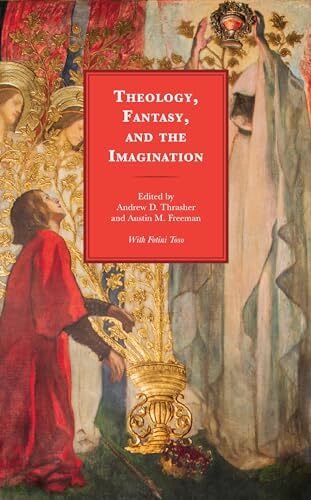
Theology, Fantasy, and the Imagination
Edited by Andrew D. Thrasher and Austin M. Freeman
Lanham, MD: Lexington Books/Fortress Academic, 2023; 238pp


Related Posts