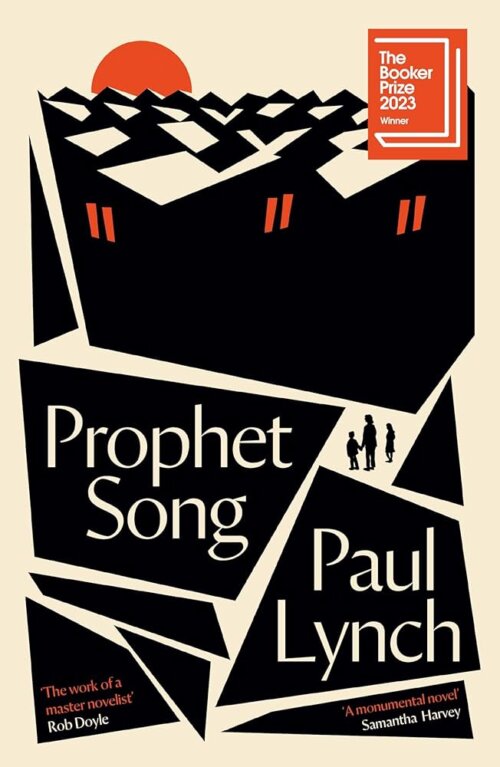
History as the Law of Force: A Review of Paul Lynch’s Prophet Song
In the early 1990s, my traveling companion and I were approached by a twelve-year-old boy in the Nicaraguan countryside. He asked us if we would like a tour of a nearby fortress where the Somoza Regime had tortured and executed prisoners in the late 1970s. The boy was from a nearby shanty village nestled in a shallow valley beneath sparse tree cover, and he needed an American quarter to fix his bike tire. He brought us up a hill to the fortress and showed us the torture chambers. The prisoners had been deemed enemies of the State, and there is little doubt that much of the torture was inspired not by the desire for information, but for the sadistic pleasure of causing pain to people who stood in opposition to the State. The concrete rooms had some garbage in them, but generally there was little sign that people hung around the place. Who would want to hang out there? Even if one does not believe in ghosts, there are certain places stained by evil to such a degree that there is little hope of exorcizing that evil. At the time of my travels, Nicaragua was filled with remembrances of the Somoza Regime, the revolution, and the Sandinista-Contra war that followed, from murals to small museums, to the storytelling of the people. The remembrances and the stories were not being shared as events we might find in a history book. The past and the memories were fully alive in the present, and one sensed that reality was unfolding anew in every moment, and in every human encounter. Only the dullest of gringos would have been unable to appreciate the richness of this time in Nicaragua. The Nicaraguan people were as lively and hopeful as any people I had ever encountered, despite the horrors of their past, and I understood that in listening and witnessing, I was playing a very small part in a redemptive process.
When I was ten years old, I began to hear stories from family members and the larger Mennonite community about the pillaging, raping, and murder of my Mennonite ancestors by Russian communists shortly after the Revolution there. My great grandfather was about to be executed by a communist gang when their leader stopped the shooting. “He treated me well in his blacksmith shop, better than his own sons,” the leader declared. My grandmother may not have been so fortunate. Shortly before his death, my uncle shared with me his suspicion that she had been raped. As with my experience in Nicaragua, there was a very human proportion to the Mennonite storytelling, with a shared knowledge about what transpired before, during, and after the sufferings that took place. As with Nicaragua, I understood that the stories of my Mennonite ancestors didn’t just belong in the past, but were part of a living present. And I believe that in both cases there was a serious attempt to reflect on history in the spiritual sense, and to put words to that spirit, to place that history within the larger context of Eden, Exodus, and Redemption.
State-sanctioned torture and murder is no trifling thing, and one would hope that when stories of such practices are shared, the context and motivations for this violence are reasonably understood and explored. This perspective is important in order to keep the human proportion of these events in mind, and to remember the relational aspect of our stories. Real experiences of torture, rape, and murder are not told for the sake of entertainment. The stories guide a search for understanding and healing. If we do not pay any mind to the context in which state-sanctioned violence occurs, and to the corruption of the human souls involved, then the violence we learn about risks becoming a source of emotive entertainment valuable only for the visceral response it elicits. Meaningless violence presented for the sake of entertainment, shock, and awe harms the human community.
When I read in this year’s Booker Prize winning novel, Paul Lynch’s Prophet Song, about a boy in contemporary Ireland being tortured to death by State actors, with a power drill going through the kneecaps and fingernails being ripped off, then I wanted to know what the context for this violence was. I had to understand this novel by the manner in which Lynch participated as an artist to bring hope and understanding to the human community—or conversely, to consider his invitation to meditate on his experience of meaningless and chaos in human history. The questions for the book that I was left with included, how does a modern democratic nation like Ireland descend into political and social disorder, and what compels a person in this setting to open their soul to the allure of evil? The questions span the soulful experiences of the person and the political reality of a nation.
Paul Lynch is a wonderfully lyrical storyteller, and his tale of a mother, Eilish, trying to protect her four children from the moral chaos and violence of the modern police state will captivate many readers. The absence of hope lies heavy in the book, and this will undoubtedly strike a chord for many as well. In a sense, Prophet Song reminded me of Cormac McCarthy’s The Road, another novel flirting with fantastical violence and hopelessness rooted in a visceral experience largely devoid of spiritual depth. People seemed to like reading that book too. The lack of spiritual depth in Prophet Song rises from the fact that a proper grounding for the setting is never established. Lynch does not explore how a modern, Western democracy like Ireland can tumble into the chaos of a police state, and why some people succumb to the allure of evil and power while others do not. The absence of an established setting not only steers the reader away from a reflection of their own world, it also leaves the novel’s characters stranded in a shallow world interacted with largely by instinct. When I read of the boy’s torture cited above, I could not help but grow self-conscious. Why was Lynch sharing this graphic passage with me? What was he trying to accomplish as a storyteller?
In Prophet Song, we do not understand why the Ireland we know has become a police state, and so Lynch’s universe doesn’t feel believable. Undercutting the creative potential of the person and their moral agency is a vague suggestion that one can “change ownership of the institutions.” This can allow for an alteration of the “structure of belief.” There is the assertion that the new State is trying to change how its citizens understand reality, and that the State enacted emergency powers because of outside threats. These outside threats are impossible for the reader to fathom, since in the story, references to the international community suggest a calm and democratically-oriented world.
In a somewhat ironic turn, in Prophet Song the mother is encouraged to escape Ireland’s police state for Canada, where freedom apparently reigns. As a Canadian, I would think that if Ireland can descend into totalitarian confusion, so too can Canada. For example, in recent years the Canadian Parliament has either succeeded or has tried to pass language laws. By extension, it naturally includes thinking laws, around matters of gender, and incredibly, global warming. Canadian Prime Minister Justin Trudeau even invoked the Emergencies Act that gave his government authoritarian power from coast to coast in order to deal with protesting truck drivers whose concerns he refused to acknowledge. While the Canadian Federal Court ruled Trudeau’s actions were not justified, hardly a ripple passed through Canadian society despite this tremendous overreach by the Prime Minister. As a reader of Prophet Song, I yearned to know what disease Irish political culture was suffering from that Canada was apparently free of, an immunity that protected Canada from the allure of totalitarian government in Lynch’s universe.
In the flattened setting of Prophet Song, a long list of events unfold that are found in every history of a totalitarian or failed state. It is to the point that they threaten to become cliches. From the book, an inexhaustive list of these events include the media becoming an organ of the state, the suppression of democratic protest through martial violence, internment camps, a silenced judiciary, extra-judicial killings, torture of political prisoners, food shortages, civil war, mass killings, pictures of the disappeared on bulletin boards, and the movement of refugees to the sea.
The question of whether or not Lynch is presenting a nihilistic vision of human history is maybe where the novel gains its greatest traction. Perhaps by recognizing our human condition, he stresses that the sufferings of human beings at the hands of the powerful is an unending reality, an inevitable fate that awaits. And if it is not us, then it will be for our children. A character suggests that we live in a world of manufactured rules made by the powerful to serve the powerful. “What rights were born with man?” a state actor asks in Prophet Song; “show me what tablet they are written on, where nature has decreed it so.” The clean lines of science are challenged by the blurred lines of human political reality when the same character challenges Eilish, who is a trained scientist. Lynch writes, “You call yourself a scientist and yet you believe in rights that do not exist. It is up to the state to decide what it believes or does not believe according to its needs.” This point of view is problematic, suggesting brute State power weaves a world of meaning for us, guiding human spirituality, creativity, and morality as the State’s needs dictate. The experienced reality of human dignity and the inherent longing for soulful freedom are not addressed in Prophet Song in a satisfactory way. Neither is a person’s capacity for self-sacrificial love expanded beyond Eilish’s claustrophobic experience.
In Prophet Song, Eilish offers reflections on our human nature, and her insights support the novel’s conspiratorial idea of State power controlling our perceived reality. “The common run of mankind, what are they all but animals in docile servitude to the needs of the body, tribe and state,” she reflects in a moment of frustration. She is struck by a banner in the street that says, “History is the law of force,” and remembers her sister summing up history as “a silent record of people who did not know when to leave.” At the same time, Eilish finds herself impulsively praying even though she has no faith, and continues a running conversation with her husband, who is presumed dead. Eilish also has dreams that inform her. In other words, as much as Prophet Song threatens to neatly sum up human existence in a strictly material reality where power and chaos reign, there is the slight glimmer of hope that maybe there is more going on behind the surface of human suffering and power mongering than can be properly articulated.
This hope is never explored. Instead, Lynch falls back to a place of little meaning and hopelessness. Eilish sees in her baby son’s eyes as “a radiant intensity that speaks of the world before the fall,” and in the next moment recognizes our fall when she “casts an unforgiving look towards a teenager playing loud techno on his phone.” In our technologically saturated world where people understand themselves and their pleasures as the orienting moral pin upon which the universe spins, what compels a person living a drone-like existence to transcend their little world? As far as our political and personal realities are concerned, how is hope born, and how is it lost? “Out of terror comes pity and out of pity comes love and out of love the world can be redeemed again,” Eilish muses. Does the reader believe that love and all that is good is born of terror? Does Lynch believe this? Driving home the hopeless conditions of our historical existence, Eilish continues. “The world is always ending over and over again in one place but not another,” she muses. “The end of the world is always a local event, it comes to your country and visits your town and knocks on the door of your house and becomes to others but some distant warning, a brief report on the news.”
The dark, chaotic tone presented in Prophet Song is difficult to accept because the author has not earned my trust. There has been social and political deterioration in any number of places, including Vietnam, Nicaragua, Yugoslavia, Libya, and Somalia, but each political reality, and each mother in those countries, is unique. Ireland, and the character of Eilish, are unique, and so in the telling of the tale Lynch would have served the reader by articulating the circumstances undergirding the horror show he reveals for us. We should not underestimate the good people around us. While empires, kingdoms, and nations rise and fall, it is also true that people love and celebrate in a cosmos where they feel quite at home, despite the challenges we experience in history. We are mortal beings, but we remember the dead, talk with the dead, and experience timelessness and mystery in such profound ways that the revels and sufferings of this world are understood within a context, laid out before an eternity that offers us our dignity even when someone has tried to strip it away from us. If our Western nations are in a state of spiritual crisis, which Lynch may be sensitive to since he conceived a story revealing such a problem, then the matter remains that we are under no obligation to participate in the crisis by throwing up our hands in surrender to the inevitable. Unfortunately, Prophet Song does not inform us of the threats to our souls nor to our collective political existence. Neither is an orientation toward the good, the true, and the beautiful which would evoke a soulful response from the reader that could run counter to the destructive forces that appear to dwell among us.
Prophet Song
By Paul Lynch
New York: Atlantic Monthly Press, 2023; 320pp


Related Posts