Iran’s Strategic Illusion Collapses
Decades of ideological rule have left Iran weaker and unstable.
The Islamic regime of Iran did not emerge as a conventional state. It was built on a radical doctrine that placed confrontation with Western influence at its center. Proxies, the language of resistance, and a persistent anti-Israel and anti-American agenda became the tools through which it operated. Over time, this approach relied on proxy groups and militant activity as tools of influence, positioning the regime as a disruptive force across the Middle East and beyond.
Nearly half a century after the establishment of the Islamic Republic, the consequences of these doctrines are no longer abstract. They have manifested in sustained instability at both the regional and global levels, threatening the interests of the United States and its allies while undermining the broader security of the region. At the same time, this dynamic has reinforced the regime’s internal posture, where the suppression of anti-regime sentiment has remained constant. The outcome has been a prolonged period of hardship for the Iranian people, who have borne the cost of a system that has consistently worked against their own interests.
Recent developments provide a clear basis for revisiting the major ideological and geopolitical campaigns that have defined the regime’s behavior through the years.
What follows is a closer look at some of the key moments that shaped this trajectory.
The First War: Iran–Iraq
The formation of the Islamic regime took place amid sweeping internal and external security challenges. Yet the interpretation of these developments by the country’s leadership did not rest on a stable or rational foundation, and the lessons drawn from them would shape the regime’s conduct in ways that proved consequential as time went on.
Returning to the early days of the 1979 Islamic Revolution, the Iranian national army initially cooperated with the new leadership and assisted in the transition of power following the departure of the Shah and the collapse of his government. The course of events might have taken a very different direction had that cooperation not been extended. Despite this, the regime proceeded to commit a series of strategic and political missteps rooted in its ideological outlook, including the imprisonment and execution of a number of experienced military leaders.
At the same time, the formation of the Islamic Revolutionary Guard Corps introduced a parallel military structure whose presence gradually eroded the coherence and identity of the national army.
The fallout?
The rhetoric and posture of the regime’s leader at the time, Ruhollah Khomeini, toward the Shiite population in Iraq, along with calls that framed resistance as a religious obligation, contributed to rising tensions. Coupled with internal instability in Iran and the weakening of its military command following the purges, these developments created an opening that Saddam Hussein sought to exploit. Having previously signed the 1975 Algiers Agreement with Mohammad Reza Pahlavi, the Iraqi leader now saw an opportunity to challenge Iranian territorial integrity and moved accordingly.
The Iran–Iraq War lasted eight years and involved extensive ground, aerial, and naval combat, claiming the lives of approximately over 500,000 people. Some observers have argued that the conflict might have ended in its early stages, yet despite multiple opportunities for a settlement, it continued for several more years, prolonging the suffering of the population and deepening the human cost of the war.
During this period, numerous observations were made by figures within Iran’s political and military leadership, and their implications would go on to influence the country’s security doctrine for decades.
A Network Built on Instability
Wherever there has been state weakness, Iran has been present and ready to exploit it. Over the ensuing years, this approach has been used to establish proxy presences across unstable environments in the region, turning them into a principal instrument for exporting the principles of the Islamic Revolution beyond Iran’s borders.
Lebanon, with Hezbollah as the chief Iranian proxy, has long served as a primary laboratory of proxy power for Tehran’s leadership. Hezbollah has carried out numerous conflicts, particularly with Israel, on behalf of the Iranian regime. The result has been lasting instability and destruction that have impacted the region and the daily lives of people in Lebanon and Iran.
In earlier stages, Iran learned how to expand its influence within a weakened Arab state, and by the mid-1980s, the broader proxy model had begun to take shape, with its early roots firmly established in Lebanon. Since then, Iran has invested heavily in Hezbollah, both financially and logistically, leading to its designation as the crown jewel of Iran’s proxy network.
For the sake of historical accuracy, it is important to note that not all components of Iran’s proxy network in the Middle East were created by Tehran. Some groups developed independently and were later supported, which in turn intensified the reach and effectiveness of Iranian proxy activity in the region.
Support for the Palestinian cause became more formalized after the 1979 revolution, particularly when the former Israeli representation in Iran was transferred to the Palestinian authorities. These early actions laid the foundation for the regime’s long-standing anti-Israel posture. As events unfolded, Iran’s involvement in the Palestinian-Israeli conflict has become increasingly visible, including its links to the October 7, 2023, terrorist attacks carried out by Hamas, which resulted in the killing and abduction of Israeli civilians.
In Iraq, Iran had already begun cultivating influence through movements such as the Badr organization, though it was not until the period following the 2003 fall of Saddam Hussein that Tehran was able to significantly expand its presence. By backing various militant groups that gained access to political structures, Iran reshaped its influence in Iraq in ways that allowed it to exert long-term leverage over the country’s internal dynamics. Groups such as Kata’ib Hezbollah and Asaib Ahl al-Haq became involved in insurgency against U.S. and coalition forces, sectarian violence, and later institutional roles within the Popular Mobilization Forces.
On a broader geopolitical level, the 2003 Iraq war created the conditions for this expansion, facilitating the rise of Iran-aligned militias and complicating efforts to stabilize the country.
By 2011, during the height of the Arab Spring, regional uprisings opened a new phase of expansion. In Syria, the brutal suppression of protests by the Syrian dictator Bashar al-Assad escalated into civil war, drawing in Iran’s IRGC Quds Force along with Hezbollah fighters in an effort to preserve the Syrian regime. Syria soon became a central corridor for Iranian proxy operations, enabling the transfer of logistical support across Iraq, Syria, and into Lebanon, thereby consolidating a continuous arc of influence.
In Yemen, the Houthis emerged from local conditions of instability and gradually took control of the capital, Sanaa. This development provided Tehran with a strategic foothold that extended its reach toward the Red Sea. Since then, Houthi activity has disrupted maritime routes and increased pressure on international shipping through the region.
What followed was decisive.
After decades of expansion, Iran’s proxy network is now under sustained pressure across multiple fronts. Hezbollah faces increasing demands from both domestic actors in Lebanon and external powers to disarm, while public frustration within Lebanon has grown over the cost of conflicts fought beyond its national interest. Several senior Hezbollah figures have been killed, and others operate under constant threat. Israeli military activity in southern Lebanon continues to intensify.
Elsewhere, key figures within Iran’s external operations have been eliminated, including the Quds Force commander targeted in a U.S. strike in 2020 following attacks on the U.S. Embassy in Baghdad. In Iraq, groups affiliated with the Popular Mobilization Forces are facing growing political and military pressure to scale back their role.
In Syria, the collapse of the Assad regime and his flight to Russia marked a major turning point. Given Syria’s role as a central pillar of Iran’s proxy structure, years of investment in funding and military support have failed to secure a lasting outcome. This development has triggered a broader weakening of the network that once extended across the region.
Hamas, following the October 7 attacks, is under sustained military pressure, with widespread destruction in Gaza and mounting calls for disarmament. Efforts to establish a durable ceasefire have yet to produce lasting results.
In Yemen, the United States has conducted a series of sustained air operations targeting Houthi-controlled areas, particularly during March and April 2025. These strikes focused on disrupting capabilities linked to drone warfare, missile systems, and logistical infrastructure tied to attacks on Red Sea shipping routes. Key locations, including Sanaa, Hodeidah, and Saada, were targeted, with reported casualties reaching into the dozens and beyond.
By early 2026, the Houthis were operating under increasing strain. External pressure from the U.S. and Israeli surveillance and potential strikes has combined with internal economic challenges and fragile ceasefire conditions. At the same time, expectations from Tehran have required them to remain an active component of the broader resistance network. This has left the group navigating a constrained environment, balancing survival with continued engagement.
Across these arenas, a clearer pattern is starting to take shape. Groups that once anchored Iran’s influence abroad are losing ground. They face growing pressure to disarm, and their political and military standing is weakening. What once looked like a structured system of regional leverage now appears highly fragile under sustained pressure.
The Nuclear Question
It was in August 2002 when it first became known to the world that Iran was pursuing a clandestine nuclear program involving uranium enrichment and heavy-water production facilities. In the years that followed, multiple rounds of negotiations were held with the United States and European counterparts in an effort to contain and resolve the issue. These efforts culminated in the Joint Comprehensive Plan of Action (JCPOA) in 2015, which imposed restrictions on Iran’s nuclear activities in exchange for sanctions relief.
The outcome?
What followed stripped away any remaining illusion about where this was heading. Years of talks and carefully staged commitments gave way to escalation, with the regime continuing along the same path that had led to this point. The consequences have been immediate and severe. It is the Iranian population that has carried the weight of it, watching economic prospects diminish while a leadership detached from reality pushes the country further into crisis.
At no point did the regime demonstrate a genuine willingness to alter its course. Nuclear activities continued to expand, and each round of negotiations was met with the same pattern of delay, evasion, and persistence.
Later developments brought the confrontation into the open. In June 2025, during the 12-day war, the United States struck Fordow and other nuclear facilities, and these strikes have continued in the course of the ongoing U.S.–Israel confrontation with Iran. The economic cost has been staggering, with an estimated 2 to 3 trillion dollars in lost opportunities, further deepening the hardship faced by the Iranian people.
From Shadow War to Open Conflict
For years, Iran and Israel were engaged in a shadow conflict largely carried out through Iranian proxy networks. That trajectory shifted following a series of escalatory events, including the Israeli strike on the Iranian consulate annex building near the embassy in Damascus, and the targeting and elimination of Haniyeh on the day of the Iranian president’s inauguration.
At that point, the threshold was crossed, and the confrontation moved into the open. It unfolded first through two waves of missile and drone attacks launched by Iran in April and October 2024. This marked an unprecedented moment, as Iran directly launched hundreds of missiles and drones toward Israeli territory. According to reports, approximately 300 projectiles were used in the first wave, while the second involved around 200 missiles in two successive phases.
The consequences were immediate.
The Iranian regime had long justified the expansion of its proxy network and resistance doctrine as a way to build a layered defensive buffer far from its own borders. That premise no longer holds. The conflict reached Iranian territory itself following Israeli aerial strikes in October 2024, in an operation named Days of Repentance which targeted air defense systems and key military sites. This escalation was followed by the full-scale 12-day war in June 2025.
During Operation Rising Lion, missile installations, air defense systems, and senior military figures were eliminated through Israeli strikes, while nuclear facilities were targeted by the United States in an operation named Midnight Hammer. The cumulative effect of these operations significantly weakened the regime’s internal position and contributed to a nationwide wave of protests that reached its peak on January 8 and 9, 2026. The response was severe, with reports indicating mass casualties as the protests were suppressed.
These direct confrontations brought the center of conflict into Iranian territory and exposed the deeper structural flaws of an ideological approach to governance. They revealed the extent to which strategic decisions, shaped more by doctrine than by practical considerations, have placed national interests at risk and led to outcomes that now unfold within the country itself.
The War Now Underway
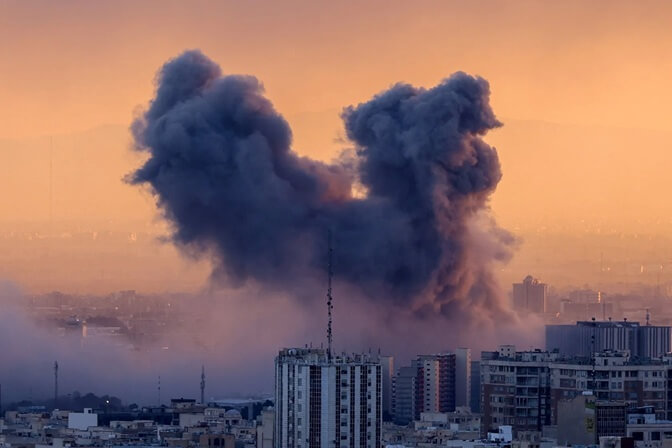
At the time of writing, U.S. and Israeli forces have launched a large-scale series of strikes against Iran. The campaign began on February 28, 2026, with the killing of Iran’s leader, Ali Khamenei, on its opening day. Israel has referred to the operation as Operation Roaring Lion, while U.S. forces have named their campaign Operation Epic Fury. In its initial phase alone, approximately 200 Israeli aircraft were involved, striking more than 500 targets according to available reports. It represents the most significant blow to Iran’s security, political, and military foundations in the history of the Islamic Republic, with far-reaching consequences.
They have misjudged this war.
It was noted earlier that many observations were made by Iranian political and military figures during the Iran–Iraq War. The interpretation of those experiences has shaped their strategic outlook, yet that understanding of modern warfare has proven deeply flawed. For years Iran has planned with the expectation of conflict with the United States. Its strategy focuses on defending its territory and sustaining resistance over time. The scale and frequency of military exercises show how this approach continues to shape its thinking. A ground confrontation may still occur in some form, though it would likely take place only after much of Iran’s defensive structure has already been degraded through sustained aerial and technological strikes.
The limitations of this approach have become increasingly visible. Significant investment in missile capabilities has not translated into strategic control of the battlefield, and internal inefficiencies have further weakened operational effectiveness.
The current U.S.–Israel campaign represents a turning point in the modern history of the Middle East. It reflects a form of warfare shaped by advanced technology and sustained air operations, rather than traditional models of confrontation. In the context of widespread public dissatisfaction and the large-scale protests that took place earlier in the year, these developments have the potential to alter internal dynamics within Iran. The pressure created by external strikes, combined with existing public frustration, may contribute to conditions in which further unrest emerges.
The regime never acted in ignorance of the risks it imposed on its own people. It understood the consequences and moved forward regardless, driven by an ideological course that has now proven profoundly destructive. The result is no longer contained beyond its borders. The pressure has turned inward, exposing the damage that has accumulated over decades of miscalculation and rigid thinking. The proxy network that was built to project influence and keep conflict at a distance has now done the opposite. It has drawn confrontation back into Iran itself. What was once presented as a source of strength now works against the regime, placing it under sustained pressure and leaving its internal position increasingly unstable.


Related Posts